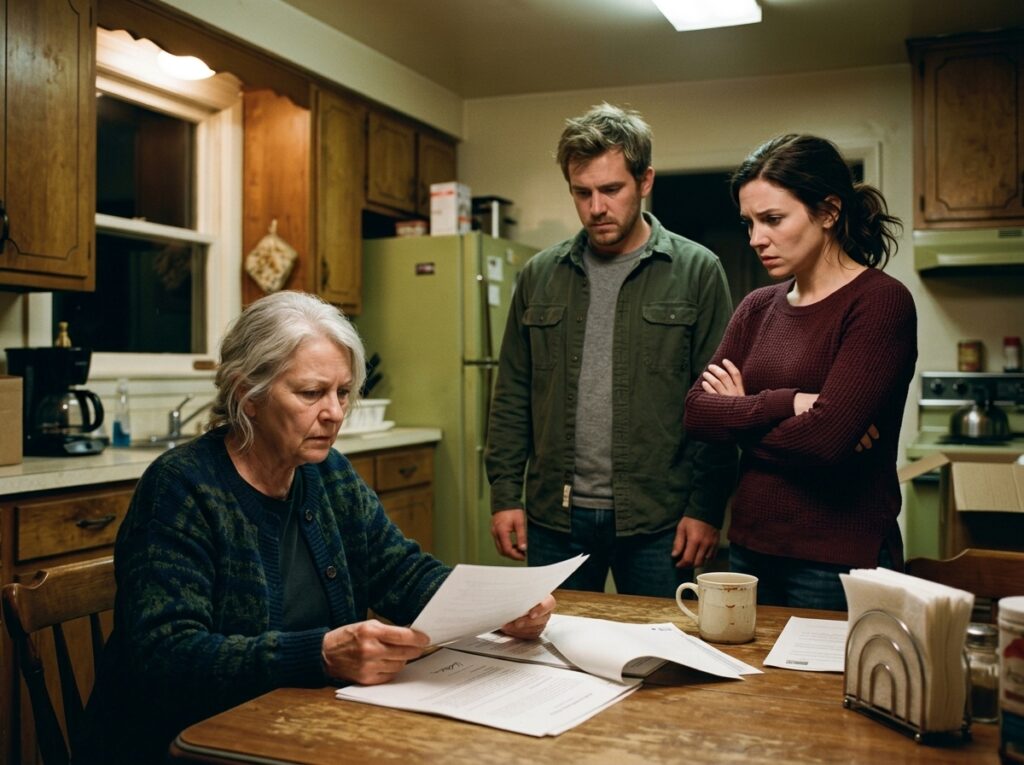
Catherine sat beside her daughter, but Harper did not lean against her. She remained apart, as though she had finally understood that she was not entitled to comfort from anyone in that room.
Caleb read the final paragraph.
“I am sorry for the home I endangered, the trust I broke, and the years I will lose. Your mother is stronger than I am. When you are old enough, thank her—not for hiding me, but for giving you a life I did not deserve to share.”
The letter slipped from his hand.
He stared at it.
“I thought he left because he didn’t care.”
“He cared,” I said. “He was simply not strong enough to become the man caring for you required.”
Caleb’s shoulders folded inward.
“I spent my entire life thinking you hated him.”
“I hated what he did. I missed the person I thought he was. Those are different things.”
He looked at me.
“And you protected him.”
“I protected you from carrying his shame.”
“You let me believe he just walked away.”
“I let you believe he had made one terrible choice instead of many. I thought that would be easier for you.”
“It wasn’t.”
“No,” I admitted. “It probably wasn’t.”
He stood and crossed the room.
For a moment, I thought he would embrace me.
Instead, he stopped a few feet away.
“I used your condo the way he used your house,” he said.
My breath caught.
“No.”
“I did. I told myself I was protecting my family. I told myself it was temporary. I signed papers without understanding them. I let someone else make plans for what you had earned.”
“You are not your father.”
“I used your trust.”
“You are not your father.”
“I watched Harper go through your things and convinced myself there was a good reason.”
His voice rose, not in anger but in anguish.
“I took the very thing you built to survive and treated it like something waiting for me.”
I stepped toward him.
“Caleb, listen to me. You made serious choices. You must take responsibility for them. But you are not condemned to repeat his life.”
He looked at the documents on the table.
“How do I fix this?”
“You start by telling the truth.”
“I am.”
“To everyone.”
His gaze moved toward Harper.
She lowered her head.
Then toward Richard.
Richard remained at the window.
Finally, toward Catherine.
She had tears in her eyes.
“I knew Harper was struggling,” Caleb said. “I knew about the debt. I knew she believed the condo could solve it. I signed the loan application. I allowed her to use my key. I told myself I was helping without admitting what I was helping her do.”
Elaine listened carefully.
“Those admissions need to be documented,” she said. “There are legal consequences to consider, but honesty is the first step.”
Caleb nodded.
Harper looked at him.
“I never meant for you to be blamed alone.”
“You didn’t make me sign.”
“I thought we were saving our marriage.”
“You were saving the business.”
“I was saving everything.”
“No,” Caleb said quietly. “You were saving the life you wanted, and I let you use my mother to fund it.”
Harper’s face crumpled.
Catherine reached for her hand, but Harper pulled away.
“I’m sorry,” Harper whispered to me.
I believed that she was sorry in that moment.
But remorse did not erase photographs, loan applications, or unauthorized entry.
“I hear you,” I said. “That does not mean I trust you.”
She nodded.
The admission seemed to hurt her more than anger would have.
Richard finally turned from the window.
“I should have stopped this.”
Catherine gave him a wounded look. “You encouraged it.”
“I thought the financial projections were manageable.”
“You inspected her property without permission.”
“I was trying to create options.”
“For whom?” Catherine asked.
Richard had no answer.
Patrick gathered the papers into careful piles.
“The trust remains intact,” he said. “The loan application does not create ownership. But we need to make sure no lender, contractor, or county office continues acting on false information.”
Elaine nodded. “I’ll send formal notices today. I also recommend changing every access code, notifying the building manager, and documenting all communications.”
I looked toward Caleb.
He understood what I was not saying.
“You want me out,” he said.
“I want everyone out.”
His face tightened.
“I’m your son.”
“Yes.”
“I have nowhere to go tonight.”
The old instinct rose again—the urge to rescue him, to make room, to say he could stay as long as necessary.
But the condo was no longer simply a place where I could offer comfort. It had become the boundary I had failed to protect.
“You can stay at a hotel,” I said. “I will pay for one night.”
His eyes flickered with pain.
“After that?”
“After that, you will make your own arrangements.”
Harper looked at him.
“I’ll go with you.”
“No,” Caleb said.
She froze.
He faced her with a sadness that was almost gentler than anger.
“I need to understand who I am without letting you make every decision for me.”
Her lips trembled.
“You’re ending our marriage?”
“I’m not deciding that today. I’m deciding that you cannot stay here, and you cannot contact my mother about her property again.”
Harper nodded slowly.
Catherine stood.
“I’m leaving with Harper,” she said. “But not because I approve of what she did.”
Richard picked up his coat.
Catherine looked at him.
“You can arrange your own ride.”
He stared at her in disbelief.
She turned to me.
“Barbara, I am sorry. I believed my daughter because I wanted to believe the best of her. That does not excuse how I treated you.”
“Thank you for saying it.”
“I should have asked you directly.”
“Yes.”
She nodded, accepting the simplicity of the answer.
One by one, they moved toward the door.
Caleb remained.
The letter lay between us on the table.
“I want to take it,” he said.
I looked at the pages.
Popular Posts
→- 1
- 2
- 3
- 4




Recently Viewed
Stories you read recently will appear here.