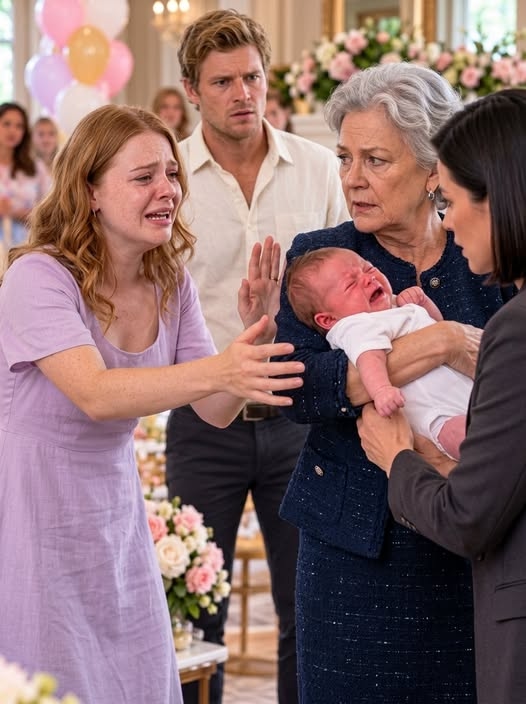
“You’re holding her incorrectly.”
My mother-in-law lifted my newborn from my arms before I could respond.
Forty guests watched her rearrange the blanket and smile toward the photographer.
I was seven days postpartum. Still recovering.
Still moving cautiously whenever I stood.
“Judith, give her back,” I said.
My husband, Ryan, touched my shoulder. “Mom’s only trying to help.”
This wasn’t my baby shower.
Judith had named it a “grandmother shower.” There was a cake bearing her name and a room upstairs she proudly described as Lily’s second nursery.
I had asked to remain home.
Ryan said declining would hurt her feelings.
Now I sat beside a gift table while his mother explained that younger women made motherhood unnecessarily complicated.
“She’s been fussing because Nora keeps feeding her,” Judith announced. “I had her calm in minutes.”
Ten minutes earlier, Judith had carried Lily into the kitchen while I used the bathroom.
When she returned with her, my daughter seemed unusually quiet.
I reached for her then.
Judith said I should relax.
Now, beneath the bright light near the window, something seemed wrong.
Lily’s skin had a gray tint.
“Ryan.”
He glanced toward her. “She’s sleeping.”
“No. Look at her mouth.”
Judith turned aside. “She’s cold. You never dress her properly.”
I stood, one hand steadying myself against the chair.
“Give me my daughter.”
That was when Dr. Hannah Patel stepped forward.
She was Lily’s pediatrician. She also lived two houses away from Judith and had stopped by after finishing a Saturday clinic.
She looked at Lily.
Then she looked again.
“Mrs. Caldwell, please give her back. Right now.”
Her voice was no longer casual.
Judith laughed. “Oh, Hannah. Surely you understand how anxious first-time mothers—”
“Give the baby to her mother.”
The room became silent.
Judith returned Lily with a sharp little sigh.
Dr. Patel loosened the blanket and examined her while I held her.
“Someone call 911.”
My knees nearly gave way.
Ryan stepped closer. “What’s happening?”
“Her color and breathing concern me. She needs an emergency assessment.”
I stared at the blue-gray shadow surrounding my daughter’s lips.
“Lily?”
Her eyelids moved.
I had never been so frightened by such a tiny movement.
Dr. Patel asked what Lily had received.
“Breast milk,” I said. “Nothing else.”
Judith answered immediately. “She’s been using all kinds of things from the hospital.”
“No.”
I looked straight at her. “What did you give her in the kitchen?”
“Don’t accuse me.”
“Tell the doctor.”
She glanced toward Ryan.
He looked down.
Dr. Patel repeated her question.
Judith opened her purse and pulled out a small tube.
“Just something for her mouth. She wouldn’t stop crying.”
Ryan whispered, “Mom.”
The doctor examined the label.
Her expression became serious.
The ambulance siren sounded outside.
As the paramedics entered, Dr. Patel handed them the tube and explained what she had observed.
Judith started backing toward the kitchen.
“I was only trying to help.”
Then she pointed toward Ryan.
“He knew. Ask him.”
I had spent the afternoon being told I couldn’t understand my own baby.
Now a doctor was asking the question nobody wanted answered.
And the two people who had called me anxious were suddenly looking at each other instead of at Lily.
I rode in the ambulance beside Lily.
Dr. Patel gave the paramedics the information she had and contacted the receiving hospital.
Ryan followed in his car.
I kept answering questions while watching my daughter’s face.
Seven days earlier, I had counted her fingers and worried about trimming her nails.
Now strangers were working around her, and I couldn’t make her skin look pink again simply by holding her closer.
At the emergency department, the team evaluated her breathing, began treatment, and ordered tests.
The tube Judith produced contained benzocaine, an oral numbing medicine.
It was not something Lily’s doctor had prescribed.
I told the team I had never approved its use.
A physician asked who applied it and when.
I described the kitchen visit, but I hadn’t witnessed what happened inside.
“My husband may know more,” I said.
I hated hearing how uncertain that sounded.
Ryan arrived with his mother.
I asked the nurse to allow him inside alone.
He stood beside the bed, pale and quiet.
“What happened in the kitchen?” I asked.
He said Lily was crying and Judith suggested soothing her mouth.
“Did you know she was using medicine?”
He nodded. “She said she’d used it before.”
I stared at him. “Lily is a week old.”
He answered that he believed his mother knew what she was doing.
His confidence had been borrowed.
Our daughter was paying for it.
My sister, Beth, arrived after I contacted her.
She placed a hand on my back and asked what I needed.
I asked her to stay.
Then I asked Ryan to tell the clinical team everything, including his mother’s claim that she had used the product before.
He stepped into the hallway.
A few minutes later, my phone buzzed with a message from Judith:
Don’t make this sound worse than it was. Nobody needs to know about the kitchen. Babies react to things.
I saved the message and showed the physician.
Meanwhile, Beth contacted my cousin, who had been recording short clips throughout the shower.
One showed me telling Judith that Lily didn’t need anything given without checking with me.
Another captured Ryan entering the kitchen while Judith carried the baby.
He remained there.
The recording didn’t show every action, but it challenged the idea that he knew nothing.
Then Beth’s phone rang.
Judith was calling relatives to say I had given Lily something and was blaming her.
The doctors were investigating a blood condition that could explain Lily’s color and difficulty carrying oxygen.
They were treating her urgently.
I remained beside the bed while Beth preserved the clips.
Ryan returned and said his mother was frigh.ten.ed, too.
Before I could respond, a hospital social worker asked to speak with us separately.
A concern had been reported about who gave Lily the medicine.
Popular Posts
→- 1
- 2
- 3
- 4




Recently Viewed
Stories you read recently will appear here.