“I was young. I trusted him. I signed papers without understanding how much responsibility I was accepting.”
Caleb stared at me. “You never told me any of this.”
“You were six years old when he left.”
“You told me he abandoned us.”
“He did abandon us.”
“But you made it sound like he simply walked away.”
“He did more than walk away.”
I reached for one of the documents.
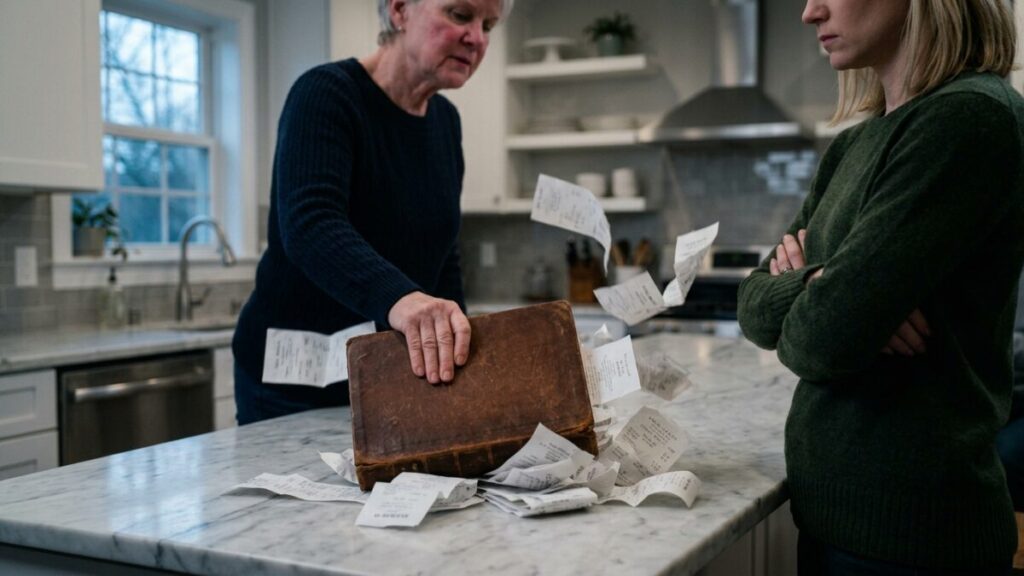
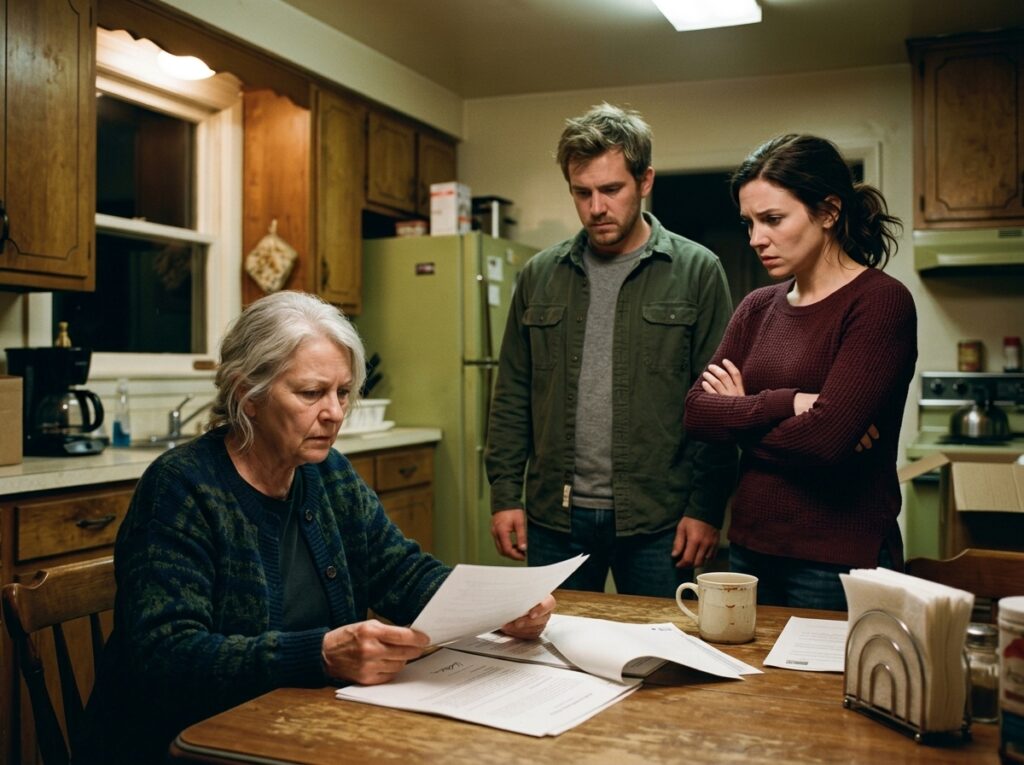
Patrick had arranged them in chronological order. Bank notices. Legal correspondence. Copies of checks. A court filing bearing my maiden name and my married name together.
“Your father secretly transferred debts into my name before he disappeared. He drained our joint savings and used my signature to guarantee additional obligations. When the business collapsed, creditors came after me.”
Caleb’s face had gone pale.
“Why would he do that?”
“Because he believed I would protect him. Because he thought I would be too ashamed to tell anyone. Because he knew I would keep working to make sure you had a home.”
Patrick’s jaw tightened.
“I met Barbara shortly after the first collection notice arrived,” he said. “At that time, I was working with the county assessor’s office. I helped her understand which records were connected to the property and which debts had no legal basis against it.”
Caleb looked at him.
“You knew my father?”
“I knew of him. I never met him socially. But I saw what he had done to your mother.”
Patrick placed another document on the table.
“This was a lien attempt against the small house where Barbara was raising you.”
Caleb picked it up.
His eyes moved across the page.
“Dad tried to take our house?”
“He tried to claim that the property had been purchased with business funds,” I said. “It had not. I had paid for it with my wages and savings. But proving that required records, legal help, and money I didn’t have.”
Patrick gave a faint smile.
“She had more determination than money.”
“I worked three jobs,” I said. “I cleaned offices at night, served breakfast at a diner before sunrise, and handled payroll for a warehouse during the day. I came home when you were asleep and left before you woke up.”
Caleb lowered the paper.
“I thought you worked so hard because Dad left.”
“I worked hard because he left me with debts and a child.”
The room became painfully quiet.
Catherine covered her mouth.
Harper’s expression had changed completely. She no longer looked angry. She looked stricken.
I had never wanted her pity.
I wanted Caleb to understand.
“Patrick helped me challenge the debts. He helped me protect the house. He explained that love did not require me to surrender every legal safeguard I had.”
Patrick opened the trust document again.
“Years later, when Barbara purchased the condo, I advised her to place it in a revocable trust. Not because she believed Caleb would hurt her. Because she had learned that informal promises and family assumptions could place everything at risk.”
Caleb looked at the trust.
“You made the trust because of him.”
“I made it because of what happened to me.”
“And you never told me.”
“I wanted you to remember your father as someone who loved you.”
His eyes filled again.
“Did he?”
I took a breath.
“Yes. I believe he loved you.”
Caleb looked startled.
“That doesn’t excuse what he did,” I continued. “A person can love a child and still be selfish, dishonest, and cowardly. I didn’t want you growing up believing his failures were your fault.”
“He never wrote to me.”
“He tried.”
Patrick touched the letter.
“This arrived at Barbara’s former address after your father disappeared. It was returned because she had already moved. The letter was eventually placed in a storage file connected to the debt proceedings.”
Caleb’s hand hovered above it.
“Why did you keep it?”
“Because I couldn’t decide whether giving it to you would help or hurt you.”
“You kept it for forty years.”
“Yes.”
He picked up the envelope.
The paper shook between his fingers.
Harper took one step toward him.
“Caleb,” she whispered.
He did not look at her.
He opened the letter carefully.
The handwriting filled two pages.
For a while, the only sound was the faint hum of the air conditioner.
Then Caleb began to read aloud.
“My son,” he said, his voice unsteady. “I don’t know if your mother will ever let you see this. I hope she does when you are old enough to understand that leaving was not an act of courage.”
He stopped.
His thumb pressed against the paper.
Then he continued.
“I told myself I was leaving to protect you from my failures. The truth is that I was ashamed and afraid. I put debts in your mother’s name because I believed I could fix everything before she discovered what I had done. I could not.”
Caleb’s lips parted.
I closed my eyes.
The words I had carried alone were finally in the room.
“He wrote that he knew I had paid for the house,” Caleb continued. “He knew the creditors had no right to take it. He said you had saved us.”
His voice cracked.
I turned away toward the balcony.
Beyond the glass, the Gulf rolled beneath the afternoon sun. For decades, I had imagined this moment. In some versions, Caleb screamed at me for hiding the truth. In others, he defended his father and accused me of destroying his memory.
I had never imagined silence.
“Keep reading,” I said.
Caleb wiped his face.
“He said, ‘Your mother will tell you I left because I chose to. She will be right. But she may not tell you that I tried to take from her before I left. She may protect my memory because she believes you deserve a father who loved you. Do not let that protection become another burden she carries.’”
Caleb lowered the letter.
No one spoke.
Richard walked to the window and stood with his back to us.
Popular Posts
→- 1
- 2
- 3
- 4




Recently Viewed
Stories you read recently will appear here.