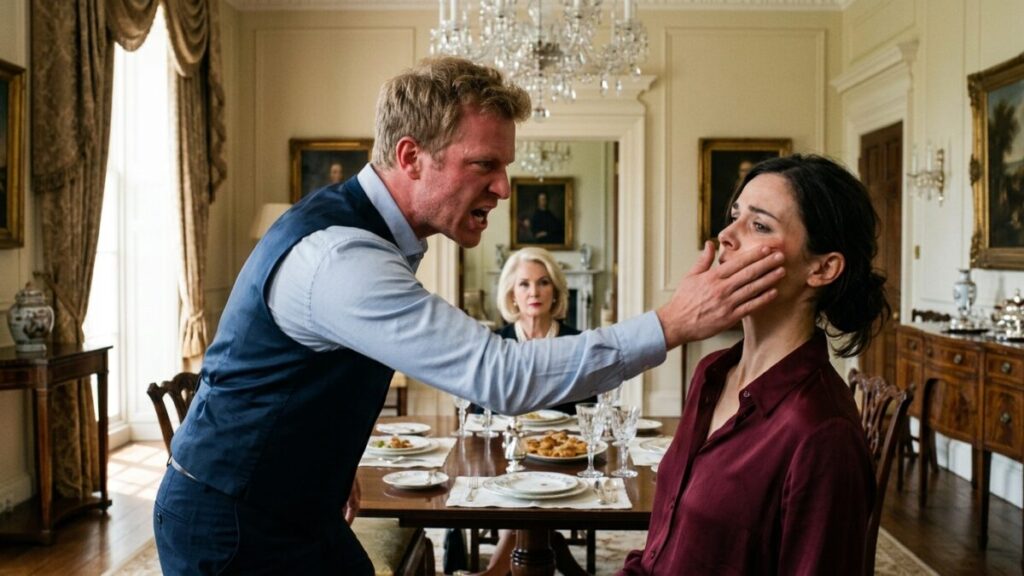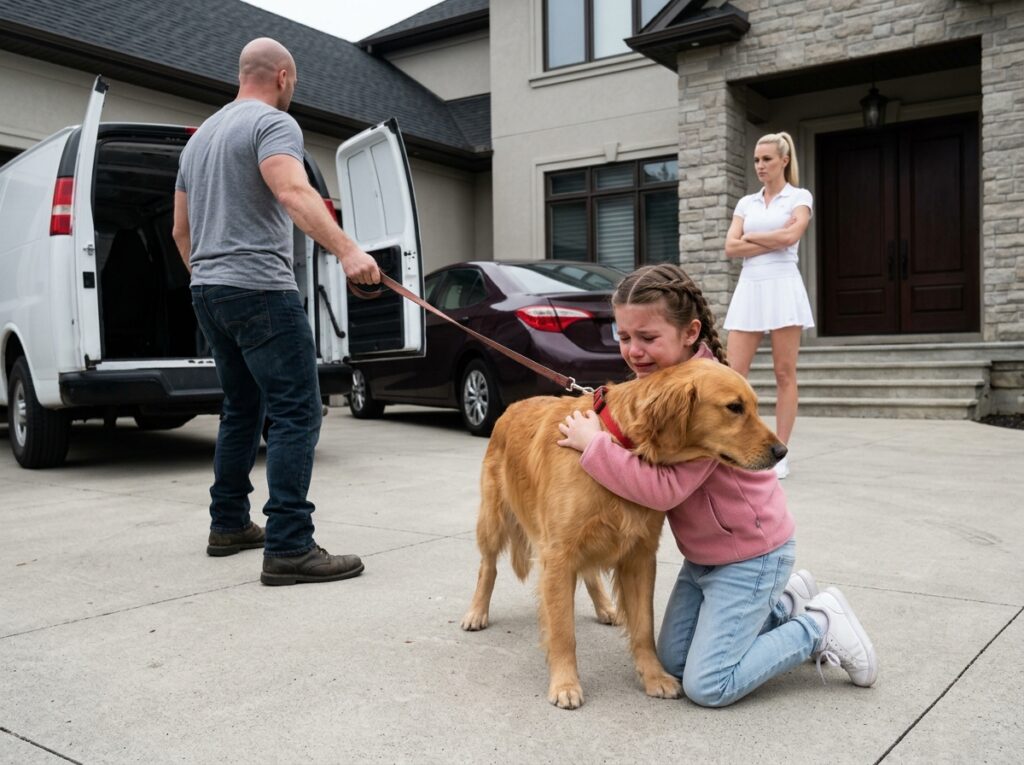
He came home early and found a stranger dragging his daughter’s dog into a van. His wife was just standing there, watching. 💔
The brass clock on the mantelpiece clicked with the mechanical precision of a firing pin.
In the quiet of the Mercer living room, sound did not merely carry; it ricocheted off bare, pale surfaces. Under Brooke’s relentless eye, the house had been stripped of its previous warmth. The honeyed maple bookcases, the deep indigo armchairs, and the worn wool throws that had once softened the autumn drafts had all been carted away to municipal auctions or consigned to suburban antique boutiques. In their place stood an altar of monochromatic minimalism: raw silk cushions the color of salt flats, an eggshell Bouclé sectional, bleached ash sideboards, and porcelain flooring polished to a mirror finish.
Brooke stood near the French doors, checking her wristwatch against the mantel clock. Two-fifteen on a brisk Friday in October. Her silver band chimed softly, syncing with her calendar. She smoothed down the front of her cream-colored cashmere knit, admiring the pristine line it made against the backdrop of the lawn.
Out on the patio lay the sole, glaring insult to her curated world.
Curled on a sun-bleached flagstone was Daisy. The golden retriever was eight years old, massive through the shoulders, with a broad muzzle turning sugar-white at the jowls and long, feathery fringes of honey-dark fur trailing from her hocks and underbelly. As Daisy breathed, a tuft of shed undercoat caught the autumn breeze, tumbling across the stone and clinging stubbornly to the rubber seal of the sliding screen door.
Brooke’s lip curled in visceral distaste.
To Brooke, Daisy was not an animal; she was a biological spill. A persistent, shedding, drooling monument to a woman she had never managed to erase from Matt’s life. Matt’s ex-wife, Commander Laura Mercer, was an engineer officer currently stationed aboard a nuclear carrier somewhere in the South China Sea. Laura’s shadow did not loom because of lingering romance—Matt’s divorce from her five years ago had been clean, mutual, and settled with dry, civilized pragmatism. It loomed because of the girl. And because of the dog.
“When you miss me, you hug Daisy,” Laura had told four-year-old Ava the morning she boarded the transport bus in San Diego, dropping an oversized puppy with huge paws and an indigo nylon collar into the child’s lap. “Daisy will hold the hug for me until I get home. No matter how long it takes.”
Ava had believed it with religious fervor. Now eight, Ava still pressed her face into Daisy’s neck when the weather turned foul or when the weekly satellite email from her mother failed to ping the family inbox on schedule. And Matt, blinded by sentimentality, treated the aging beast as untouchable scripture.
“Daisy stays,” Matt had said six months ago, his tone quiet, immovable, the day Brooke suggested a rehoming sanctuary specializing in senior retrievers. “Do not bring it up again, Brooke. It is not open for discussion.”
Brooke had smiled then, poured him a glass of cold sancerre, and kissed his cheek. But in her mind, the calculation had already begun. Men like Matt did not understand sacrifice; they had to be guided into it through carefully constructed inevitabilities.
She turned from the glass doors and walked into the sterile, white-tiled kitchen. On the counter lay her tablet. She tapped the screen, awakening the email thread with a breeder outside Seattle.
Payment received: $4,500 non-refundable deposit. Teacup French Bulldog, platinum white coat, blue eyes. Delivery confirmed for November 4th.
A dog that fit in a tote bag. A dog that could be trained to relieve itself on scented microfiber pads in the utility room. A dog that would match the sofa.
Brooke opened the messaging application and pulled up the conversation with a user named Ray_O_Services from an obscure neighborhood odd-jobs board.
Ray: Running behind. Concrete mixer blocked the south access road. ETA 2:40.
Brooke felt a sharp needle of annoyance prick the back of her neck. She typed back with swift, sharp taps of her manicured fingernails:
The girl’s bus stops at 3:15. You have until 2:50 to have the dog secured in the vehicle and off the property. Forty miles out. County animal intake, drop box after hours if the gate is locked. Cash is in an envelope on the porch bench. No mistakes.
The plan was ironclad. She had rehearsed the tears for three nights in the bathroom mirror while the shower ran to drown her voice. Ava had been running down the hall with her heavy school shoes on; Daisy had snapped; the skin had been broken. A tragic, heartbreaking crisis of household safety. “Matt, I tried to clean the wound, but the dog lunged again. I panicked. A man from a canine behavioral rescue took her for immediate quarantine before Ava went into shock. We can’t bring an aggressive animal back under this roof. What if she’d bitten Ava’s face?”
No father, not even one as stubborn as Matt Mercer, would bring a dog back after it drew his daughter’s blood. And Ava would be too bewildered, too handled, to dispute the manufactured fog of the afternoon.
Brooke walked back to the French doors, slid them open, and stepped out onto the cold stone.
“Daisy,” she murmured, her voice tight, devoid of melody. “Inside. Now.”
The dog lifted her heavy head, amber eyes watching Brooke with that maddening, quiet intelligence dogs possess when they sense they are despised. Daisy rose slowly, joints stiff from the damp chill, and stepped into the foyer. Brooke immediately shut the glass behind her, latching it with a sharp, final click.
Six miles away, the structural engineering offices of Mercer & Lind sat in a quiet, brick-and-timber commercial park. Matt Mercer sat behind a drafting desk buried beneath topographic cross-sections of a proposed riverbank stabilization project.
His cell phone vibrated against the blotter. He glanced at the caller ID: Naval Fleet Communications – Port Liaison.
Popular Posts
→- 1
- 2
- 3
- 4




Recently Viewed
Stories you read recently will appear here.