I looked at my son.
He shook his head. “I never told him that.”
Harper’s eyes moved rapidly between them.
Richard realized he had exposed too much.
Catherine stared at her husband. “You knew about this?”
“I knew there were discussions.”
“You told me we were staying here because Barbara had graciously offered the condo.”
Richard’s expression tightened. “I was trying to secure a comfortable arrangement.”
“For us?”
“For the family.”
Catherine let out a bitter breath. “You mean for Harper’s business.”
Harper’s face crumpled with anger. “My business is not a crime.”
“No one said it was,” Caleb replied.
“But everyone is acting as if I should apologize for trying to save it.”
I felt a sudden, unwelcome flicker of pity.
Not for the scheme.
For the desperation underneath it.
She had built a design business, taken on debt, and apparently convinced herself that my condo was the only way to keep everything from collapsing.
But pity did not erase choices.
“How much debt?” Catherine asked.
Harper looked at the floor.
“Harper.”
“Two hundred and eighty thousand,” she said.
Catherine covered her mouth.
Richard closed his eyes.
Caleb leaned against the table as if his legs had weakened.
I stared at him.
“You signed loans connected to her business.”
“I co-signed one.”
“One?”
He didn’t respond.
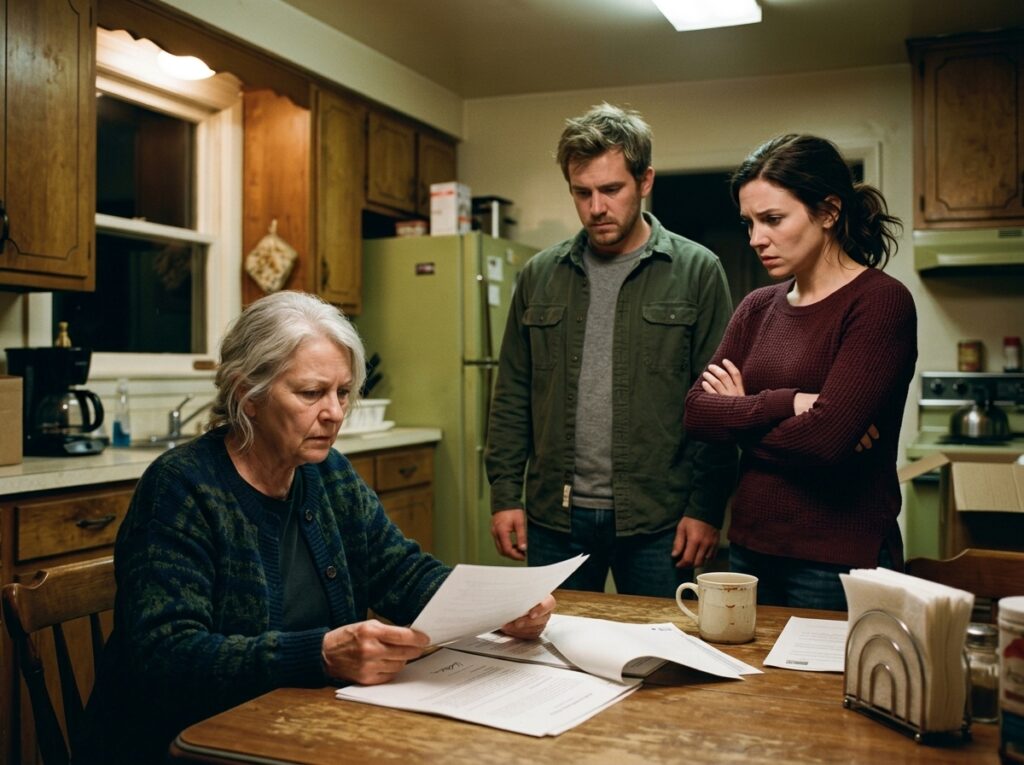
Elaine quietly gathered the documents.
“What does this have to do with my condo?” I asked.
Caleb looked at me, and his face held the expression of a man who had run out of places to hide.
“Harper said the business could recover if we secured a larger line of credit.”
“Using the condo.”
“She said we wouldn’t actually borrow against it until after you passed away.”
The room became silent.
There it was.
The truth stripped of polite phrases and future plans.
They had built a financial strategy around my death.
I gripped the back of a chair.
No one had touched me, yet I felt as though the floor had disappeared beneath my feet.
Caleb stepped toward me.
“Mom, I never wanted anything to happen to you.”
“That is not what I said.”
“I never wanted you gone.”
“But you planned for what would happen when I was.”
“I thought it was years away. I thought—”
“You thought I was an asset.”
His face broke.
“No. I thought I was protecting my family.”
“Your family included me.”
“I know.”
“Then why did no one protect me?”
He had no answer.
Harper began crying quietly, though I could not tell whether it was regret or fear.
Catherine turned away from her.
Richard moved toward the door.
“Catherine, we should leave.”
She did not move.
“I am not leaving with you until you tell me how much you knew.”
Richard looked stunned. “I knew there were financial concerns.”
“How much?”
“Some.”
“Did you know the plan depended on Barbara’s condo?”
He said nothing.
Catherine’s disappointment was almost physical.
“You let me walk into this home and speak about replacing the furniture.”
“Catherine—”
“You let me believe I was a guest when I was being used as part of a performance.”
Harper wiped her cheeks. “Mom, that isn’t fair.”
“It is more fair than anything you have done to Barbara.”
That sentence seemed to reach Harper.
Her shoulders lowered.
For the first time, she looked at me without defiance.
“I was going to pay everything back,” she said.
“Using money from the business?”
“Using the profit after the renovation.”
“There was no renovation.”
“There would have been.”
“Without my permission.”
She looked toward Caleb.
“I thought he would convince you.”
The words were almost inaudible.
Caleb closed his eyes.
I heard Patrick take a slow breath behind me.
The doorbell rang.
Everyone turned.
Elaine checked the time. “The building manager may have arrived with the remaining footage.”
Patrick went to the door.
It was not the manager.
A courier stood outside holding a certified envelope.
“Barbara Whitmore?”
“I’m Barbara.”
He handed me the envelope and obtained my signature.
The return address belonged to a commercial lending company.
My name was not on the envelope.
Caleb’s was.
He stared at it.
“Mom, I can explain.”
I did not open it.
“Explain why a lender is sending documents to this condo.”
“I didn’t know they had your address.”
“Why would they need it?”
He looked at Harper.
She shook her head rapidly.
“Don’t open that here,” she said.
The urgency in her voice answered me.
I gave the envelope to Elaine.
She examined it without breaking the seal.
“This may contain information relevant to the property. We should review it with care.”
Caleb’s hands began to tremble.
“I didn’t sign anything using the condo as collateral.”
“Then you should have no reason to fear the contents,” Elaine said.
Harper stepped between them.
“Give it to me.”
“No,” I said.
She stopped.
I had spoken quietly, but the room obeyed the sound.
“This came to my home. My attorney will open it.”
Caleb looked at me with exhausted desperation.
“Mom, please.”
I almost reached for him.
That instinct had guided me through his childhood, his college years, his divorce—no, there had never been a divorce, I reminded myself; Harper had been his only wife—and every crisis he had brought to my doorstep.
But this was different.
Comforting him now might become another way of avoiding the truth.
Elaine broke the seal.
Inside was a copy of a loan application.
The borrower was Harper’s design company.
The co-borrower was Caleb.
Under “proposed collateral” appeared the legal description of my condo.
Beneath it was a handwritten notation:
Ownership transfer anticipated upon maternal succession.
My vision blurred.
Caleb made a small sound.
“I didn’t write that.”
Harper whispered, “It was only a draft.”
“Your husband signed the application,” Elaine said.
“I told him it was preliminary.”
“You told me it was a business projection,” Caleb said.
“You knew we needed funding.”
“I didn’t know you listed Mom’s condo.”
“You knew we were going to inherit it.”
Popular Posts
→- 1
- 2
- 3
- 4




Recently Viewed
Stories you read recently will appear here.