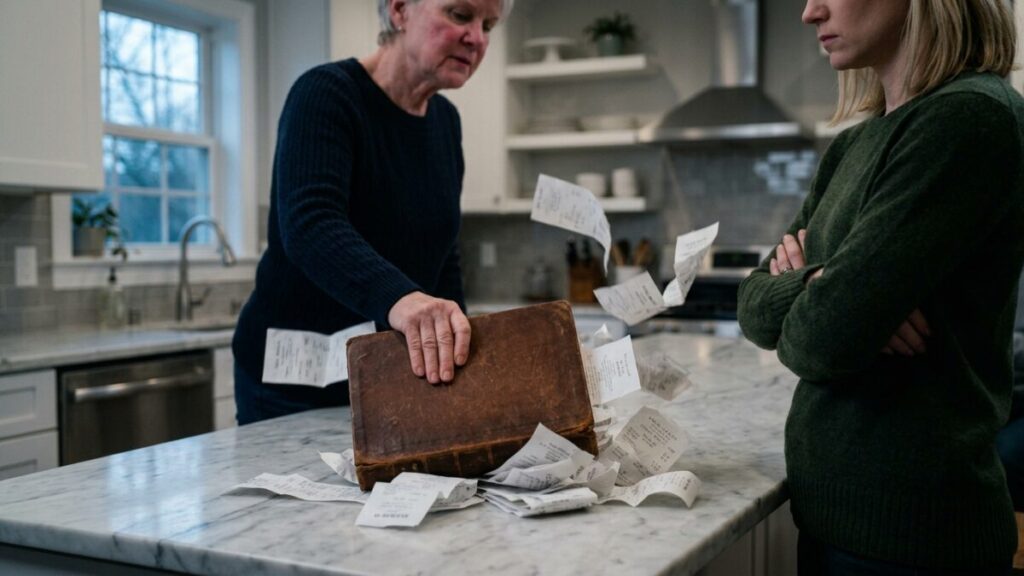
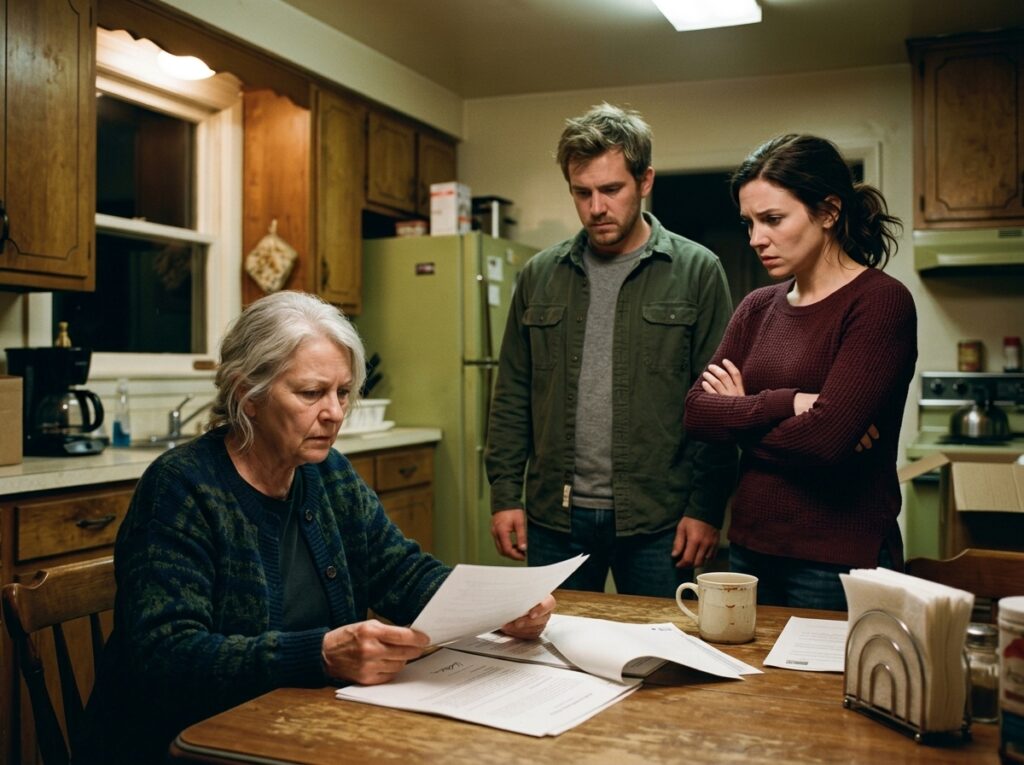
The word worth settled into the room with an ugly weight.
I looked at Harper.
“You weren’t planning for your parents to stay here for a few days.”
She said nothing.
Catherine turned toward her daughter. “Harper?”
Richard’s jaw tightened. “No one has made any final plans.”
Elaine removed a sheet of paper from her portfolio.
“Perhaps this will clarify the matter.”
She placed a printed document on the table.
At the top was a renovation proposal from Richard’s architectural firm. The property address was mine. Under “client,” the name listed was Caleb Whitmore.
My son stared at it as though the paper had appeared from nowhere.
“I didn’t authorize this,” he said.
Richard looked at him. “You approved the preliminary discussion.”
“I never signed anything.”
“You gave verbal consent.”
“For an estimate?”
“For planning purposes.”
Harper moved closer to him. “Caleb, don’t make this sound worse than it is.”
He picked up the proposal with unsteady hands.
The final section showed projected renovation costs, estimated post-renovation value, and a line labeled “anticipated equity position.”
The number beneath it was more than twice what I had paid for the condo.
I saw Caleb’s face change.
Not surprise.
Recognition.
“You’ve seen this,” I said.
He lowered the paper.
“I saw a draft.”
“When?”
“A few weeks ago.”
“And you said nothing.”
“I didn’t think it mattered.”
“It involved my home.”
“I thought it was just a possibility.”
Harper’s expression hardened. “We were trying to plan responsibly.”
“You planned around property you did not own,” Elaine said.
Richard gave a short laugh. “The trust may name Barbara as trustee, but families make arrangements all the time.”
“Families also respect legal ownership,” Elaine replied.
Catherine looked from the proposal to her daughter. “You told us Barbara had already agreed.”
Harper’s mouth opened, then closed.
That was the moment Catherine understood.
Not every detail. Not yet.
But enough to realize she had been brought into a plan whose foundation was not solid.
She looked at me, and for the first time since arriving, there was no expectation in her expression. Only discomfort.
“Barbara,” she said softly, “I believed Harper when she told me you wanted us here.”
“I know.”
“She said the condo would eventually belong to Caleb.”
“That is what she told everyone.”
Richard’s face darkened. “This is becoming unnecessarily hostile.”
“No,” I said. “It is becoming honest.”
I took the renovation proposal from Caleb’s hand and read the second page.
A note in the margin mentioned a future refinancing strategy.
The handwriting was Harper’s.
I recognized it from the birthday cards she had given me over the years.
“Future collateral,” I read aloud.
Caleb went completely still.
Harper reached for the document. “That was only a phrase.”
“Why is it written here?”
“It was part of a financial discussion.”
“With whom?”
She looked at Caleb.
He did not answer.
The silence revealed more than either of them intended.
I turned toward my son. “You knew this condo was being discussed as collateral.”
His eyes filled with shame.
“I knew there had been conversations.”
“About using my property to secure a loan?”
“No one was taking anything from you.”
“You had no authority to offer it.”
“I never offered it.”
“Your name is on the proposal.”
“I signed it as a preliminary acknowledgment.”
Elaine took the page from me.
At the bottom, below Caleb’s signature, was a note stating that the property could be leveraged after transfer of ownership.
After transfer of ownership.
Not if.
After.
My hands went cold.
Harper stepped toward me. “Barbara, you’re misunderstanding the language.”
“I understand it perfectly.”
“The condo was going to stay in the family.”
“Your family.”
“Our family,” she snapped. “Caleb is your son.”
“And you believed being married to him made you entitled to what I earned?”
Her expression hardened.
“I believed you loved him enough to help him.”
The words struck deeper than her earlier insults.
Because they sounded almost reasonable.
That was how manipulation worked. It wrapped itself in the language of love and made resistance look like cruelty.
Caleb looked at her.
“Stop,” he said.
Harper stared at him.
“Stop explaining this as if Mom caused the problem.”
“You’re choosing her over us now?”
“I’m choosing the truth.”
Catherine sat down abruptly in the nearest chair.
“Harper,” she said, “what business loan is this?”
Harper’s face changed.
Richard looked at his wife. “There is no need to involve you in every detail.”
“I asked what business loan this is.”
Catherine had spent the entire weekend speaking with the polished confidence of someone who believed she was entitled to comfort. Now her voice carried something different—fear.
Harper glanced at Caleb.
He looked away.
That was answer enough.
Catherine rose slowly. “You told us the condo was being prepared for us.”
“I said it might be available.”
“You said Barbara had agreed.”
“She would have agreed if she understood the circumstances.”
“Which circumstances?”
Harper’s lips pressed together.
Richard stepped forward. “The business has experienced temporary setbacks.”
“Whose business?” Catherine asked.
No one answered.
Patrick, who had been silent near the balcony, finally spoke.
“Harper’s design company.”
Catherine turned toward her daughter.
Harper’s cheeks reddened.
Richard looked at Patrick with open hostility. “You’ve been investigating us?”
“No,” Patrick said. “I’ve been helping Barbara protect her property. Your name came up when you contacted the county office about permits.”
Richard’s face lost its color.
I looked at him. “You contacted the county?”
“I made an inquiry.”
“You told them you represented the owner.”
“I said I was coordinating a potential renovation.”
“That is not what the assessor’s office recorded.”
Patrick’s voice stayed calm. “Richard submitted preliminary permit questions under the assumption that Caleb had authority to approve construction.”
Richard’s gaze shifted toward Caleb.
“You told me your mother had given you control.”
Caleb’s head snapped up. “I never said that.”
“You said the trust was a formality.”
“I said I didn’t understand it.”
“You said Barbara was becoming forgetful.”
The words seemed to echo.
Popular Posts
→- 1
- 2
- 3
- 4




Recently Viewed
Stories you read recently will appear here.