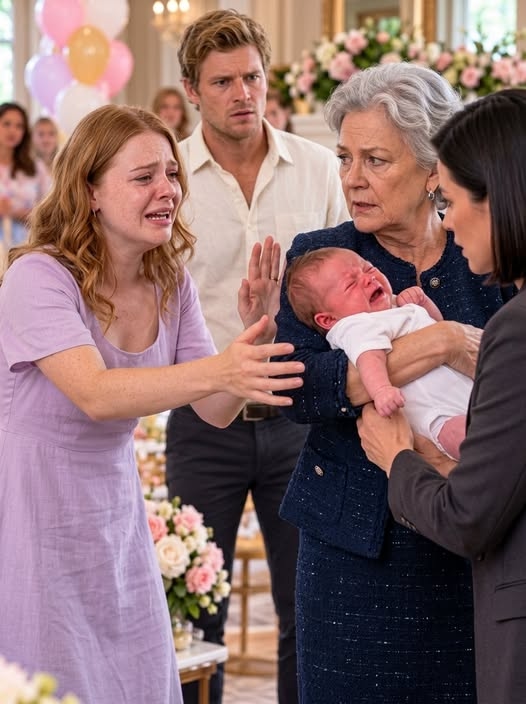
A shareholder called out.
“Are you going to destroy Harrington Industries?”
“No.”
I looked at Daniel.
“I’m going to insist that its financial condition be honestly disclosed.”
The room grew quiet.
“Nobody benefits from hiding losses until ordinary employees lose their livelihoods.”
Daniel’s face flushed.
“You have no right to stand here and lecture us.”
I met his eyes.
“I have the same right as every properly authorized creditor representative.”
His younger brother Ethan rose from the back row.
“This is personal revenge.”
I looked at him.
“Your family’s conduct made this personal.”
Then I turned toward the shareholders.
“But the decisions involving this company will be handled through the proper financial and legal processes.”
The meeting ended in confusion.
Outside, journalists crowded the steps.
Daniel pushed through them without answering questions.
For the first time, Harrington Industries’ collapse was no longer a rumor.
It was a public crisis.
That evening, Julian received confirmation that several Harrington-controlled accounts had been placed under review.
Investigators had requested additional records.
A proposed rescue transaction had fallen apart.
And the company’s shares had fallen sharply.
I should have felt triumphant.
Instead, I felt strangely empty.
Then Detective Ruiz called.
“We found Charles.”
My heart jumped.
“Is he alive?”
“Yes.”
“Where?”
“At a private residence outside Hartford.”
I exhaled.
Then she continued.
“Claire, he claims he was hiding voluntarily.”
“Why?”
“He says someone threatened his family.”
“Who?”
“He won’t name them.”
I looked at the city lights.
“Can I speak with him?”
“Not right now.”
“Why?”
“Because he made a statement about Project Crown.”
I gripped my phone.
“What statement?”
“He says you aren’t the rightful owner.”
I stared into the darkness.
“Who does he say owns it?”
Detective Ruiz paused.
“Your brother.”
Charles Harrington requested a meeting through his attorney.
Detective Ruiz advised me that the circumstances surrounding his disappearance remained under investigation.
I declined any private meeting.
Instead, I agreed to provide questions through counsel.
The first question was simple.
Where was Michael Bennett?
Charles’s written response contained three words.
I don’t know.
The second question concerned the Harrington-owned medical facility where Michael had reportedly been treated.
Charles acknowledged that the clinic existed.
He denied involvement in any improper detention or identity concealment.
The third question concerned Project Crown.
His response was longer.
He claimed that Michael had inherited rights through an earlier family agreement.
He alleged that Evelyn Bennett had concealed those rights.
And he asserted that Claire Bennett had never received complete ownership.
I read the statement twice.
Then I asked Julian to produce the original trust documents.
He looked troubled.
“Claire, there may be a complication.”
“What complication?”
“Your mother’s instructions refer to a succession instrument.”
“Where is it?”
“We don’t know.”
I stared at him.
“How can a trust control assets worth over a billion dollars and have a missing succession instrument?”
“Because the instrument was deposited with a private custodian.”
“Which custodian?”
Julian hesitated.
“Blackwood.”
I closed my eyes.
Everything returned to Blackwood.
Every road.
Every lie.
Every person who had vanished.
That afternoon, Rebecca’s independent review produced a preliminary finding.
She had not been shown to have transferred confidential trust records improperly.
But she had failed to disclose several contacts with Charles promptly.
I kept her removed from the Blackwood matter.
Trust, once damaged, could not be restored by one explanation.
I appointed separate independent counsel and asked for a complete audit of the records.
Then I received another message.
It came from the number associated with the man claiming to be Michael.
I NEED TO SEE YOU.
I stared at the screen.
A second message appeared.
NO LAWYERS.
Then a third.
I KNOW WHAT MOM HID.
I forwarded the messages to Detective Ruiz.
An investigator arranged a secure procedure for verifying the sender’s identity.
For hours, nothing happened.
Then the unknown man agreed to provide a photograph and a childhood detail not available in public records.
He sent a picture of a wooden music box.
I recognized it immediately.
My mother had kept it beside her bed.
It played a melody from an old French lullaby.
Then he sent four words.
LITTLE BIRD, DON’T CRY.
My knees weakened.
Only one person had ever called me Little Bird.
I sat on the floor of my apartment and stared at the phone.
For the first time since my mother’s funeral, I began to cry.
Not because I felt powerless.
Because I suddenly remembered the boy holding my hand at Blackwood.
The boy who promised he would never leave me.
The boy everyone had told me was imaginary.
Then another message arrived.
CLAIRE, PLEASE LISTEN.
I wiped my face.
The final message contained one sentence.
DANIEL IS NOT WHO YOU THINK HE IS.
I stared at the screen.
I typed a reply.
WHAT DO YOU MEAN?
The answer appeared almost immediately.
HE WAS NEVER SUPPOSED TO MARRY YOU.
My heart began pounding.
Then Michael sent a photograph.
It showed Daniel standing beside a woman in a white wedding gown.
The photograph had been taken five years earlier.
And the woman was not me.
The woman in the photograph was named Victoria Lane.
According to public records, she had married Daniel Harrington in a private ceremony overseas.
The marriage had never been widely publicized.
The legal status and dates required verification because the records came from another jurisdiction.
But the photograph was real.
So was Victoria.
And she had disappeared from Daniel’s public life years before I met him.
Rebecca’s replacement counsel arranged for an investigator to locate her.
Three days later, Victoria agreed to speak with me through her own attorney.
She was thirty-seven.
She had pale blonde hair and a quiet, watchful expression.
When I entered the room, she stood immediately.
“Claire?”
“Victoria.”
She looked at my face.
Her expression changed.
“Did he hurt you?”
“Yes.”
She closed her eyes.
“I’m sorry.”
We sat.
For several moments neither of us spoke.
Then Victoria opened her handbag.
She placed a photograph on the table.
Daniel stood beside her on a beach.
Popular Posts
→- 1
- 2
- 3
- 4




Recently Viewed
Stories you read recently will appear here.