He looked at me for a long time.
“You have your mother’s eyes.”
I sat across from him.
“Mr. Mason, what happened at Blackwood?”
His expression darkened.
“People became greedy.”
“Who?”
“People who thought they could own information.”
“Was my father involved?”
Henry lowered his gaze.
“Yes.”
My throat tightened.
“Did he betray my mother?”
Henry shook his head.
“Your father betrayed the men who hired him.”
I leaned forward.
“Then he was protecting her?”
“At first.”
“At first?”
Henry looked at the closed door.
“Andrew changed after they took the boy.”
“What boy?”
Henry stared at me.
Then he whispered:
“Your brother.”
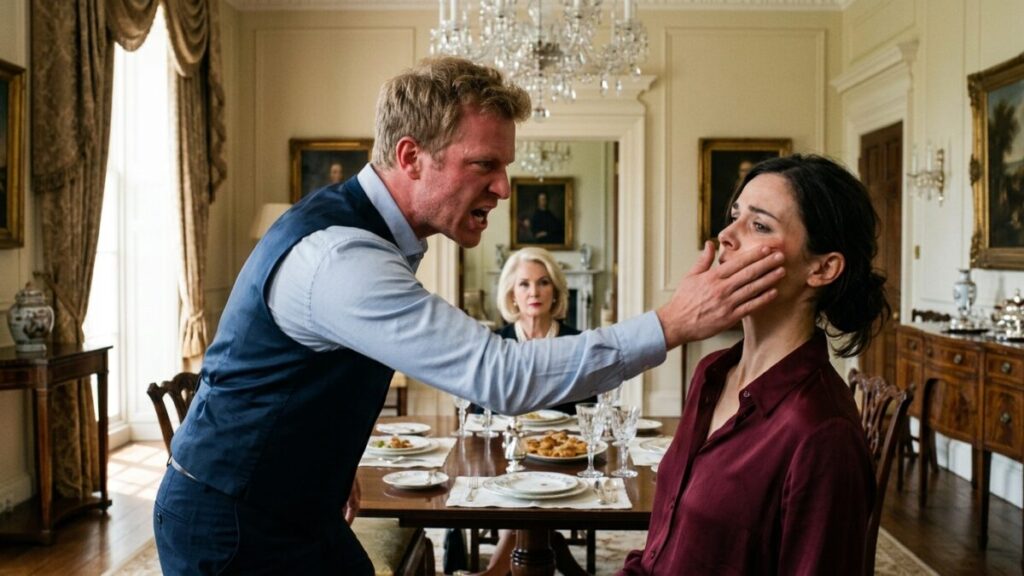
The words struck harder than Daniel’s slap.
I had never had a brother.
At least, that was what my mother had always told me.
Henry reached into his coat.
He withdrew an old photograph.
Two small children sat together on the steps of Blackwood.
One was me.
The other was a dark-haired boy about two years older.
On the back, someone had written:
CLAIRE AND MICHAEL.
And beneath it:
SUMMER, 1996.
I carried Michael’s photograph for three days.
Every time I looked at it, I felt as though my childhood was changing beneath my feet.
The boy had dark hair.
A serious expression.
And my father’s gray eyes.
I remembered playing with someone at Blackwood.
A child who showed me how to catch fireflies.
A boy who called me Little Bird.
But I had always believed those memories were dreams.
Henry Mason told us that Michael was two years older than me.
He had lived at Blackwood with our parents during the research project’s early years.
Then something happened.
A security breach.
A missing drive.
An emergency evacuation.
And Michael disappeared.
My mother apparently believed he had been taken.
My father blamed the Consortium.
The Consortium blamed my father.
No official kidnapping report was ever filed under Michael Bennett’s name.
It was as though someone had erased him.
Rebecca uncovered a sealed family court record.
The record established that my parents had registered the birth of a son.
But six months after the Blackwood incident, the boy’s identity records had been restricted under a protective proceeding.
The court order did not explain where he went.
I felt sick.
“Why would my mother hide him from me?”
Rebecca looked at me.
“She may have believed secrecy was necessary to protect him.”
“Or me.”
“Possibly.”
I stared at the photograph.
I had spent thirty years believing I was an only child.
Now I had to confront the possibility that my entire family history had been constructed around a secret.
That evening, I returned to my apartment.
My security team had checked the building.
The elevator opened onto my private floor.
I walked toward my door.
Then I stopped.
A small white envelope lay on the carpet.
My name was written across it.
Inside was a photograph.
Daniel stood beside a man in a dark suit.
They were leaving a private club in London.
The photograph was recent.
I turned it over.
Three words were written on the back.
HE IS MICHAEL.
I stared at the man.
He was tall.
Dark-haired.
About thirty-six.
His face was partly turned away.
I recognized the eyes.
My father’s gray eyes.
My phone rang.
Unknown number.
I answered.
A man’s voice spoke.
“Claire Bennett?”
“Who is this?”
“Someone who remembers Blackwood.”
My heart pounded.
“Michael?”
Silence.
Then he said:
“Don’t trust your attorney.”
I looked toward the security camera above my door.
“What?”
“Rebecca Sloan is not telling you everything.”
“Who are you?”
The man exhaled.
“Your mother tried to protect us.”
“Us?”
“You and me.”
My eyes filled with tears.
“Michael?”
He did not answer.
Instead, he spoke urgently.
“Whatever happens next, don’t let Rebecca open the third Crown archive.”
The call disconnected.
I stood motionless.
Then my phone displayed a new message.
It contained a photograph of Rebecca entering a building with Charles Harrington.
The timestamp was from the previous evening.
And underneath it was one sentence.
SHE HAS BEEN WORKING WITH HIM FOR YEARS.
Rebecca did not deny the meeting.
When I showed her the photograph, she went very still.
Then she closed her office door.
“Claire, I can explain.”
“Please do.”
“Charles Harrington approached me about a settlement.”
“Why didn’t you tell me?”
“Because I hadn’t verified the proposal’s authenticity.”
“Rebecca.”
She met my eyes.
“That was a mistake.”
I placed the photograph on her desk.
“Have you worked with him before?”
She hesitated.
And that hesitation frightened me more than an immediate confession.
“Yes.”
I felt my stomach drop.
“For how long?”
“Since before your mother died.”
I stood.
“Explain.”
Rebecca looked exhausted.
“Your mother asked me to maintain limited contact with certain people associated with Blackwood.”
“Charles?”
“Among others.”
“Why?”
“To detect attempts to access the restricted trust assets.”
I stared at her.
“You were reporting to him?”
“No.”
“Then what were you doing?”
“Listening.”
She opened a secure cabinet.
Inside were files I had never seen.
“Your mother created a monitoring arrangement.”
“Monitoring what?”
“The people who pursued Project Crown.”
Rebecca placed a document before me.
It bore my mother’s signature.
The date was two months before her death.
I read the instructions.
Rebecca was authorized to receive confidential communications from Charles Harrington, provided she disclosed material developments to designated trustees.
But the most recent meetings had not been disclosed to me.
I looked up.
“You should have told me.”
“You’re right.”
“Are you protecting me or protecting the trust?”
Rebecca lowered her eyes.
“I believed they were the same thing.”
“They aren’t.”
For the first time in twelve years, I questioned whether I could trust the woman who had handled my most important legal affairs.
I asked Rebecca to step aside from all Blackwood-related matters pending an independent review.
She agreed.
I retained separate counsel to evaluate her conduct.
Then I left.
Outside, rain hammered the Manhattan sidewalks.
My phone rang.
Daniel again.
I almost ignored it.
Then I answered.
“What do you want?”
Popular Posts
→- 1
- 2
- 3
- 4




Recently Viewed
Stories you read recently will appear here.