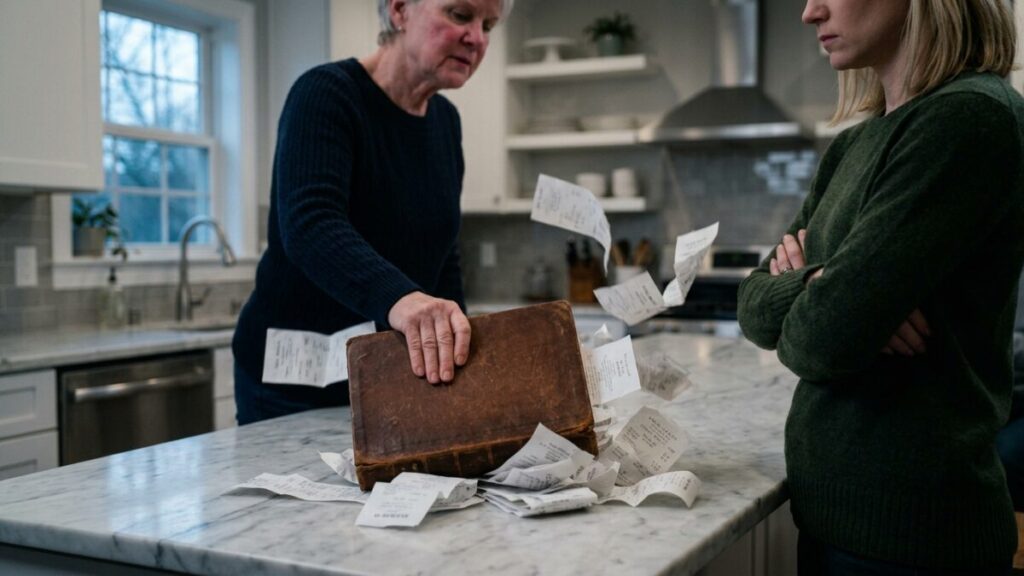
And when the money wasn’t enough anymore, they came for the house.
I boarded the plane feeling something I hadn’t felt in years.
Certainty.
I wasn’t confused anymore. I wasn’t second-guessing myself. I wasn’t wondering if maybe I was overreacting or being too sensitive.
I knew exactly what had happened, and I knew exactly what I was going to do about it.
The flight was five hours.
I didn’t sleep.
Instead, I created a second document. This one wasn’t about money. It was about evidence.
I went through my security camera footage frame by frame, taking screenshots of everything. Rachel measuring the walls. Her father pointing at my furniture, discussing what to remove. Her mother opening my kitchen cabinets, deciding what to keep. The mover carrying boxes labeled for my upstairs bedrooms. Evan standing in the background, hands in his pockets, fully aware of what was happening.
Each image was dated and timestamped by the camera system.
Undeniable proof that this wasn’t a misunderstanding or a miscommunication.
It was planned. Deliberate. Coordinated.
I organized the images into a folder and added them to the financial records.
Then I drafted a timeline—a simple chronological account of how we got here—starting with the first financial request five years ago and ending with that night’s footage of them moving into my home without permission.
No emotional language, no accusations, just facts: dates, amounts, actions.
By the time the plane began its descent into Seattle, I had built a case so airtight that no amount of crying or apologizing or playing the family card could dismantle it.
The shame I had felt earlier was gone.
In its place was something sharper, colder: resolve.
I looked out the window as the city lights came into view below. Dawn was still an hour away. The sky was that deep blue that comes just before sunrise, and the world below looked quiet, peaceful.
But I wasn’t peaceful.
I was a woman who had just spent five hours documenting every way her family had betrayed her trust.
And I wasn’t finished yet.
I checked my phone as the wheels touched down.
No messages from Evan. No calls from Rachel.
They had no idea I was coming.
They thought I was still in Hawaii, blissfully unaware, sipping tropical drinks while they erased me from my own home.
I smiled, just barely.
Good.
Let them think that.
Let them settle in. Let them unpack. Let them get comfortable in rooms that didn’t belong to them. Let them believe they had won.
Because the deeper they walked into this situation, the harder it would be for them to lie their way out of it.
I gathered my things as the plane taxied to the gate—my carry-on bag, my laptop, my phone with its folders full of evidence.
I didn’t text anyone, didn’t call ahead, didn’t warn them I was back.
I wanted them completely off guard.
I wanted to see their faces when I walked into that house and shattered the illusion they had built—the illusion that I was too old, too weak, too afraid of conflict to fight back.
I stepped off the plane and into the terminal.
The air was cool. The airport was quiet.
And I was ready.
I had spent five years being taken advantage of.
I had spent five hours documenting it.
Now it was time to end it.
I walked through the empty terminal, my footsteps echoing against the tile floor, and headed toward the exit.
Seattle was waiting.
And so was my house.
But this time, I wasn’t walking into it as the woman they thought I was.
I was walking into it as the woman I should have been all along: the woman who knew her worth, the woman who demanded respect, the woman who refused to be erased.
The sky outside was beginning to lighten, just barely.
Dawn was coming.
And so was I.
I rented a car at the airport and drove through the empty, pre-dawn streets of Seattle.
The city was still asleep. Streetlights glowed orange against the dark sky. A few delivery trucks rumbled past, but otherwise the roads were mine.
I didn’t go straight to the house.
Instead, I parked two blocks away in front of a small park where the trees would hide my car from view.
I needed to see what was happening before I walked into it. I needed to understand the full scope of what they had done.
I pulled out my phone and opened the security app.
Six cameras.
Every angle of my property covered.
I tapped the live feed and my stomach dropped.
The house was fully lit. Every window glowed.
At 4:30 in the morning, my home looked like a department store during a holiday sale.
I zoomed in on the front entrance.
A moving truck sat in my driveway, its back doors open.
Two men in company uniforms were carrying a dresser up my front steps.
Behind them, Rachel’s father directed traffic, pointing toward the staircase.
I switched to the kitchen camera.
Rachel’s mother stood at my counter, unpacking dishes.
Not her dishes.
My dishes were already stacked in a cardboard box near the sink, labeled in thick black marker.
Donate my dishes.
The ones my husband and I had picked out together thirty years ago. Plain white porcelain with tiny blue flowers along the rim. Nothing fancy.
But ours.
And she was replacing them.
I switched to the upstairs hallway camera.
Boxes lined the walls. Clothing racks filled with coats and dresses I didn’t recognize. Suitcases stacked three high.
This wasn’t a temporary visit.
This wasn’t helping me out or combining households.
This was a full relocation.
Rachel’s parents weren’t staying for a few weeks while they looked for a place.
They were moving in permanently, and I was expected to accept it.
I watched as Rachel’s mother walked into my bedroom.
Popular Posts
→- 1
- 2
- 3
- 4




Recently Viewed
Stories you read recently will appear here.