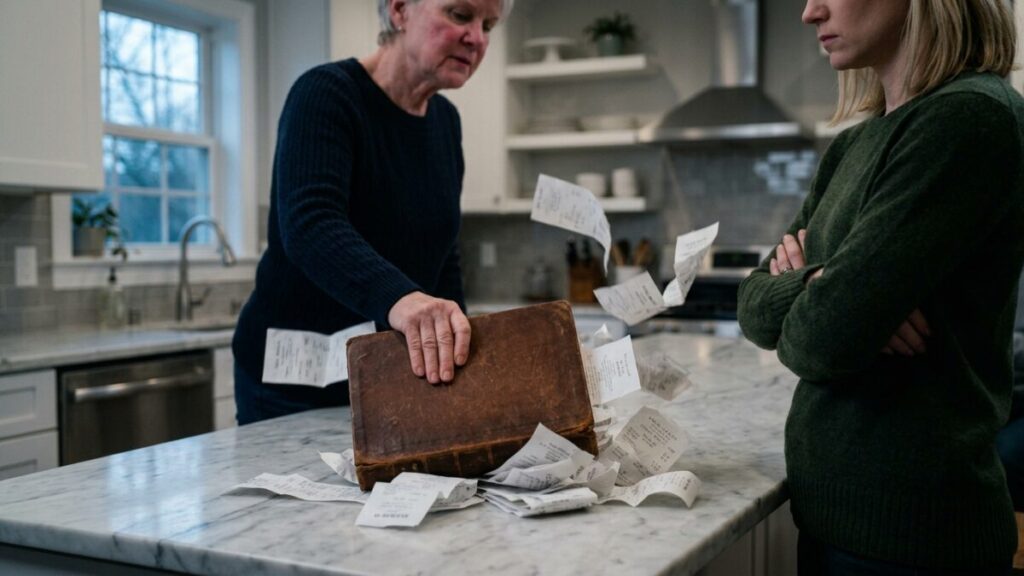
I stared at it.
That was more than a year of my retirement income, gone—funneled into the lives of two adults who never once offered to pay me back. Two adults who were, at this very moment, measuring my walls and deciding which rooms they’d claim for Rachel’s parents.
My stomach turned.
This wasn’t generosity. This wasn’t love. This wasn’t even support.
This was exploitation, carefully disguised as need.
And I had let it happen.
No. I had funded it.
I had smiled through every request. I had reassured them that it was fine, that I was happy to help, that family takes care of each other.
But the care only went one direction.
When my roof leaked last spring, did they offer to help with repairs? No. Evan said they were too busy.
When I mentioned feeling isolated after my book club disbanded, did Rachel invite me to spend time with them? No. She suggested I join a senior center.
When I asked if they could help me move furniture so I could deep clean, did they show up? No. They sent a text saying they’d try to come by next month.
Next month never came.
I wasn’t family to them. I was a resource—an ATM with a pulse.
And the moment I stopped being useful, they planned to take the one thing I had left: my home.
I closed the banking app and sat in the silence of that hotel room, feeling something shift inside my chest. Shame turned into anger. Anger turned into clarity. Clarity turned into resolve.
I wasn’t going to scream. I wasn’t going to cry. I wasn’t going to beg them to see me as a human being instead of a means to an end.
I was going to let them finish what they started.
I was going to let them move everything in, settle her parents into my rooms, unpack their lives into my home, and then I was going to show them exactly what happens when you mistake silence for permission.
I zipped my suitcase closed, picked up my phone, and checked my flight details.
Four hours until boarding.
I ordered room service, ate methodically, and began organizing every receipt, every bank record, every text message where they had asked for money.
I wasn’t preparing for a conversation.
I was preparing for war.
And this time, I wasn’t going to lose.
The airport was nearly empty when I arrived. Late-night flights to Seattle aren’t exactly popular, and I was grateful for the quiet. I needed space to think, space to plan, space to organize the storm that was building in my chest into something precise and undeniable.
I checked my bag, cleared security, and found a seat near the gate where I could work undisturbed.
My laptop came out first, then my phone, then the notepad where I had scribbled the initial financial tally back in the hotel room: $54,000.
Even now, seeing it written in my own handwriting, it felt impossible.
How does someone give away that much money without realizing it?
The answer was simple, and it made my chest tighten with something close to embarrassment. I gave it away in pieces—$2,000 here, $5,000 there—small enough amounts that I could justify them individually, tell myself it was just helping out, just being supportive, just doing what mothers do.
But when you add all those small sacrifices together over the course of five years, they stop being kindness. They become a pattern of control.
I opened a new folder on my desktop and named it simply: records.
Then I got to work.
I started with my bank statements going back sixty months—every transfer to Evan, every Venmo payment to Rachel, every time I had covered a dinner bill because their cards were mysteriously declined.
I copied each transaction into a spreadsheet: date, amount, purpose.
The purpose column was the hardest to fill in because half the time they hadn’t even told me what the money was for, just that they needed it urgently. Always urgently.
But I remembered enough. The wedding deposit. The car repair that turned out to be a down payment on a newer model. The emergency dental work that I later found out was cosmetic veneers. The overdue electric bill that came right before they bought a sixty-inch television.
My fingers moved faster as the anger built.
Next, I pulled up my text messages. I scrolled back through years of conversations, screenshotting every request.
“Mom, can you help us out with rent this month? We’re a little short.”
“Mary, the kids need new shoes and we don’t get paid until Friday. Can you cover us?”
“Hey, Mom. Our credit card got declined at the grocery store. Can you send 200?”
I saved every single one.
Then I went further. I searched my email for receipts—anything I had purchased for them and never been reimbursed for.
Furniture I had bought when they moved into their apartment. Gifts I had given that they had specifically requested. Expensive things they claimed were necessities.
A crib. A stroller. A high chair. Baby monitors. Clothes. Toys.
Thousands of dollars in items that weren’t gifts at all. They were requirements—things Rachel told me they absolutely needed, and if I didn’t buy them, I was being unsupportive.
The spreadsheet grew longer and longer.
By the time boarding was announced, I had documented every dollar.
$54,128.
The number sat at the bottom of the screen, cold and factual.
I saved the file, backed it up to the cloud, emailed a copy to myself.
Then I sat back in my seat and stared at it.
This was the cost of being too agreeable, too trusting, too willing to believe that people you love would never take advantage of you.
For the first time, I let myself say it out loud, quietly under my breath as passengers filed past me toward the gate.
I was exploited. Not helped. Not needed.
Exploited.
They saw my kindness and turned it into a subscription service—automatic, expected, endless.
Popular Posts
→- 1
- 2
- 3
- 4




Recently Viewed
Stories you read recently will appear here.