They were too busy realizing the enormity of what had happened.
They had been used as pawns in Rachel’s scheme, and now they were paying the price.
Evan had been quiet through all of this, standing to the side, watching his wife’s lies disintegrate.
But now, as Rachel’s parents turned on her, as the neighbors whispered louder, as the movers loaded the last of the furniture onto the truck, he finally spoke.
“Mom,”
he said, his voice tight,
“can we please just talk about this inside, away from everyone?”
I looked at him—my son, the boy I had raised, the man I had supported, the person I had given $54,000 to without question.
And I saw what I should have seen years ago.
He wasn’t going to defend me.
He was going to defend them, one last time.
I looked at my son standing there, his face drawn and tired, asking me to go inside—away from the neighbors, away from the witnesses, away from the accountability.
“No,”
I said simply.
His face tightened.
“Mom, please. This is family business. It shouldn’t be happening out here.”
“Family business should have stayed family business,”
I replied.
“But you made it public business when you tried to steal my house.”
“We weren’t stealing,”
he said, his voice rising in frustration.
“God, Mom, why do you keep saying that? We’re your family. We were trying to help you.”
There it was.
The same line Rachel had used.
The same manipulation, just delivered by someone I had loved longer.
“Help me how, exactly?”
I asked.
“By moving your in-laws into my home without asking? By planning to renovate my house with my money? By relegating me to the smallest room while they took over everything I built?”
“You’re twisting it,”
Evan said, running a hand through his hair.
“You’re making it sound so much worse than it was.”
“Then tell me what it was,”
I said.
“Explain it to me. Make it make sense.”
He exhaled sharply.
“Rachel’s parents needed a place to stay. They’re getting older. Their rent kept going up. We thought—you have this huge house and you’re here all alone—and it would be good for everyone. Company for you. Stability for them. It was supposed to be a win for everybody.”
“Except nobody asked me,”
I said.
“Because we knew you’d say no,”
he admitted.
The honesty shocked even him.
I could see it in his face the moment the words left his mouth.
“You knew I’d say no,”
I repeated slowly.
“So instead of respecting that, you decided to just do it anyway.”
“We thought once you saw how good it could be, you’d understand,”
he said quickly, trying to backtrack.
“We thought you’d see that having people around was better than being alone.”
“I’m not alone by accident, Evan,”
I said.
“I’m alone by choice. I like my peace. I like my space. I like knowing that every decision in my home is mine to make.”
“But what about when you can’t make those decisions anymore?”
he asked.
“What about when you fall or get sick or need help?”
“Then I’ll ask for it,”
I said.
“From professionals, from people I hire. From anyone but people who would use my vulnerability as an excuse to take what I’ve built.”
He flinched.
“That’s not fair, Mom. We love you.”
“Do you?”
I asked quietly.
The question hung between us.
He opened his mouth, closed it, opened it again.
“Of course we do. You’re my mother.”
“Then show me the love,”
I said.
“Show me where it is in the $54,000 I gave you that you never paid back. Show me where it is in the plans to put me in the smallest room of my own house. Show me where it is in the lies you told your in-laws to get them to participate in this scheme.”
His face crumpled.
“We were going to pay you back. We just needed time.”
“Five years wasn’t enough time?”
“We had expenses. The kids, the house. Life is expensive, Mom.”
“Life is expensive for me, too,”
I said.
“But I managed it without asking you for help, without taking what wasn’t mine.”
“You have more than us,”
he said.
And there was an edge to his voice now. Something bitter, something that had probably been there for years.
“You own your house outright. You have savings. You have retirement income. We’re struggling.”
“So your solution was to take from me,”
I said.
“To share with you,”
he corrected.
“That’s what family does. They share.”
“Sharing requires consent,”
I said.
“What you did is called taking.”
Rachel stepped forward, her tears dried now, replaced with something harder.
“You’re being impossible. You’re acting like we committed some crime. We were trying to create a multigenerational household. That’s how families used to live together. Supporting each other.”
“Supporting,”
I said.
“Interesting word choice.”
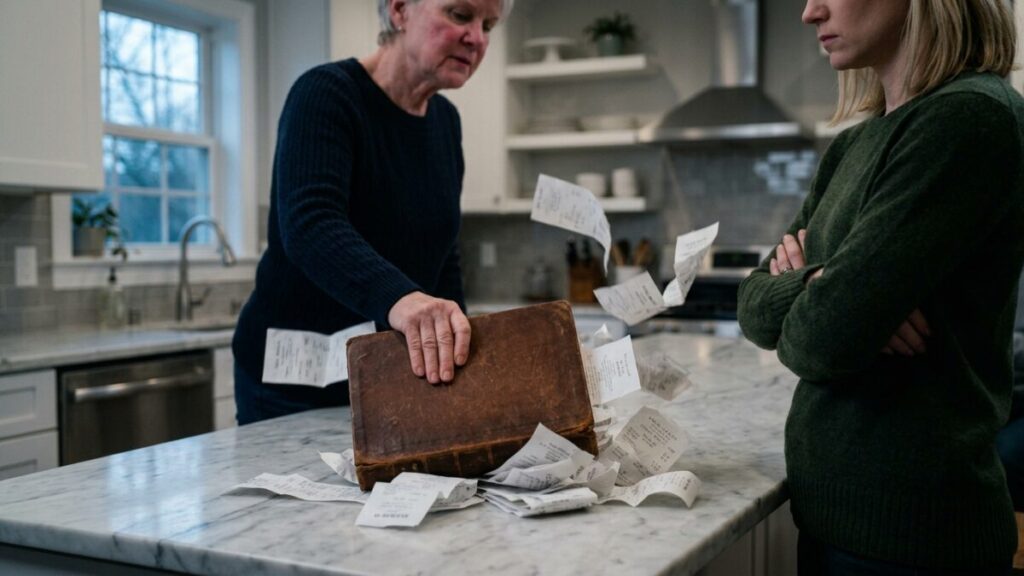
I pulled out the financial ledger again.
“This is support,”
I said, holding it up.
“$54,000 over five years. I supported you constantly, without question, without asking for anything in return.”
I flipped to a marked page.
“But when I needed help moving furniture last year, you were too busy. When I asked if you could help me clean out the gutters, you said you’d get to it eventually. When I mentioned feeling isolated after my book club ended, you suggested I find new hobbies.”
I looked at both of them.
“That’s not support,”
I said.
“That’s extraction. You took everything I offered and gave nothing back. And when there was no more money to take, you came for the house.”
Evan’s jaw tightened.
“You’re overreacting. You’re making this into something it’s not.”
“Am I?”
I asked.
I reached into my bag and pulled out a set of keys.
New keys.
Shiny and unused.
“These are the new locks,”
I said calmly.
“I changed them all this morning. Front door, back door, side entrance, garage.”
Evan’s eyes widened.
“You changed the locks?”
“Yes.”
Popular Posts
→- 1
- 2
- 3
- 4




Recently Viewed
Stories you read recently will appear here.