She looked at the neighbors, playing to her audience now.
“That’s all we wanted,”
she continued.
“To make sure Mary wasn’t alone anymore, to fill this big house with life and love again.”
A few of the neighbors shifted, their expressions uncertain.
It was a good performance.
I had to admit, if I hadn’t spent the last twelve hours documenting everything, I might have even doubted myself for a moment.
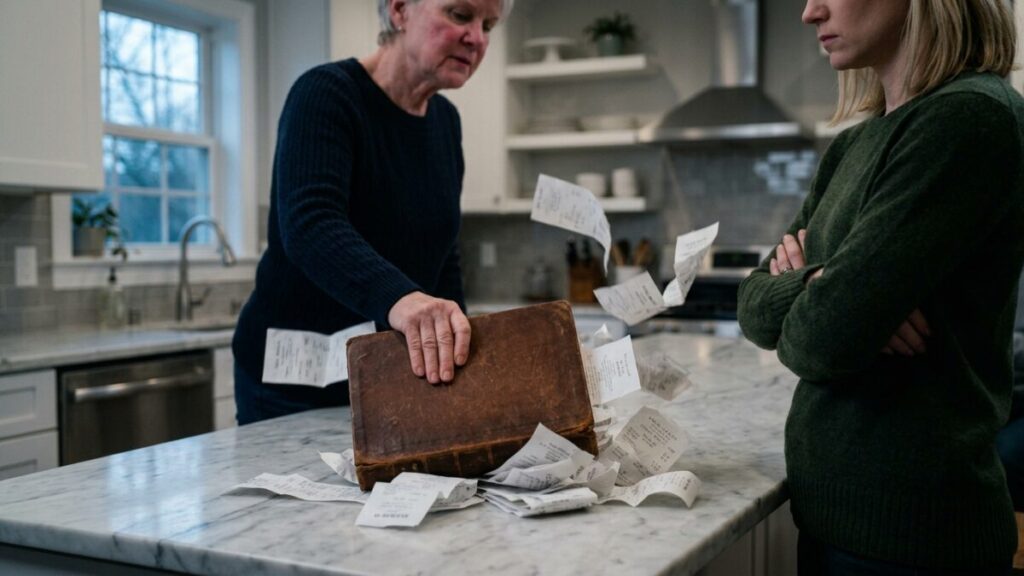
But I had the receipts.
Literally.
I opened the folder again and pulled out a printed screenshot from my security camera.
It showed Rachel standing in my living room, pointing at my furniture while talking to the mover.
I read the timestamp aloud.
“Tuesday, 4:30 in the afternoon. Two days ago.”
Then I read the caption I had added beneath the image—a direct quote from the audio recording.
“Mary won’t know until it’s too late. By the time she gets back, we’ll be moved in, and she’ll have no choice but to accept it.”
Rachel’s face went white.
The neighbors’ uncertain expressions hardened.
“That doesn’t sound like helping me,”
I said quietly.
“That sounds like trapping me.”
Rachel opened her mouth, but nothing came out.
Her mother jumped in, trying to salvage the story.
“Rachel was just stressed. She didn’t mean it the way it sounded.”
“Really?”
I asked.
“Because I have more.”
I pulled out another screenshot.
This one showed Rachel’s mother in my kitchen, going through my cabinets.
“These dishes are so outdated,”
the caption read.
Another direct quote.
“We’ll donate them and get something modern.”
Rachel’s mother flushed.
“I was just trying to help you update things.”
“Without asking me,”
I said.
“Well, we didn’t want to bother you while you were on vacation.”
“How considerate,”
I replied, my tone flat.
I pulled out the third screenshot.
Rachel’s father measuring my bedroom wall.
“This room is perfect for us,”
he had said to his wife.
“Mary can take the small room downstairs. She doesn’t need much space at her age.”
The neighbors gasped.
Rachel’s father stammered.
“I… I’m not… We weren’t trying to take your room, Mary. We were just looking at options.”
“Options,”
I repeated.
“Options for which rooms you’d claim in my house without my permission.”
He had no response.
Rachel tried again, her voice growing shrill.
“We were going to fix the place up for you—do repairs, paint, make it nice. It was going to be our contribution, our way of paying you back for all your help over the years.”
I pulled out yet another document: the contractor estimate.
I had found it in the binder, tucked between the moving schedules.
“This is an estimate you requested,”
I said, scanning the page.
“For knocking down the wall between the kitchen and dining room, for converting the garage into a mother-in-law suite, for adding a second bathroom upstairs…”
I looked up at her.
“These aren’t repairs, Rachel. This is a renovation.”
A renovation that would have cost $40,000.
Her eyes widened.
“And according to this estimate,”
I continued,
“the payment method listed is owner financing.”
“That’s me.”
“You were planning to renovate my house and make me pay for it.”
The neighbors’ whispers grew louder.
Rachel’s story was crumbling with every piece of evidence I presented.
“That was just a preliminary estimate,”
she protested weakly.
“We weren’t actually going to do it.”
“Then why did you request it?”
I asked.
“Why did you meet with the contractor? Why did you discuss financing options?”
She had no answer.
Her father tried to step in, his voice taking on a harder edge now.
“Mary, you’re cherry-picking information and making us look bad. You’re taking everything out of context.”
I pulled out the written moving plan, the one that listed exactly which parent would get which room.
I read it aloud, slowly and clearly.
Master bedroom, east side: Mom and Dad.
Second bedroom, west side: Dad’s office.
Third bedroom, north side: Mom’s craft room.
Downstairs guest room: Mary.
Garage conversion: rental income opportunity.
I paused on that last line.
“Rental income,”
I said.
“You were planning to convert my garage into an apartment and rent it out.”
Rachel’s parents exchanged panicked glances.
That detail had clearly been something Rachel hadn’t shared with them.
“Rachel?”
her mother asked, her voice tight.
“What is she talking about?”
Rachel fumbled for words.
“That was just an idea. Just something I thought might help generate income for the household.”
“My household?”
I corrected.
“Income from my property that you planned to collect.”
Her mother’s face changed.
The realization was dawning.
“Rachel,”
she said slowly.
“Did you actually ask Mary if we could move in?”
Rachel’s silence was deafening.
“Rachel,”
her father pressed.
“Did you tell her we were coming?”
“I was going to,”
Rachel said quickly.
“I just wanted to get everything set up first so she could see how good it would be so she wouldn’t worry about the details.”
Her mother took a step back, staring at her daughter like she was seeing her for the first time.
“You told us Mary invited us,”
she said, her voice shaking.
“You said she wanted us here. You said she was lonely and asked for our help.”
“She is lonely,”
Rachel insisted.
“I wasn’t lying about that.”
“But she didn’t invite us,”
her mother said, the words coming out like an accusation.
“She didn’t ask us to move in.”
Rachel’s silence confirmed it.
Her father’s face went from angry to horrified.
“We gave up our apartment,”
he said quietly.
“We packed up our entire lives. We thought we were helping family. We thought we were wanted.”
“You are wanted,”
Rachel tried.
“Mary just doesn’t realize it yet.”
“She realizes you lied to us,”
her mother said, her voice rising.
“You lied to us and you lied to her, and now we’re standing in the middle of the street being humiliated because you couldn’t be honest.”
Rachel started crying again, but this time her parents didn’t comfort her.
Popular Posts
→- 1
- 2
- 3
- 4




Recently Viewed
Stories you read recently will appear here.