The restaurant was not asking for a loan. The restaurant was asking to be funded by my wife’s dead mother without my wife’s full knowledge of what she would be signing.
I carried the pages into the kitchen. Olivia saw her name first. Her hand went to her mouth. “I didn’t know he brought that,” she said.
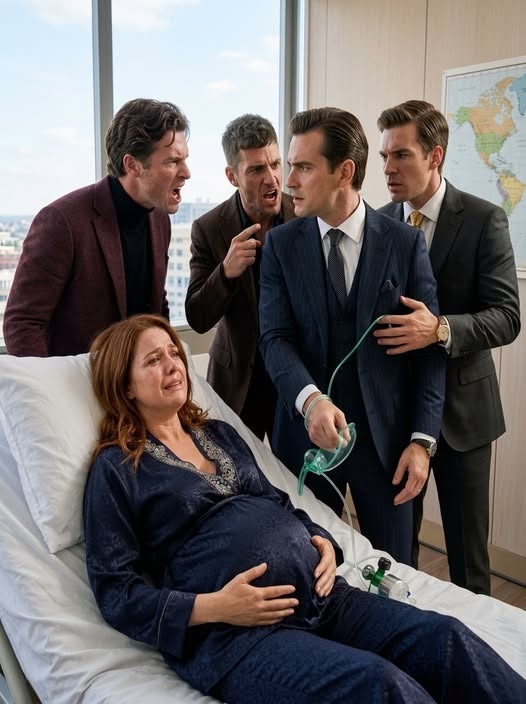
Michael turned on her so fast his chair scraped the floor. “Stop talking.”
That was when the siren turned onto our street.
It didn’t sound like justice. Justice is a word that belongs to later, after the adrenaline and the paperwork and the long quiet evenings of reckoning. What it sounded like in that moment was consequence. It sounded like the outside world arriving in a house where everyone had been counting on the inside remaining private.
The officers arrived first. The ambulance pulled in right behind. Our front porch looked too small for all of it, the uniforms and radios and medical bags, the neighbors who came out onto their lawns and then thought better of it but didn’t quite go back inside.
A small flag near the front door moved in the evening air as though nothing unusual were happening beneath it.
Inside, the officers separated everyone. That mattered more than almost anything else that happened in the next hour. It stopped Michael from performing the role of concerned son in front of me. It stopped David from turning the kitchen into a negotiation. It gave Sarah a room where she could speak without four people watching her mouth for the right words.
The EMT crouched beside her on the living room floor and asked questions in the flat calm voice of someone who has learned that stillness is its own form of kindness. Name. Date. Pain level. Whether she felt dizzy. Whether she had lost consciousness at any point. Sarah answered all of them clearly and steadily, but her eyes kept finding me across the room. I stayed where she could see me.
One officer took Michael into the dining room. I heard Michael’s voice through the wall describing the afternoon as a disagreement that had gotten out of hand, as an accident, as a family matter that had been blown far out of proportion by an unexpected arrival. His voice had the rehearsed quality of someone who had prepared for the possibility of explanation. He had not prepared for photographs with timestamps.
David told the officer in the kitchen that he had never touched Sarah. That was probably true. Men like David rarely need to use their hands when they have someone who loves them more than he deserves nearby to do the reaching for them. He said it three times, each repetition quieter than the last, as though the defense were fading even as he made it.
Olivia sat at the kitchen table with her hands in her lap looking at the witness page as though it had arrived from somewhere else and had nothing to do with her. Jessica cried into a paper napkin. The napkin was from our drawer, the good ones Sarah kept for company.
I gave the police the photographs from my phone. I showed them the timestamp. I handed over copies of the documents and let an officer photograph the originals in place on the coffee table before they were moved. I described the call order, what I had seen, what Sarah had told me, in the sequence it happened. The dispatcher confirmed the call record. The officer wrote everything down without comment, in the way that good officers do, reserving judgment for later and gathering fact now.
At the hospital, Sarah sat in a intake chair that was too plastic and too bright and gave her name to the nurse in a voice that was still smaller than her own. The cut needed closing. The swelling needed monitoring. Her pupils were checked twice. There was no life-threatening injury, which should have been a relief and was, though the relief sat alongside things that relief is not large enough to contain.
The police report listed the injury, the documents, the 911 call, the statements from all parties. A case number was printed in the upper right corner. Sarah looked at that number for a long time.
“What are you thinking?” I asked.
She said, “I’m thinking about how close I came to letting him make me feel rude for saying no.”
I didn’t say anything. There wasn’t a response that would have fit around what she had just said. She had not been weak. She had been trained, by love and by the particular logic of motherhood, to make herself smaller around a person who had learned to count on that. That is not weakness. That is what happens when someone you have known since before they could walk decides to weaponize the version of you that can’t stop caring about them.
Michael came to the hospital that evening. The officer at the desk would not let him back. I saw him through the glass doors in the waiting area, standing with his hands in his jacket pockets, looking in our direction. He looked younger than he had in the kitchen. That did not soften me. A man can look like someone’s child and still be responsible for what he did. The two things coexist without canceling each other out.
The following morning, Sarah and I sat in the dining room with the documents spread between us and coffee growing cold on both sides. She had said she did not want to sit in the kitchen yet. So we used the dining room, where the morning light came in at a different angle and the table carried different memories.
The transfer form was unsigned. The business account authorization was unsigned. The witness page was blank. The notary acknowledgment had never been completed. The beach house remained Sarah’s, exactly as it had been before any of this began, because she had held her position in a room where everyone had been counting on her to give it up.
Popular Posts
→- 1
- 2
- 3
- 4




Recently Viewed
Stories you read recently will appear here.