Sarah had given Michael more chances than he had earned because she was his mother and because she remembered who he had been. She remembered scraped knees and baseball practices and the summer he was twenty-two and slept on our living room floor for three weeks after his first serious heartbreak because he couldn’t stand to be alone in his apartment. She remembered every fever she had sat through, every school form she had signed, every meal she had packed in a brown bag with his name on it.
That was the trust he had counted on. A mother’s memory. He had walked into her house with papers and a pen because he understood, better than he should have, that she would rather sit quietly with whatever was happening to her than make him feel ashamed of himself.
“He grabbed my arm,” Sarah said. She sounded as though the words embarrassed her. “I pulled away. I hit the table.”
I saw the corner of the coffee table then. A small dark smear where her eyebrow must have caught it.
Behind me, the kitchen found another punchline.
For one ugly moment, I wanted to walk into that room and do something I could not take back. I wanted to become a different kind of man, the kind that solves things with his hands, the kind that makes a loud and immediate accounting of what had happened in my living room. The feeling was strong enough that I had to sit with it for a full breath before I could move past it.
I took out my phone instead.
Anger is easy. Anger is available to everyone. Evidence is harder and rarer and it outlasts everything.
I took three photographs. Sarah’s injury, the blood on the rug, the open folder with the county recorder form and the notary page visible in the frame. The phone recorded the time automatically. Five-twenty p.m. Then I called 911, keeping my voice low and steady. I gave our address. I said my wife had a head injury. I said there had been a confrontation over property documents. I said the parties involved were still on the premises.
The dispatcher told me to stay on the line. I said I would.
Sarah caught my sleeve as I started to stand. For a moment I thought she was trying to stop me, to ask me not to make it bigger than it was, to say what she had said a hundred times over the past three months about giving Michael one more chance to come around on his own.
Instead she whispered, “Don’t let them take it.”
Not don’t hurt him. Not don’t make a scene. Not give him a chance to explain.
Don’t let them take it.
I understood then how long this had been happening before I opened the door. How many days of phone calls and silences and pressure dressed up as concern. How many times someone had reminded her that she was being emotional, that she was being impractical, that love was a reason to let go of things.
I squeezed her hand once. “They won’t,” I said.
I stood and walked to the kitchen doorway.
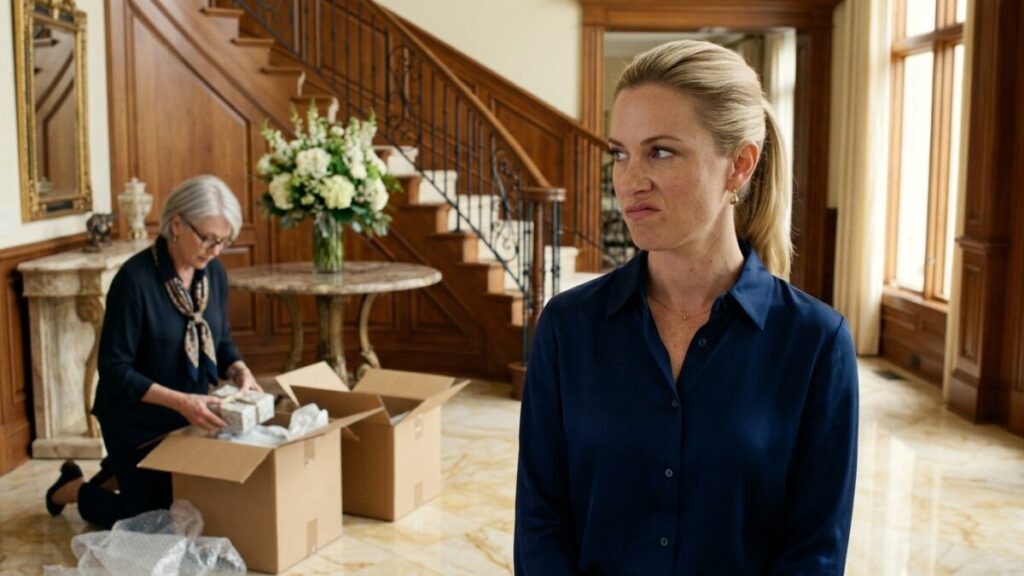
The table was fully set. Glasses, plates, napkins. Olivia had her phone face-down beside her fork. Jessica was mid-sentence. David was in my chair. It was a small thing, that last detail, the kind of thing that shouldn’t matter as much as it does. But it sat under my skin the same way the laughter had.
Michael looked up at me with a grin still on his face. I watched it leave. Not all at once, the way a light goes out, but the way a tide pulls back, slowly enough that you can see the shape of what the water was hiding.
He knew I wasn’t supposed to be there. He knew his mother was supposed to have time. Time to clean herself up, time to compose a version of the afternoon that didn’t require explaining, time to absorb whatever had happened and present it to me as something that was already resolved and smaller than it was.
Olivia’s fork stopped halfway to her mouth. Jessica’s fingers tightened on her glass stem. David leaned back with the expression of a man deciding whether to be friendly or offended.
I set the phone face-up on the counter. The 911 call was still active on the screen.
“Nobody moves,” I said.
Nobody did.
David spoke first, because men like David have spent their lives using the first sentence of any confrontation to establish that they are in charge of its terms. “Now hold on,” he said. “This is family business.”
I looked at him steadily. “Sit down.”
He sat. His pride caught up with him a second later, but by then the moment had passed.
Michael rose halfway from his chair. “Dad, you’re overreacting. She fell, it was—”
The dispatcher’s voice came through the phone asking whether everyone in the house was safe.
“My wife is injured,” I said, not taking my eyes off my son. “The individuals who were pressuring her to sign property transfer documents are in front of me.”
Olivia began to cry. It was not the kind of crying that comes from remorse, from seeing someone hurt and feeling the weight of it. It was the crying of someone who has just understood that a plan has failed and the failure has witnesses. Panic looks for exits. Compassion looks toward the person who is bleeding.
Sarah’s voice came from the living room, still quiet, still careful. “Check the second page.”
The kitchen changed.
Michael’s eyes snapped to the folder on the coffee table. Olivia said his name under her breath.
I walked back to the documents and looked. Under the deed draft was a witness page with Olivia’s name typed beside a blank signature line. And behind that, a second authorization form directing the proceeds from any sale of the property into a business account that had not been mentioned to Sarah. Not once. Not in three months of pressure and politely reframed requests. Not ever.
Popular Posts
→- 1
- 2
- 3
- 4




Recently Viewed
Stories you read recently will appear here.