I came home two days earlier than planned, a bottle of red wine and a box of pastries on the passenger seat, a small surprise I had been looking forward to since the conference ended Thursday morning instead of Saturday night.
After more than twenty years of marriage, I still loved the feeling of watching Sarah’s expression change when I walked through a door she thought would stay closed until Sunday. It was one of those private pleasures that belong only to long marriages, the specific joy of knowing someone’s face well enough to anticipate how it rearranges itself for you. I did not call her. I did not text our son. I changed my ticket, took the first flight out of Denver, and drove home from the airport in the kind of quiet contentment that felt, for those forty minutes, like everything I had ever wanted from a life.
I pulled into the driveway at five-eighteen on a Friday evening and saw Michael’s SUV parked at the curb.
That should have made me smile. The four of us sharing a dinner I hadn’t expected, Sarah’s good dishes out on a weeknight, Michael’s laugh filling the kitchen the way it always had. That should have been the best version of an already good day.
It didn’t make me smile.
There are things you register before your mind lets you understand them. The porch lights were on even though the sun hadn’t fully set. The front door was not latched. The house smelled of lemon floor cleaner and warm carpet and underneath both of those something else, something older and metallic that I recognized without wanting to.
Copper.
I pushed the door open with my shoulder, bottle in one hand and pastries in the other, and I saw my wife on the floor.
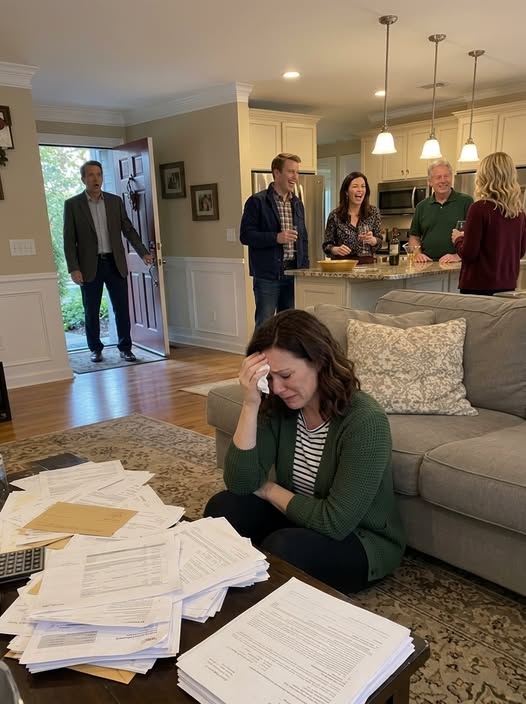
Sarah was sitting upright against the sofa with one hand pressed to her right eyebrow. Blood had trickled down her temple and soaked into the collar of her cream-colored shirt. It had dripped onto the anniversary rug, the one she bought for our twentieth, the one she always made me step around when my shoes were wet. Her knees were pressed together. Her shoulders were drawn forward. She looked like a woman trying to take up as little space as possible in the living room she had spent half her adult life making comfortable for everyone around her.
The wine bottle slipped from my hand onto the entryway table. The pastry box hit the floor.
Sarah looked up at me and her mouth opened, not to ask for help, not to cry out, but to explain. Before I could ask anything. Before I could even speak. She wanted to explain. That was the first thing that broke my heart, and it had nothing to do with blood.
I went to my knees beside her.
“Sarah. What happened?”
She tried to shake her head and grimaced.
From the kitchen came laughter. Michael’s laugh, the one I had heard at Little League games and graduation parties and every loud holiday for sixteen years, the one that used to fill the garage when he was a teenager pretending to know more about engines than I did. I heard Olivia’s quieter chuckle underneath it. Then David’s voice, deep and satisfied, the voice of a man who believed that confidence and correctness were the same thing. Then Jessica said something I couldn’t quite make out, and then there was another burst of noise from the table, silverware and voices and the ordinary sounds of people who were comfortable.
That sound was happening ten paces away from my wife’s blood on the rug.
A house can hold two truths at once. Sometimes that is the thing that makes it unbearable.
I touched Sarah’s wrist gently. “Who did this?”
She swallowed. Her eyes moved toward the kitchen.
That was enough, but she kept going. Her voice came out hoarse and too careful, the voice of someone who has been choosing their words for a long time. “I tried to get rid of them,” she said. “I told them I wouldn’t sign.”
I saw the documents then. On the coffee table, open beside a black pen. Not bills. Not family photos. Not any of the ordinary papers that live on family coffee tables. A county recorder cover sheet. A notary acknowledgment page. A deed transfer form. And beneath those, a second authorization page I couldn’t quite read from where I knelt.
The beach house.
Sarah’s mother had left it to her four years ago, a small place on the Oregon coast that smelled like salt and cedar and the particular kind of quiet that only older houses hold. It wasn’t grand. It wasn’t worth a fortune. But it was the last physical thing that connected Sarah to her mother, and that made it worth everything.
Michael had started asking about it three months ago. Politely at first. He said David’s restaurant just needed a little bridge money, a temporary thing, and the beach house was sitting half-empty most of the year anyway. He said Sarah was being emotional. He said the practical thing was obvious to everyone willing to look at it clearly.
I had said no. Sarah had said no. Michael acted as though our refusal were a personal wound inflicted on him, as if a parent maintaining a boundary were a form of aggression.
After that, the calls got shorter. The messages got colder. Olivia stopped sending Sarah pictures from Sunday dinners. David started calling the beach house an asset, which told me everything I needed to know about how he had been framing it to my son. Not an inheritance, not a memory, not a piece of a woman’s mother. An asset. A liquid resource waiting to be unlocked by people with better uses for it.
Popular Posts
→- 1
- 2
- 3
- 4




Recently Viewed
Stories you read recently will appear here.