My Mother Fed a Homeless Teenager While We Barely Had Enough to Eat—Years Later, Her Final Request Revealed a Secret I Never Imagined
I was eight years old when my mother began giving our best food to a homeless teenage boy, even though our family could barely afford groceries.
Sometimes he received roasted chicken while my little brother and I ate watery soup. Other days, Mom carried freshly baked bread to him while insisting she wasn’t hungry herself.
I grew to resent that boy more than anyone.
Then, years later, as my mother lay in a hospital bed during her final hours, she used her remaining strength to whisper one unexpected request.
“Promise me you won’t abandon Gabriel.”
Even then, she was thinking about him.
I reluctantly agreed.
But after her funeral, when I finally went searching for the young man I’d blamed for so much of my childhood unhappiness, I discovered someone entirely different waiting outside our old house.
And what he revealed about my parents changed everything I thought I knew.
My name is Rachel Miller, and I grew up in the small town of Bluebell Valley.
My father died when I was eight, leaving Mom, Abigail, to raise my younger brother and me while struggling with overdue bills and overwhelming grief.
Every grocery purchase mattered.
Every meal required careful planning.
Yet almost every afternoon, Mom prepared a generous plate of food, wrapped it carefully, and carried it toward the municipal dump beyond Oakridge Avenue.
That’s where Gabriel lived.
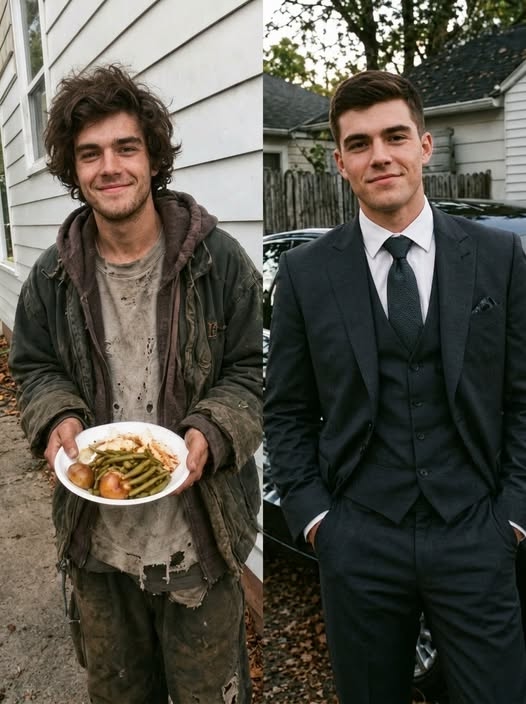
He was around seventeen, thin and exhausted, and slept beneath a makeshift shelter constructed from old roofing materials.
He had no family nearby and nowhere else to go.
Mom never explained why she seemed so determined to help him.
I only knew that whenever our kitchen had something special, Gabriel somehow received it.
One Saturday afternoon, I smelled apple pie baking.
It was my favorite dessert.
For the first time in weeks, I felt excited about dinner.
But when I entered the kitchen, Mom was wrapping the freshly baked pie.
“Are we having that tonight?” I asked eagerly.
She hesitated.
“No, sweetheart. I’m taking it to Gabriel. There’s vegetable soup on the stove for us.”
I stared at her.
“Why does he get pie when we barely have enough food?”
My frustration spilled out before I could stop myself.
Mom’s expression changed.
“Rachel, don’t speak about Gabriel that way.”
“But we’re your children!”
Her voice became unusually stern.
“That’s enough. I don’t want to hear you say something like that again.”
Then she carried the pie outside.
I stood alone in the kitchen, feeling rejected.
In my eight-year-old mind, there was only one explanation.
My mother loved Gabriel more than she loved me.
After that afternoon, I avoided him whenever possible.
Sometimes Gabriel waved as I walked home from school.
Once, he offered me a small wooden bird he’d carved himself.
I dropped it near his feet.
He quietly picked it up.
“You don’t have to like me,” he said gently. “But please be careful crossing the road. Your mother worries about you.”
I ignored him.
At the time, even his kindness felt like another attempt to win my mother’s affection.
Years passed.
Eventually, Gabriel disappeared from the neighborhood.
Mom never told me where he’d gone.
After graduating, I moved three hours away to Pine Ridge, determined to build a life that didn’t involve our painful family history.
Our relationship became distant.
At first, we spoke on birthdays.
Then holidays.
Eventually, only when one of us felt guilty enough to make the first call.
Eleven years later, I received a phone call at work.
A nurse from St. Jude Regional Hospital told me my mother had suffered a serious stroke.
Her condition was critical.
I left immediately.
When I reached her hospital room, Mom looked smaller than I remembered.
I sat beside her and took her hand.
“I’m here, Mom,” I whispered. “I’m sorry we lost so much time.”
Her fingers tightened around mine.
I promised to handle the house, the bills, and anything else that needed attention.
Then she struggled to speak.
“Rachel… please…”
I leaned closer.
“I’m listening.”
Her voice was barely audible.
“Don’t abandon Gabriel. Promise me.”
For a moment, the old resentment returned.
Even now, after all these years, Gabriel was the person she wanted me to remember.
“I promise,” I whispered.
Mom closed her eyes.
She passed away later that day.
After the funeral, I prepared a pot of beef stew, packed some fresh bread, and drove toward our old neighborhood.
I intended to find Gabriel, give him the food, and fulfill my promise.
I expected to search near the dump or ask neighbors if they’d seen him.
Instead, an expensive black SUV was parked outside Mom’s house.
Beside it stood a well-dressed man wearing a dark wool coat.
When he saw me, his eyes filled with tears.
“I wasn’t sure you’d come,” he said.
I studied his face.
There was something familiar about his expression.
Then I recognized him.
“Gabriel?”
He nodded.
I looked from his expensive vehicle to his polished appearance.
“What happened to you?”
He glanced toward the house.
“Your mother never told you the whole story, Rachel.”
I felt a chill.
“What story?”
Gabriel took a slow breath.
“Before she died, your mother asked me to keep one final secret. But it actually began with your father, long before you and I ever met.”
Part 2: The Secret My Father Left Behind
I stood beside Gabriel’s vehicle, struggling to understand how the homeless teenager I remembered had become the successful man standing before me.
“Why didn’t Mom ever tell me about you?” I demanded.
Gabriel opened the back of his SUV and removed an old metal box.
It was dented and scratched, with a small brass lock.
He placed it carefully on the hood.
“Your father knew my family,” he began.
I stared at him.
“My father?”
Gabriel nodded.
Years earlier, his mother, Clara, had worked cleaning offices at my father’s factory.
Popular Posts
→- 1
- 2
- 3
- 4




Recently Viewed
Stories you read recently will appear here.