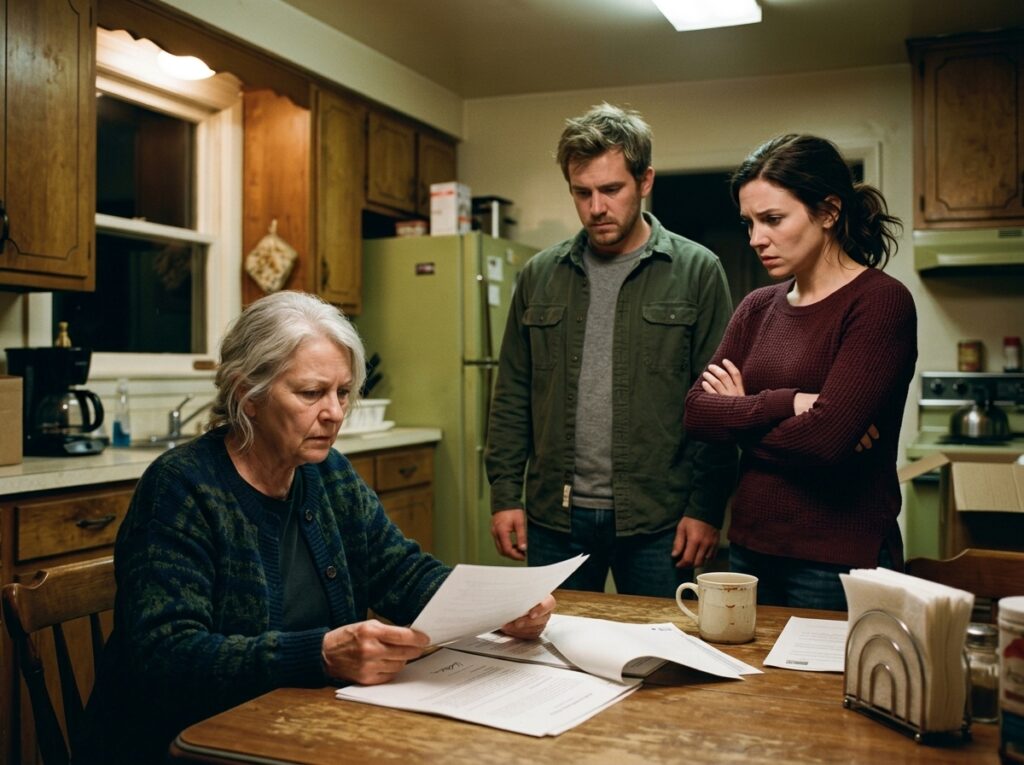
I kept the utility confirmations.
The grocery receipts.
The vet bill for Murphy’s ear infection.
The printed insurance payments.
The check stubs.
The pharmacy receipts.
The lawn service invoice.
I kept them in a brown ledger with blue ink, the same kind I used when Henry and I were first married and every dollar had a place to stand.
Jenna thought I kept coupons because I was old.
I kept records because I was awake.
One Saturday morning, I came home from the grocery store carrying two paper bags and a gallon of milk. My hands ached. The Arizona oranges Jenna liked had gone up again, but I bought them anyway because she had mentioned wanting them.
She was in the kitchen when I walked in.
Brian stood by the coffee maker, staring into his mug like answers floated there.
Jenna did not offer to take a bag.
She folded her arms.
“Ruth,” she said, “we need to talk.”
There is a way people say that sentence when they have already decided you are the problem.
I set the groceries on the counter.
“What is it?”
Jenna looked at Brian.
He did not look at me.
Then she said it.
“You live here free. That has to change.”
The milk carton was still cold against my wrist.
“Free?”
“Yes,” she said. “Free. We gave you a place to stay. We have a mortgage. We have bills. We know you have money from selling your house.”
I looked at my son.
“Brian?”
He rubbed the back of his neck.
“Mom, nobody is attacking you.”
Jenna gave a small laugh.
“No, we’re being fair. Either contribute properly from your savings or start packing.”
Properly.
That word sat between us like a receipt no one wanted to read.
I thought about the grocery bags.
The July electric bill.
The water notice.
The dog food.
The dinners.
The insurance confirmations printed and tucked into the brown folder in my dresser.
I thought about Henry, who had worked thirty-nine years at the same plant and put money away one careful dollar at a time so I would never have to beg anyone for a roof.
Then I said one word.
“No.”
Jenna blinked.
Brian looked up.
I picked up the milk and placed it in the refrigerator.
Jenna’s mouth tightened.
“Then you should start packing.”
So I did.
Not loudly.
Not dramatically.
I went to the spare bedroom, opened the closet, and took out the two suitcases I had never fully unpacked.
Jenna followed me down the hall, her slippers whispering against the floor.
“You’re really going to make this into a scene?”
I folded my cardigan.
“No.”
“You can’t just leave because we asked for responsibility.”
I placed Henry’s photo in my tote bag.
“I’m leaving because you clarified the arrangement.”
Brian stood in the doorway, pale and silent.
“Mom,” he said, “where would you even go?”
That was when I took the small white envelope from my purse.
Inside was a closing packet for a one-bedroom condo near the library.
Nothing grand.
Nothing fancy.
Just a sunny kitchen, a little patio, and a front door that opened only for people I invited.
“I closed yesterday,” I said.
Jenna stared at the envelope.
Brian’s lips parted.
“You bought a place?”
“Yes.”
“With cash?”
“With my money.”
The sentence changed the room.
Not because it was cruel.
Because it was clean.
For two months, I had been searching quietly.
The realtor was a woman named Denise who had sold my ranch house and called me every Friday afterward, not to chase a commission but to ask whether I was really all right.
The first time she showed me the condo, the afternoon sun fell across the kitchen tile in a warm square. The cabinets were older but solid. The patio faced a maple tree. The bedroom had enough room for Henry’s cedar chest.
I stood in the doorway and felt something I had not felt since moving into Brian’s house.
Privacy.
Not loneliness.
Privacy.
The kind that lets you exhale.
I made an offer that same day.
I did not tell Brian.
That was not revenge.
That was protection.
By Sunday afternoon, movers carried my boxes out.
Jenna watched from the hallway with her arms folded, but she did not call me free again.
Brian tried to help with one box, then put it down when he saw it was heavier than he expected.
“You should have told me,” he said.
I looked at him.
“I waited for you to ask how I was living here. You never did.”
He opened his mouth.
No words came.
At the front door, I removed their spare-room key from my key ring and placed it on the entry table.
Then I picked up the brass key to my new condo.
Brian whispered, “Mom, I didn’t think you’d actually go.”
I looked at him.
“That was the problem.”
Three weeks passed.
My new kitchen smelled like lemon soap and quiet.
I drank coffee by the patio door.
I bought flowers for myself.
I hung Henry’s picture in the hallway and placed his cedar chest at the foot of my bed.
I found the library, the little grocery store with good peaches, and a walking path where older women in bright sneakers passed me every morning and nodded as if we had agreed to survive something.
I slept through the night for the first time in two years.
Not because I missed Henry less.
I never did.
But because no one sighed outside my bedroom door.
No one used my age as a reason to treat me like furniture.
No one called a room mine only when they wanted me to clean it.
My condo was small, but every inch of it belonged to peace.
Then the calls started.
First Brian.
Then Jenna.
Then Brian again.
I let them ring until the fourth message.
His voice sounded smaller than I remembered.
Popular Posts
→- 1
- 2
- 3
- 4




Recently Viewed
Stories you read recently will appear here.