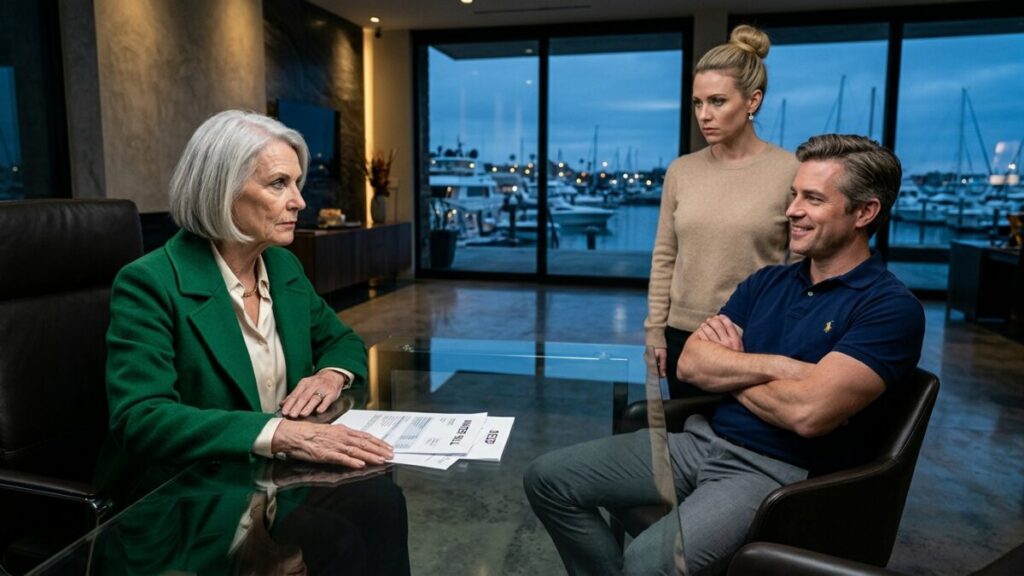
“I know,” I said, “but I need closure on this chapter. I need to see him one last time and say everything I need to say.”
“Then I will go with you,” Sarah said, “and we will legally record everything.”
Two days later, I entered the prison visiting room. Mark was sitting on the other side of the glass—emaciated, deep circles under his eyes, uniform wrinkled.
I picked up the phone. He did the same.
“Mom,” his voice broke, “thank you for coming.”
“I didn’t come for you, Mark,” I said. “I came for me—for closure. Please listen to me.”
“I was desperate,” he said. “The debts were killing me. The collectors were threatening to hurt my family. I panicked and made bad decisions.”
“Bad decisions,” I repeated. “Mark, you planned my murder. You celebrated the idea of my death. You stole from me for years.”
“I know,” he whispered. “I know. And I regret it. Every second here, I regret it. But Mom, I’m still your son. Your only son. You can’t abandon me.”
“You abandoned me first,” I said. “The day you decided my death was worth less than your financial comfort.”
“What can I do for you to forgive me?”
I looked at him for a long time.
“Nothing,” I said. “There is nothing you can do. Forgiveness doesn’t work like that. It is not earned with pleas or empty promises. It is earned with real change—with genuine remorse—with time and actions. And you have none of those things.”
“Please, Mom.”
“Goodbye, Mark. This is the last time we will see each other. I will live the time I have left in peace—without your toxicity, without your lies.”
I hung up the phone while he shouted something inaudible from the other side of the glass.
I left that prison feeling as if a thousand-pound weight had been lifted from my shoulders.
The following months were a whirlwind of legal proceedings, hearings, and testimonies. Every week brought new revelations about the depth of Mark’s betrayal.
Sarah discovered he had forged my signature not only on bank documents, but also on sales contracts for two additional properties I didn’t even know he had sold. The money—another three hundred thousand—had gone straight to cover more gambling debts and to the offshore account.
“In total,” Sarah explained during one of our meetings, “Mark stole approximately one point two to two million dollars from your estate in different ways over three years.”
“One point two million,” I repeated, still processing the magnitude of the theft. “Three years—stealing from me right under my nose. And he would have kept doing it if the accident hadn’t accelerated his plans.”
“In a twisted way,” Sarah said, “that accident saved you from additional years of theft.”
It was a twisted way of seeing things.
But she was right.
The main trial began in October, six months after the arrest. The room was full of reporters, curious onlookers, and some of my employees who wanted to show their support.
Rachel testified first, just as she had promised. With fabricated tears and a trembling voice, she told how Mark had convinced her to participate in the plan.
“He said his mother was suffering,” she claimed, “that it would be an act of mercy to accelerate her death.”
She lied shamelessly.
“I didn’t want to, but I was afraid to contradict him. Mark can be very intimidating when he gets angry.”
Mark’s defense attorney tried to discredit her testimony, pointing to the recordings where she clearly participated with enthusiasm, but the damage was already done. The jury had heard someone close to Mark confirm his intentions.
Frank, the hospital orderly, testified next. He admitted Mark had offered him fifty thousand to administer lethal doses of morphine.
“He showed me bank transfers,” Frank explained. “Ten thousand upfront, the rest after she died. He said it would be quick, that no one would suspect because she was already sick.”
“And you accepted?” the prosecutor asked.
“At first, I thought he was joking,” Frank said. “But when I saw the money in my account, I got scared. I went straight to the authorities. I’m an orderly. My job is to save lives, not take them.”
Mark’s attorney tried to argue that Frank had attempted to extort his client, but the recordings of their conversations proved otherwise. Mark had initiated the contact, offered the money, and insisted on the plan.
When it was my turn to testify, the silence in the room was absolute. I walked toward the stand with my head held high, though my legs were trembling.
The prosecutor guided me through the events. I told them about the accident, about the false diagnosis Dr. Henry had given with my consent, about Mark’s reaction to hearing I only had three days to live.
“Can you describe that reaction for the jury?” the prosecutor asked.
“He smiled,” I said. “It wasn’t a nervous smile or one of shock. It was a smile of relief and satisfaction.”
I swallowed hard.
“When the doctor left, my son leaned toward me and whispered, ‘You’re finally going to die, Mom. All your money will be mine and my wife’s. It’s about time.’”
I heard murmurs of disbelief in the room. Some jury members looked at me with compassion.
“How did you feel when you heard that?” the prosecutor asked.
“Like my heart had been ripped out,” I said. “For thirty-five years, I was his mother. I raised him alone after my husband died. I sacrificed everything to give him the best life possible. And the moment he thought I was dying, his only concern was when he could collect his inheritance.”
Tears streamed down my face. I didn’t try to stop them. They were real.
Every single one of them.
The defense attorney tried to attack my credibility during cross-examination.
“Ms. Helen, isn’t it true that you orchestrated this elaborate plan to trap your son—that you lied about your medical condition intentionally?”
Popular Posts
→- 1
- 2
- 3
- 4




Recently Viewed
Stories you read recently will appear here.