One I had written to my husband after our first snowfall there. No one clapped. No one needed to. After they left, I stayed behind to lock up. I stood in the doorway and looked around at the room we had made. The soft light, the worn couch, the warmth that had nothing to do with the thermostat.
It was small. It wasn’t perfect, but it was a kind of home, and I had built it from the ashes of everything they tried to take. That morning, a small envelope arrived in my mailbox. No return address, no handwriting, just my name typed neatly in the center. I carried it back upstairs, placed it on the kitchen table, and stared at it for a while.
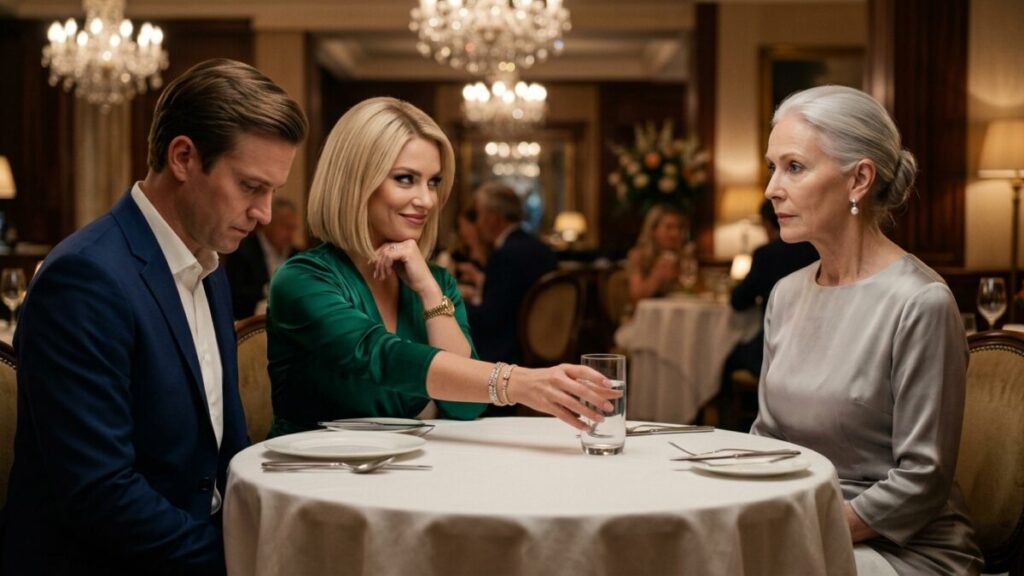
I had a feeling what it was. Not dread, just a quiet bracing. Inside was an invitation. Sylvia was hosting a retirement dinner for herself, a formal gathering on the same yacht they had used for that birthday party. It included Mitchell and Desiree’s names in the RSVP section. I traced the gold foil print with my thumb and let out a short, tired breath.
It wasn’t the invitation that stung. It was the silence before it. The fact that once again they hadn’t spoken to me directly. This wasn’t about closure. It was a performance, a display, and I had no interest in attending another act in their play.
I walked over to the closet and pulled out a small box tucked behind my coats. It held my husband’s watch, a worn photograph of the cabin porch, and a sealed letter I had written a year ago, but never sent. I opened it and read it quietly to myself. It was addressed to Mitchell.
In it, I had written about the smell of cedar and pine sap in early spring, about the mornings when he was ten, fishing quietly with his father, not yet old enough to know the weight of grown-up choices. I wrote about love and how it can harden into control when we confuse proximity with connection.
That letter reminded me why I started the fund, why I rebuilt my life piece by piece, not to retaliate, but to recover. I placed the invitation in the box next to the letter and closed the lid. Later that afternoon, I met Lenora and Mavis at the community center. We were setting up for our new winter housing initiative.
Foldable cots, warm blankets, little welcome bags with socks and cocoa. There was a small line forming at the door. One woman had frost on her coat sleeves. Another had her belongings in a suitcase with a broken wheel. We didn’t have speeches or clipboards, just soft voices and open hands.
One of the newer volunteers, a college student, asked me how I kept going, how I didn’t let anger shape everything I did. I told her that I used to carry anger like a second spine, stiff, rigid, always ready to hold me upright. But over time, I realized it made me unmovable. So I let it soften, not disappear, but shift.
That night, I stood in the hallway of the shelter and watched two women laugh over a jigsaw puzzle, their voices low, but filled with something that sounded like the beginning of safety. Back at home, I made tea, sat at my kitchen table, and began writing a letter to Rosalie, the former librarian who now ran weekly reading sessions in our lounge.
I told her about the invitation, and how proud I was that I had no desire to attend. I had built something real, something mine, and there was not a yacht on this earth that could carry me back to who I used to be. That spring, the lake thawed early. I drove up alone, winding through the familiar back roads, passing the same crooked fence post that marked the turnoff I had known for decades.
The air smelled of pine needles and wet earth. I hadn’t been back here since the day they told me it was gone. But now it wasn’t theirs to take anymore. It had taken nine months of legal work, a retired judge’s recommendation, and one quiet conversation with the new buyers, who had purchased the place, unaware of the betrayal behind its sale.
After learning the truth, they agreed to a lease-to-buy transfer. The cabin wasn’t mine on paper just yet, but it was back in my hands in every way that mattered. I stepped onto the porch and ran my hand along the wooden railing, the one Mitchell and his father built the summer before his high school graduation.
It had been freshly sanded, but the grooves from old nails still whispered their history. I unlocked the door, walked inside, and stood in silence. Nothing flashy, just the creak of the old floorboards, the faint scent of cedar. The kitchen counter where my husband used to cut apples.
The sofa where I had read books with Mitchell when he was small before all the noise and rolls and pride got in the way. I unpacked a small bag. Just enough for a few days. Then I lit the fireplace, made a pot of coffee, and sat down in the same chair I always did, facing the water.
There were still patches of ice floating far out near the middle. The wind blew steady and low. Later that evening, I wrote a short letter, not to send, just to write. I told Mitchell I wasn’t angry anymore. I told him I understood now that sometimes people cling to what makes them feel important, even if it costs them someone who once loved them without condition.
I wrote that I hoped someday he would look in the mirror and see the boy who used to skip rocks on this lake, not the man who had forgotten how to listen. Then I folded the letter, placed it in the drawer by the window, and left it there. Some things don’t need to be mailed. When I left the next morning, I locked the cabin and placed the key in my coat pocket.
Popular Posts
→- 1
- 2
- 3
- 4




Recently Viewed
Stories you read recently will appear here.