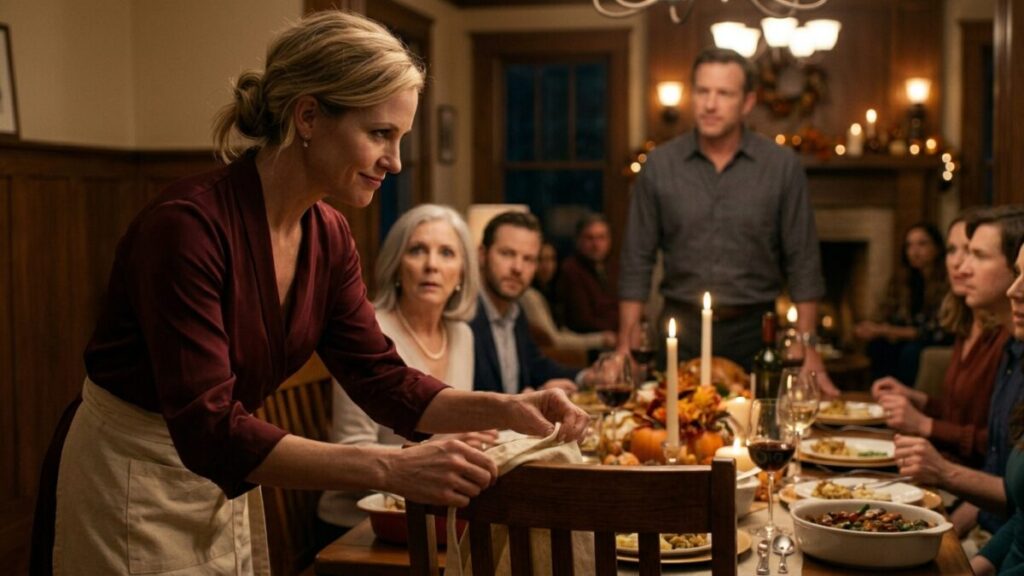
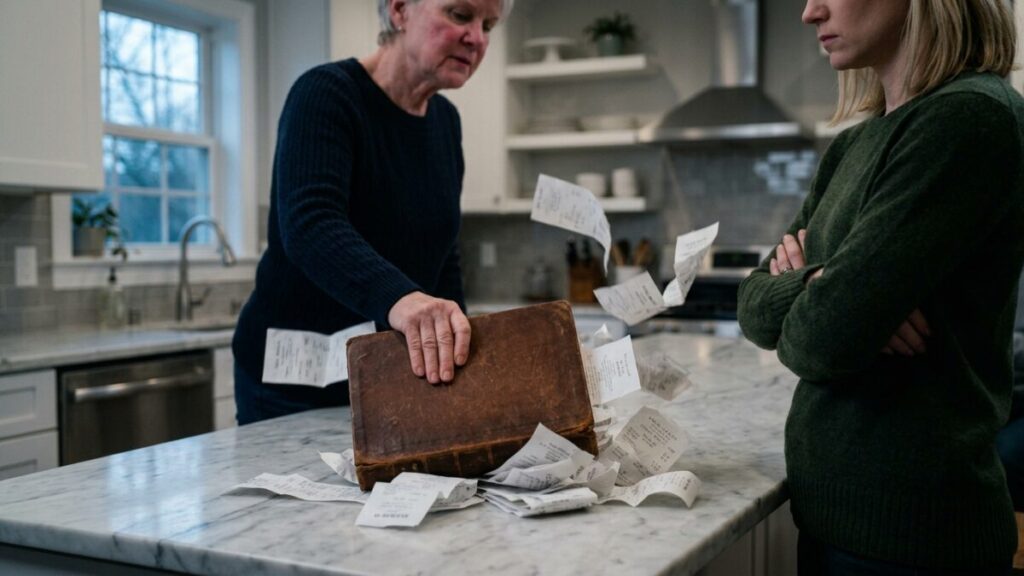
There was laughter, shyness, even a few tears. And it was all real. Honest in a way I hadn’t experienced in a long time. I shared my own story, not the full version, just the part about feeling erased, about having something I built handed away like it was nothing.
I didn’t name Desiree or Mitchell, but the pain in my voice carried enough shape for them to understand. They listened, then June spoke, then Edgar. One by one, the room filled with memory. It was like breathing in fresh air after months underground. When I walked home that evening, I passed by a boutique window.
A soft scarf in the display caught my eye. Forest green with copper stitching. I stood there longer than I expected, watching how it moved slightly under the ceiling fan’s breeze. I went inside and bought it. Not because I needed it, but because I wanted to choose something just for me.
Later that night, as I folded the scarf into my drawer, I caught sight of the invitation again. I pulled it out, set it on the table, and opened my laptop. Instead of writing to Desiree, I wrote to Marci. I told her I wanted to expand the circle into a monthly event, include workshops, maybe even an exhibit.
I could offer to teach a session on legacy planning. Not the legal kind, the personal kind. How to leave behind a life that couldn’t be rewritten or stolen. As I hit send, I realized something had shifted. I wasn’t trying to get back what I had lost anymore. I was building something new.
And this time, no one could sell it out from under me. The call came just after eight on a Thursday evening. I had just finished reviewing the final draft of our monthly storytelling flyer when my phone buzzed on the counter. It was from a number I didn’t recognize, but something in me knew to pick it up.
It was Sylvia. Her voice was lower than I remembered, slower, like she had rehearsed every word, but still wasn’t sure she believed them. She said Desiree had been going through a difficult time, that Mitchell was under pressure at work, that the vow renewal had not gone as smoothly as they hoped.
She didn’t say sorry, not directly, but she did mention the cabin. She said it had been a complicated decision that Desiree thought I would understand in time, that it wasn’t personal, just practical, just a piece of property. I sat on the edge of my bed, listening to that word echo in my head.
Just property. Sylvia paused, then asked if I’d be willing to meet for lunch. She said she had something she wanted to return. Her voice caught slightly on the word return, like it weighed more than it should. I agreed, not out of curiosity, not for closure, but because I was ready to look her in the eye and feel nothing.
We met at a quiet diner two days later. She arrived wearing a pale blue coat I had once admired. She looked tired, not aged, just worn, the way people look when they know they’ve crossed a line they can’t uncross. She slid an envelope across the table. I didn’t reach for it. I waited.
She said she found some old letters in the cabin safe. Letters I had written to my husband years ago. Ones I thought had been lost in the fire we had during our first winter there. Apparently, they had been tucked away, sealed in a weatherproof pouch I didn’t even know he had used.
She said Desiree was planning to throw them out, thought they were just scrap paper, but Sylvia had opened one and kept them. There was no apology in her tone, just explanation. I took the envelope. It was heavier than I expected. She reached for her coffee, but didn’t drink. Then, softly, she said something I hadn’t braced for.
She said she missed me. I didn’t respond. I didn’t smile or nod. I simply stood, thanked her for the letters, and walked out. The air outside was sharp, cold enough to pull you back into yourself. I held the envelope against my chest and kept walking.
At home, I opened the letters slowly, one by one. The ink had faded in places. My handwriting was uneven, sometimes rushed, sometimes careful. Each word brought back pieces I had forgotten. Mornings by the lake, the sound of his laugh when the heater broke.
The time we made soup from what we had left in the pantry and still called it a feast. I read them all in one sitting. When I finished, I didn’t cry. I felt something steadier, like grounding, like gravity. I knew what I needed to do next. Not for revenge, not to prove a point, but to mark a boundary.
The next morning, I reached out to the lawyer who had helped me with my apartment lease. I asked about creating a trust, something small, something focused. By the afternoon, I had the name for it, the Cedar Table Fund, a place for women over sixty who had been displaced, erased, sold out, women who needed a place to sit and be heard.
And this time, the deed would carry only my name. That morning, I ironed my best slate-gray blouse and laid out the envelope from the attorney’s office beside it. The apartment was quiet. I could hear the low hum of the radiator and the distant sound of someone dragging a trash bin across the parking lot.
I moved slowly, but each step carried intention. The restaurant I chose wasn’t glamorous. It was the same one where Mitchell used to take me when Desiree was pregnant with Eli. A small diner on the east side, where the booths still had cracked red vinyl, and the servers called everyone sweetheart. I had made a reservation under my name.
Popular Posts
→- 1
- 2
- 3
- 4




Recently Viewed
Stories you read recently will appear here.