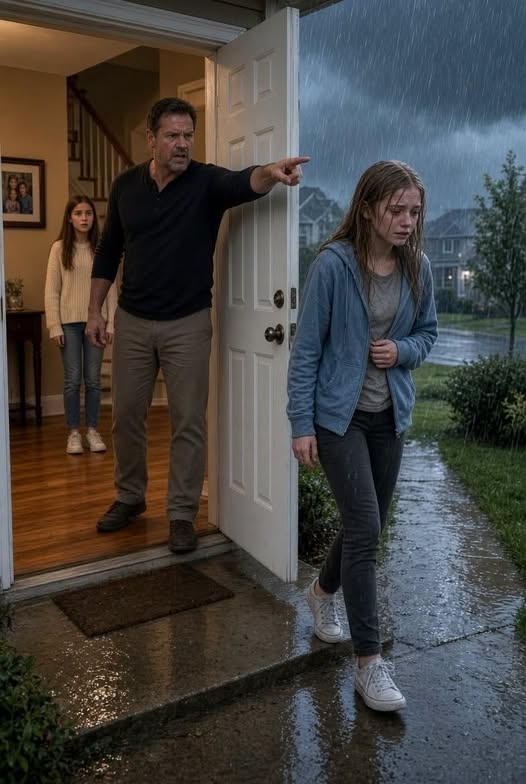
The deadbolt did not merely slide into its brass strike plate; it dropped with the mechanical finality of an iron portcullis.
In the foyer behind me, the bevelled glass panel shuddered against its oak frame. Rain struck the outer pane like handfuls of river gravel slung hard against the dark, and through that warped distortion, I saw only the silhouette of my father, Paul, his broad shoulders squared in the rigid posture he used whenever he convinced himself that cruelty was simply discipline under another name. Beside him, slightly recessed into the hallway’s amber light, Karen stood with her hands tucked inside the sleeves of her beige cashmere cardigan—a woman whose stillness was never peace, only the calculated patience of someone waiting for a trap to spring.
“Don’t look back through that glass, Maya,” his voice had reached me before the heavy timber shut out the house entirely, muffled yet jagged at the perimeter. “You made this choice when you brought that poison under my roof. I don’t need a sick daughter. I don’t need your mother’s ghost rotting out my life.”
Then the latch turned. The heavy bolt engaged.
The porch roof offered three feet of shelter before the eaves surrendered to the October gale. The wind had a teeth-baring bite that belonged to late November, coming down off the spine of the Blackwood Ridge to tear the last crimson leaves from the sugar maples and paste them, wet and rotten, against the bluestone walk. I was wearing an unzipped gray cotton track jacket over a thin jersey shirt. My socks were already sponging up rainwater through the canvas seams of my worn-out high-tops. Clutched against my ribs, hooked by one fraying nylon strap, was my high-school knapsack—stuffed not with the paraphernalia Karen had shrieked about over the roast chicken, but with an unfinished chapter on quadratic functions, an overdue library copy of Tess of the d’Urbervilles, and two bruised clementines I had forgotten to eat at noon.
I did not knock. I knew the geometry of that house better than the lines on my own cold palms. If I knocked, Karen would come to the door with her phone already glowing, whispering about trespass and boundary enforcement, her low, reasonable voice vibrating with that terrible, venomous pity she had spent fourteen months perfecting. If I stayed on the porch, Paul would eventually emerge with the porch broom to sweep away the mess I made by existing outside his sightline.
I turned my back on the amber light and stepped off the stone into the dark.
The driveway ran four hundred yards down to Old State Route 9, flanked by hemlocks that groaned in the gusts like old ships taking water. My breath came in short, white bursts that disappeared before they could warm my chin. My fingers, curled through the backpack’s nylon webbing, were already losing their prickle, settling into that dull, rubbery numbness that signals the body’s retreat inward—the blood pulling back from the useless periphery to protect the stubborn, thumping heart.
By the time I reached the mailbox at the county road, my thighs were numb where the saturated denim slapped against them with every stride.
Route 9 had no sidewalks, only a strip of crushed aggregate and weed-choked ditch between the blacktop and the barbed-wire fences of the Miller dairy farm. Every semi-truck that thundered south toward the interstate threw up a blinding plume of freezing spray that hit me like a bucket of ditch water, driving needles through my shirt and plastering my dark hair across my forehead and lips. I couldn’t lift my phone to call my aunt in Brattleboro because the phone was sitting on the corner of the dining room table back on High Ridge Lane—confiscated by Paul twenty minutes before the door clicked, seized as evidence of illicit contact while Karen nodded from behind the salt cellar.
Just keep moving toward the bridge, I told myself. My jaw was locked so hard that my molars ground together, sending dull sparks of ache behind my ears. Four miles to the Sunoco at the bypass. Four miles. There’s a heated vestibule. There’s a payphone. Somebody will have a quarter, or the clerk will call the county desk.
The road did not stay flat. It climbed the shoulder of Roundtop Hill, where the trees fell back to let the wind hit the tarmac broadside. My knees began to hitch, uncoordinated and stiff, like rusted hinges refusing to close. Once, my left foot slipped on a patch of wet birch mulch; I went down hard on the gravel shoulder, the stones digging through the wet fabric of my jeans into the cap of my knee. I didn’t cry. Tears required warmth, and my tear ducts felt dry, crusted with the cold sting of sleet that had begun to mix with the driving downpour.
I got up, dragged the backpack back over my right shoulder, and kept walking.
By the third mile, the sound of the storm changed. It no longer sounded like wind in the branches; it sounded like a continuous, low-frequency hum, vibrating inside the skull itself, accompanied by a strange, honeyed lethargy that whispered through my ribs. The shivering, violent and exhausting for the first forty minutes, abruptly stopped.
That’s better, a detached voice remarked somewhere behind my eyes. The cold isn’t so bad now. It’s just heavy.
The ditch to my right looked soft, lined with a thick mattress of russet fern and dead chicory. A pair of twin halogen lights crested the hill behind me, sweeping high beams through the spray, painting long, skeletal shadows of the guardrail posts across the asphalt. I didn’t turn around to flag them down. My shoulder refused to lift; the arm felt like a dead branch lashed to my torso with hemp rope.
The car hissed past, its tires parting the standing water with a sound like tearing silk. The red taillights hovered for three seconds in the mist, vanished around the sweeping bend toward the creek, and took the light with them.
Popular Posts
→- 1
- 2
- 3
- 4




Recently Viewed
Stories you read recently will appear here.





