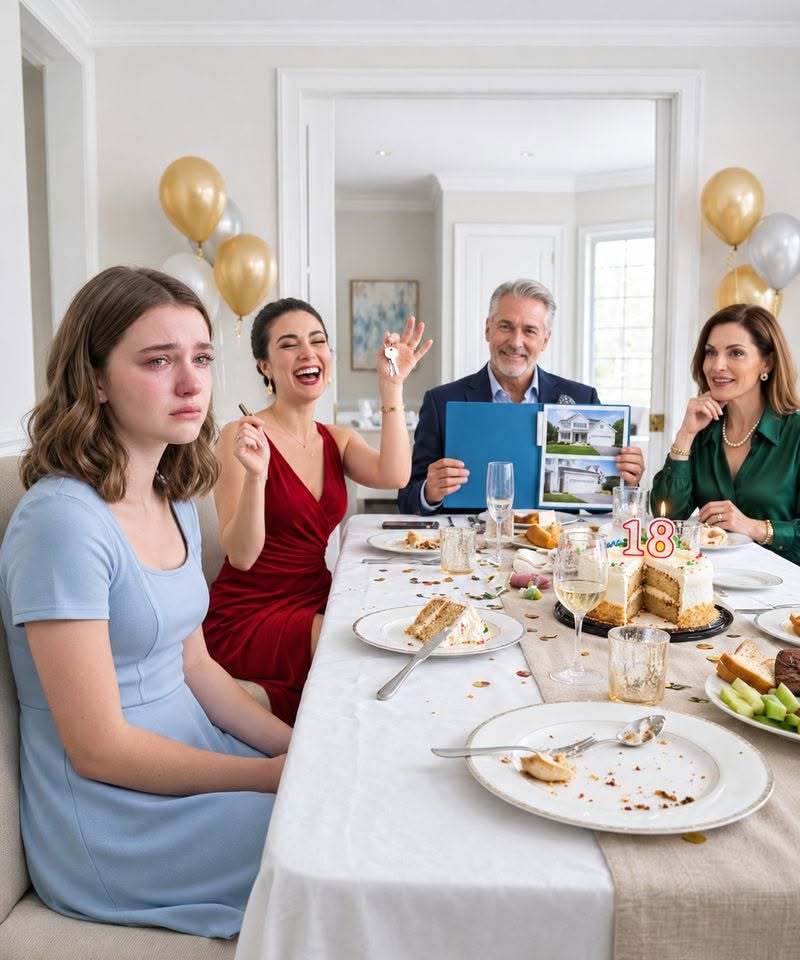
Mom suddenly spoke.
“We thought we’d come back.”
“When?” I asked.
She hesitated.
Then she admitted that they’d struggled financially, moved in with relatives, and eventually had my younger sister.
Every year, returning became more difficult.
“You could have called,” I said.
“I know.”
“You could have visited on my birthday.”
Her eyes filled with tears.
“I know.”
For the first time that morning, she seemed ashamed rather than angry.
But I couldn’t forget that she’d arrived with garbage bags and expected me to surrender the only home I’d ever known.
I asked why they’d come now.
Mom admitted that an old neighbor had told them Grandpa was dying. They’d known about his illness but waited until after the funeral.
Dad believed the house could solve their current financial problems.
He’d been unemployed for nearly a year, they were renting after selling their previous home, and Brianna’s tuition was coming due.
“So you came for the property,” I said.
Mom lowered her eyes.
“Your father thought we could start over.”
I couldn’t understand how someone could abandon a child for seventeen years and then expect to move into the home where she’d been raised.
Mom finally opened the blue envelope.
As she read Grandpa’s letter, tears began running down her face.
“He knew I was ashamed,” she whispered.
Grandpa had written that she could return without money or excuses. He only wanted her to be honest and maintain a relationship with me.
But she’d kept postponing that conversation until the years became too difficult to face.
“I’m sorry, Clara,” she said.
It was the first apology I’d ever heard from her.
I didn’t forgive her immediately. I wasn’t ready.
Instead, I told her that she couldn’t move into the house or remove Grandpa’s belongings.
She accepted that.
Dad was less cooperative.
He announced that he’d have another attorney examine the will and insisted the matter wasn’t finished.
Marian calmly reminded him that the house remained my residence and that he had no authority to take anything.
Then she mentioned a probate hearing scheduled for the following month.
Dad frowned.
“What hearing?”
“The hearing concerning Harold’s second trust.”
I looked at her.
“What second trust?”
Marian opened the folder again.
“This concerns a financial arrangement your grandfather made shortly after you came to live here.”
Mom went completely still.
Marian explained that Grandpa had sold an investment property and established an account to support my care.
But that wasn’t the surprising part.
“For several years,” she continued, “monthly payments were also made to your parents.”
I stared at her.
“My parents received money from Grandpa?”
“Yes. The payments were intended to help them maintain contact with you and contribute to your upbringing.”
I turned toward Mom.
She couldn’t meet my eyes.
Dad looked equally stunned, although his silence felt different.
Marian placed a bank statement on the desk.
“The payments continued for four years. Your grandfather eventually discovered that the money was being received while the agreed visits and correspondence were not taking place.”
Mom whispered that she’d believed the deposits came from an inheritance.
Then she looked at Dad.
“Daniel, you told me your father had cut us off.”
He didn’t answer.
For the first time that morning, I saw genuine fear in his expression.
Marian reached for another document.
“And there’s something else Clara needs to understand about the guardianship agreement.”
She turned the paper toward me.
The signatures at the bottom belonged to both my parents.
But the agreement wasn’t temporary.
It had transferred permanent guardianship to Grandpa, without a scheduled end date.
I stared at the document, realizing that my parents hadn’t simply failed to return after one weekend.
Only three months after leaving me there, they’d signed papers giving Grandpa the legal responsibility of raising me.
And neither of them had ever told me.
Part 4: My Parents Signed Away Their Rights to Raise Me—Then I Found the Letters Grandpa Had Kept
I stared at the guardianship agreement on Grandpa’s desk. My parents’ signatures were clearly visible beneath the document that had given him permanent responsibility for raising me.
For seventeen years, I’d believed they had simply failed to return. Now I knew they’d made that arrangement official only three months after leaving me.
Mom shook her head.
“That isn’t what I thought we were signing.”
Marian Bell, Grandpa’s attorney, explained that the document had been witnessed and notarized. It had no scheduled expiration date.
Dad rubbed his forehead.
“We were struggling. Your grandfather could give Clara a better life.”
“That doesn’t explain why you told me it was temporary,” Mom said.
He looked at her sharply.
“Don’t pretend you weren’t there.”
“I was there because you said it was paperwork for school and medical appointments.”
Popular Posts
→- 1
- 2
- 3
- 4




Recently Viewed
Stories you read recently will appear here.