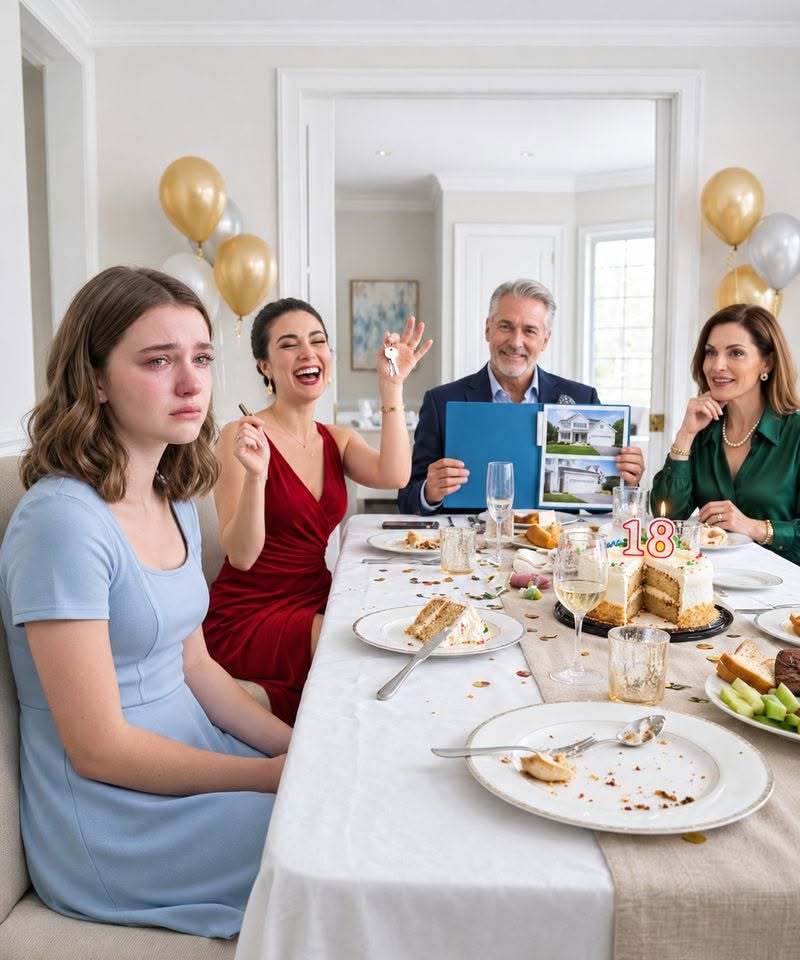
Part 1: My Parents Abandoned Me at Five—Then Returned After Grandpa’s Funeral to Take His House
The morning after my grandfather’s funeral, my parents arrived at his house with a moving truck. I hadn’t seen them in seventeen years, but my mother didn’t hug me or ask how I was coping with his death.
Instead, she handed me two black garbage bags.
“Pack your belongings, Emily. Your grandfather was responsible for you, and now he’s gone. This house belongs to us.”
My younger sister, Brianna, had already walked upstairs.
“I’m taking the master bedroom!” she announced.
I was twenty-two years old, standing in the home where I’d spent almost my entire childhood, watching the family that abandoned me prepare to throw me out.
But I didn’t argue. A few days before Grandpa died, he’d given me very specific instructions about what to do if my parents ever returned.
And I intended to follow them.
My parents had brought me to Grandpa’s house when I was five, promising that I would stay for a weekend. They drove away that Sunday, and the weekend somehow became seventeen years.
There were no birthday calls, Christmas visits, or letters explaining why they hadn’t returned.
Grandpa never made me feel like an unwanted responsibility. He raised me on his pension, taught me to grow vegetables, helped with my homework, and made sure I knew there was always a place for me at his table.
When I became old enough to understand what my parents had done, he never encouraged me to hate them.
He simply told me that adults sometimes failed the people who depended on them.
Now he was gone, and I was still struggling to accept that I’d never hear his voice again.
My father interrupted my thoughts by directing two movers toward the staircase.
“Start bringing down the furniture upstairs.”
“Dad, those are Grandpa’s things,” I said.
He gave me an irritated look.
“Your grandfather wanted this property to stay in the family. Don’t make this difficult.”
I looked at the funeral wreath still hanging on the front door.
Apparently, seventeen years of absence hadn’t stopped my parents from believing they were entitled to everything Grandpa owned.
Mom pointed toward the garbage bags.
“I expect your things packed before lunch.”
I slowly placed them beside the staircase.
Then I remembered Grandpa’s hospital room, the weak pressure of his hand around mine, and the warning he’d given me shortly before he died.
“If your parents come back, don’t argue with them at the door.”
I’d asked why he thought they would return.
He’d looked at me with an expression I hadn’t understood at the time.
“Let them inside. Let them talk. Give them enough time to show you what matters to them.”
“And then?”
“Open my study.”
He hadn’t explained anything further.
So I stood quietly while Brianna complained about the furniture, Dad ordered the movers around, and Mom began deciding which of Grandpa’s belongings should be thrown away.
I didn’t tell them what I knew.
I didn’t even ask them to leave.
Because Grandpa had spent his final days preparing for this possibility, and I trusted him.
Then I heard a faint click from the hallway.
The door to his study opened.
My mother turned toward it, still holding one of the garbage bags.
A woman’s voice came from inside.
“Evelyn. I see you’ve finally decided to come back.”
Mom froze.
And when the woman stepped into view carrying a leather folder, the garbage bag slipped from my mother’s hand.
Part 2: My Parents Tried to Throw Me Out of Grandpa’s House—Until His Attorney Revealed the Will
The woman standing in Grandpa’s study looked to be in her late sixties. She wore a dark green cardigan and held a leather folder against her chest.
I recognized her from the funeral. She had sat quietly beneath the oak tree, watching the service without speaking to anyone.
My mother stared at her.
“What are you doing in this house?”
“I’m Marian Bell,” the woman replied. “Harold’s attorney.”
Dad stepped forward.
“Our attorney?”
“No. Your father’s attorney.”
Marian turned toward me.
“Clara, your grandfather asked me to be here after his funeral. He wanted you to open this room when your parents returned.”
Mom immediately protested that Marian had no right to enter the property. But Marian explained that Grandpa had given her written authorization, along with instructions concerning his estate.
She invited me into the study.
Everything looked exactly as Grandpa had left it. His reading glasses rested beside the desk lamp, and the familiar smell of cedar and old paper filled the room.
I hadn’t been able to enter since his death.
Seeing his empty chair hurt more than I expected.
Marian placed the folder on his desk.
Popular Posts
→- 1
- 2
- 3
- 4




Recently Viewed
Stories you read recently will appear here.