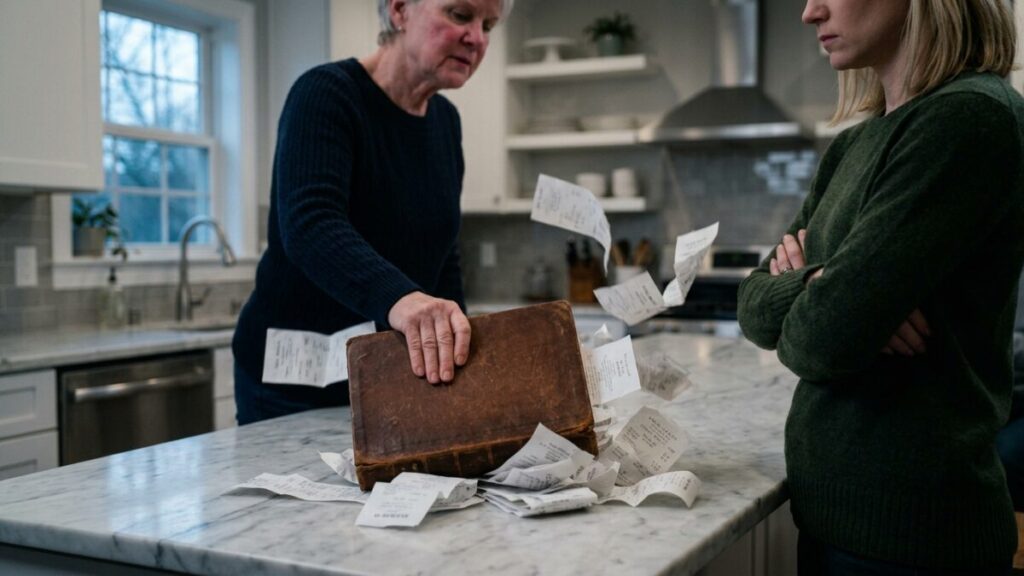
They sold my lake cabin for a party, a party I wasn’t even invited to. My daughter and her husband used my home to celebrate his mother on a yacht while I was left with nothing but silence. I sat in my car that night, staring at the place I once called mine. I could have screamed, but instead I chose something else.
What happens when the one they erased decides not to disappear? I still remember the way the light hit the lake that morning. Calm, undisturbed, like it had no idea what was about to come. I stood on the porch of the cabin my husband and I bought 50 years ago. It wasn’t big. It wasn’t fancy, but every nail, every beam held something of us.
We patched that roof ourselves the summer he got diagnosed. And even now, five years after I buried him, I could still hear his footsteps creaking along that hallway. I had just finished my coffee when the mail came, a thin envelope from the utilities office. Nothing strange. I opened it and saw a late notice for the water bill, but that made no sense.
I paid it on time, always had. I even double checked the amount just last week. So I called, gave them my name. The woman on the line went quiet for a second too long. Then she said, “Ma’am, you’re not listed on this account anymore.” I sat down, heart ticking uneven. Not listed on my own house.
She said the property had been transferred to new owners last month. At first, I thought maybe it was a mistake, a mix-up in the records, but then I checked the deed, pulled it up online, and there it was, sold, paid in full. The buyer was a business name I didn’t recognize. I don’t remember hanging up the phone.
I just remember staring at the lake like it could explain something, like maybe it had seen the whole thing. That night, I called my daughter, Desiree. She picked up like everything was fine. She asked if I had gotten the pictures from her latest trip to Miami. I told her I needed to talk.
Serious, urgent. Her voice dipped, but only a little. She said, “Mom, maybe we should sit down next week and go over everything together.” I knew then. I knew before she even admitted it. Her husband, Mitchell, owns a luxury charter company. I had heard something about a yacht party they were planning for his mother’s eightieth.
Champagne, live band, white linen dinner on open waters, the kind of thing people film with drones and hashtags. The cost? A little over $170,000. And they used the cabin, my cabin, my only home. Sold it to fund that celebration for someone else’s mother. I didn’t scream. I didn’t slam the phone.
I just sat there with the air heavy around me. Some part of me still wanted to believe it was a one-time thing, a moment of desperation. But deep down, I think I had seen this coming. Small signs over the years, a shift in tone, a skipped holiday, a cold silence where warmth used to be.
Still, I had never imagined they’d take everything. Not like this. I know some of you reading this right now might think I should have fought back right away, that I should have called the police or a lawyer or gone to the news. But when someone strips you of more than just a house, when they quietly erase the life you built, your first instinct isn’t rage.
It’s stillness. I stayed in that stillness for a few days, and then I did something else. But that was where the next chapter of my life quietly began. The following morning, I drove to the county clerk’s office. I didn’t call ahead. I didn’t make an appointment. I walked in with a copy of the water bill and the name of the business that had bought the cabin.
The clerk, a quiet man with gray temples and a nervous smile, pulled up the transaction without much delay. The cabin had been sold for $420,000, paid in cash. The name on the seller line was not mine. It was a trust, a trust my late husband and I had created decades ago with both our names on it. But after his passing, Desiree became the secondary trustee.
I remembered the meeting with the lawyer. She had offered to help manage the paperwork back when I was still grieving and just trying to survive the loneliness. I had signed papers I barely read, trusted her the way mothers do. She had moved the cabin into the trust. Then she had moved the trust into her control.
All legal, all neat. My name was still attached but held no power. I walked back to my car and sat there with the windows rolled down, the air sticky against my skin. My chest was tight, but I wasn’t crying. It felt like something had shifted, like a door had quietly closed behind me.
That afternoon, I drove past Mitchell’s company building. I hadn’t been there since the opening party years ago. He had rented a warehouse space in a gentrified block near the marina, polished concrete and oversized glass doors. Through the windows, I could see a banner still hanging. It read Sylvia’s 80th Yacht Soirée.
It was only then I understood the full picture. Sylvia, Mitchell’s mother. The woman who once told me I was too frumpy to sit at the head table at Desiree’s wedding. The woman who referred to me in front of others as the cabin lady. And now they threw her a birthday party with money that came from the place I had scrubbed floors, fixed pipes, and baked pies for my grandchildren in.
Popular Posts
→- 1
- 2
- 3
- 4




Recently Viewed
Stories you read recently will appear here.