Daniel eventually came and sat beside me on the old bench at the edge of the dock.
We watched the water for a few minutes without speaking.
Then he said, “I’m sorry about how that came out.”
I looked at him.
“How it came out?”
“The timing was bad.”
“The timing.”
He rubbed his hands together.
“It’s been a hard decision. Vanessa and I have talked about it a lot. We really believe it’s the right thing.”
“For whom?”
“For everyone,” he said too quickly.
I waited.
“The upkeep is expensive,” he continued. “You’re alone here so much. Florida would be good for you. The place we found has amenities. You wouldn’t be isolated.”
“Did you read the trust documents?”
His mouth tightened.
“Our lawyer reviewed everything.”
“Which lawyer?”
He named a firm in Scottsdale I had never heard of.
For the first time that afternoon, he looked at me fully.
Something passed over his face.
Not guilt exactly.
The shadow of it.
A man realizing he may have memorized answers to the wrong test.
My phone buzzed.
Margaret.
On my way. Bringing two associates and anchor documents. Also bringing title audit results. You should see what I found.
I read the message twice.
Then I looked at my son.
“Did Vanessa mention the home equity line?”
He blinked.
“What?”
“The home equity line taken out against the lake house eighteen months ago.”
He went very still.
I told him Margaret ran annual title audits as part of trust maintenance, a detail I had never mentioned because I never imagined I would need to. The latest audit had flagged a financial instrument filed with the county recorder’s office. The property had been used as collateral for a line of credit worth $250,000.
“The signature appears to be mine,” I said. “It is not mine.”
Daniel’s face changed.
Confusion first.
Then the look of a man trying to build an innocent explanation on ground that is already moving.
Then stillness.
“Vanessa?” he said.
It came out like a question.
“You should probably wait until Margaret arrives.”
Margaret’s gray sedan pulled into the gravel drive exactly at the forty-five-minute mark.
She was not alone.
Two younger attorneys stepped out after her, both carrying document cases. They moved with the quiet efficiency of people who did this kind of work often and found no drama in it.
Vanessa saw them from across the yard.
I watched certainty drain from her face.
She crossed the lawn quickly and intercepted Margaret near the dock.
“This is private property,” Vanessa said. “You are trespassing.”
Margaret opened her briefcase.
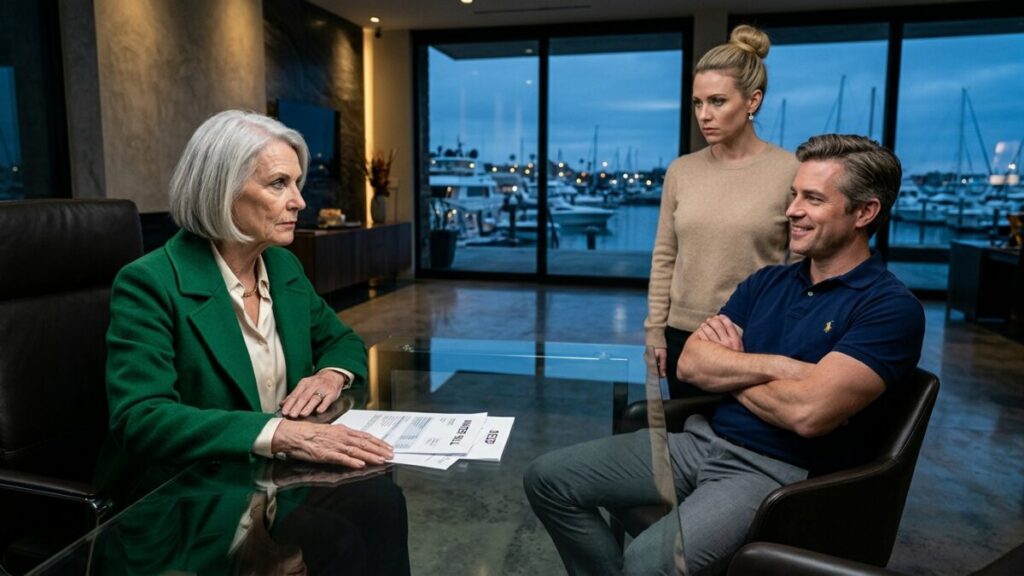
She handed Vanessa a document and explained, in the patient tone of someone reading a bedtime story to a child who did not understand the language, that the property was held in an irrevocable trust, that she was the independent trustee, that the trust contained a generation preservation clause, and that the clause had been triggered twenty-seven days earlier when an unauthorized listing agreement was filed with a brokerage firm in Phoenix.
Vanessa’s lips parted.
Margaret continued.
“As trustee, I have exercised authority under Section 4B of the trust instrument to initiate emergency injunctive relief halting the sale, recalling the listing, notifying the brokerage firm of filing irregularities, and commissioning an independent title audit.”
She paused.
“The title audit was very interesting.”
Vanessa said something about lawyers working for old men with nothing better to do.
Her voice had changed.
The cheerful confidence was gone.
What remained was sharper.
Frightened.
Margaret did not respond to the insult.
One of her associates removed a bound document roughly two inches thick from a case and placed it on the picnic table exactly where Vanessa had set her manila envelope.
Margaret rested one hand on top of it.
“The audit uncovered not one but three separate instruments filed against the property using a notarized copy of Mr. Marsh’s signature that he did not provide.”
The yard was silent.
“A home equity line of credit for $250,000. A second lien used as collateral for a business loan taken out in the name of an LLC registered in Delaware called Hartwell Property Group. And a title transfer document filed but not yet recorded, transferring an undivided interest in the property to Hartwell Property Group.”
Margaret opened the document.
“Hartwell Property Group has one registered member.”
She said Vanessa’s full legal name.
I looked at my son.
He had not moved from the bench. His hands were flat on his knees. He stared at the papers as if they were alive.
Some guests began quietly collecting purses and jackets.
Others stayed frozen, held by the terrible magnetism of seeing a family mask fall in public.
Vanessa shifted.
I watched calculation move across her face.
She had trained herself to be charming, persuasive, and strategically vulnerable.
But she had not trained for being caught in front of actual paperwork.
“I was advised by counsel that the trust was amendable,” she said. “And that Ed’s signature was obtained properly.”
Properly.
She said the word as if she was no longer sure what it meant.
Margaret nodded.
“That is a very interesting legal theory. I look forward to hearing it explained to a judge.”
Vanessa’s face tightened.
“As for the forged signature,” Margaret continued, “that matter will likely be handled by the county district attorney rather than civil court. My office is prepared to assist with whichever process moves faster.”
“I’m calling our lawyer,” Vanessa snapped.
“Excellent idea,” Margaret said, gesturing toward the end of the dock. “Reception is better there.”
Vanessa walked away with her phone pressed to her ear.
Her back was to us, but I could see her shoulders tighten. She turned once, looked at the bound audit on the table, then turned away again.
The call lasted four minutes.
When she came back, she did not look at Margaret.
She looked at Daniel.
What she said to him, I will not repeat in full. Some of it later became part of legal correspondence. Some of it simply does not deserve preservation.
Popular Posts
→- 1
- 2
- 3
- 4




Recently Viewed
Stories you read recently will appear here.