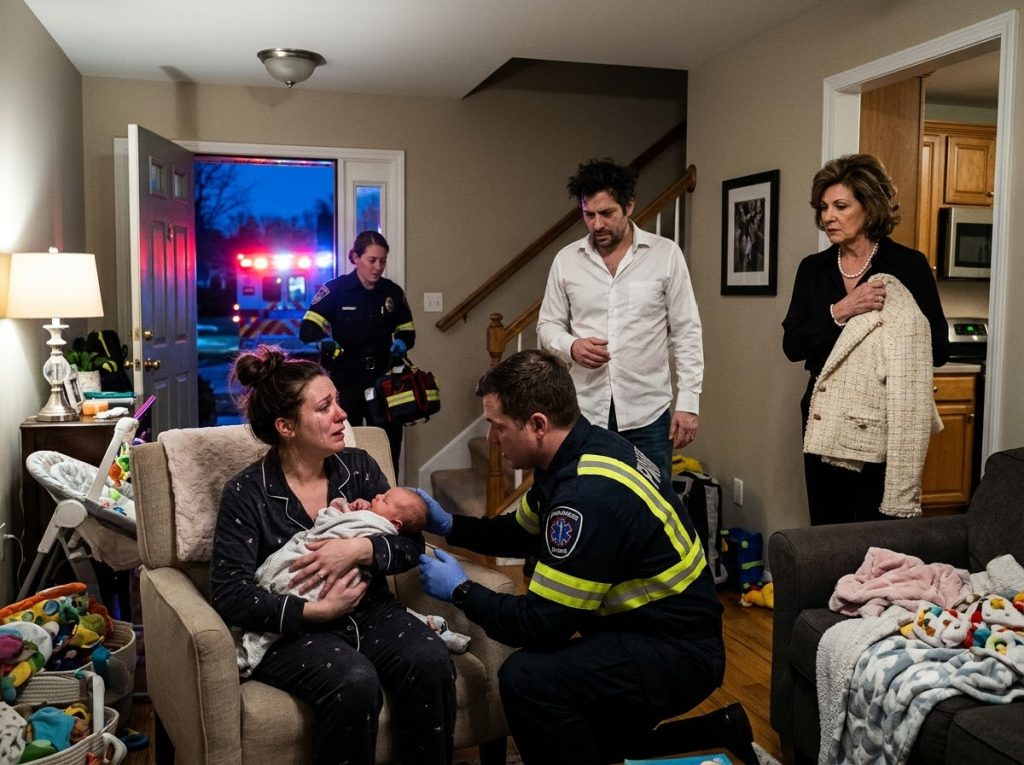
At 4:17 a.m., my mother-in-law threw away my breast milk, and then my baby stopped breathing easily.
Chapter 1
At 4:17 a.m., I found my mother-in-law feeding my seven-week-old daughter the infant formula that her doctor had strictly advised us against. My freshly pumped breast milk was in the trash. Before dawn, my baby would be in an ambulance, and I would be wondering if my husband, the man I loved, had anything to do with it.
My name is Megan Parker. Until that morning, I thought the worst part about having newborn twins was the exhaustion. I was wrong. The worst part was realizing that someone could look you straight in the eyes, call their actions love, and knowingly put your child in danger.
I had come downstairs because the house was too quiet. That sounds absurd until you’ve spent seven weeks learning to recognize the thousand sounds two newborns make. Even from the bedroom, I could tell the difference between Sadie’s sleepy little cry and Molly’s impatient one. I could hear the hum of the refrigerator, the mechanical beat of the breast pump motor, the floorboards creaking near the kitchen. But when I woke up just after four, all I heard was the distant clinking of glass.
I had undergone an emergency C-section after Molly’s heart rate stopped during labor. My scar still hurt whenever I stood up too fast. I had pumped twice since midnight, fed both girls, washed the bottles, labeled the milk, and gone back to bed for what I hoped would be forty precious minutes of sleep. Two bottles were in the refrigerator: 200 ml each, labeled with the time. I knew this because every 30 ml had taken an effort I could hardly explain to someone who had never spent hours in the dark praying a breast pump would yield enough milk.
Donna was sitting in the living room recliner, Molly nestled against her. Sadie was sleeping nearby in her cream-colored bassinet, one tiny fist tucked under her chin. Donna’s pearl necklace glinted above her black blouse, her cream tweed jacket casually draped over the armrest of the chair, as if she were heading to a golf club rather than helping her exhausted daughter-in-law.
A bottle was held under Molly’s nose. “What are you giving her?” I asked.
Donna looked up without flinching. “Breakfast.”
“That’s not her milk.”
“No, Megan.”
I crossed the room so fast my hip hit the coffee table. On the side table sat a blue formula scoop. Next to it was the blue-and-white can of standard cow’s milk formula that Dr. Shah had strictly advised us not to use for Molly. “Tell me you didn’t give her that.”
Donna sighed, as if I were interrupting her morning routine. “You need to stop acting like I’m poisoning your children.”
“Give her to me.”
“She just started eating.”
“Donna.”
Something in my voice finally convinced her to hand over my baby. Molly was warm and heavy, like a vulnerable newborn. Her eyelids were fluttering. I pulled the bottle away and examined the label, desperately wishing I were wrong. I wasn’t.
Three weeks earlier, when our baby girls had been home for barely a month, I had tried that formula after a rough night. Redness appeared around Molly’s mouth and neck. Then she vomited twice. Dr. Shah advised us to stop standard cow’s milk-based formula until we could test for a potential milk protein allergy. He wrote the warning down on a piece of paper, highlighted it, and asked Derek and me to repeat the instructions back to him. Donna had seen that paper on our refrigerator. She had mocked it so much that it was impossible for her to have forgotten.
I carried Molly into the kitchen. An empty bottle sat in the sink. Another milk storage bottle was sticking out of the trash can, next to the stainless steel canister. I could read my handwriting: 3:18 a.m. — LEFT. A little star next to it indicated the side I had finished pumping on.
Chapter 2
“What did you do with my milk?”
“It looked thin.”
“You threw away my milk because it looked watery?”
“I didn’t know how old it was.”
“The time is written on it.”
Donna crossed her arms. “These babies have been hungry all week.”
“They’re seven weeks old. They cry.”
“Your milk isn’t filling them up. I’ve raised three children, Megan. I’ve seen this before.”
“This isn’t about your opinion of my milk. This is a medical directive.”
“She had a tiny rash.”
My knees felt like they were giving out. “You knew she reacted to it.”
Donna hesitated just long enough to betray herself. Then she said, “Derek told me the doctor was just being cautious.”
Popular Posts
→- 1
- 2
- 3
- 4




Recently Viewed
Stories you read recently will appear here.





