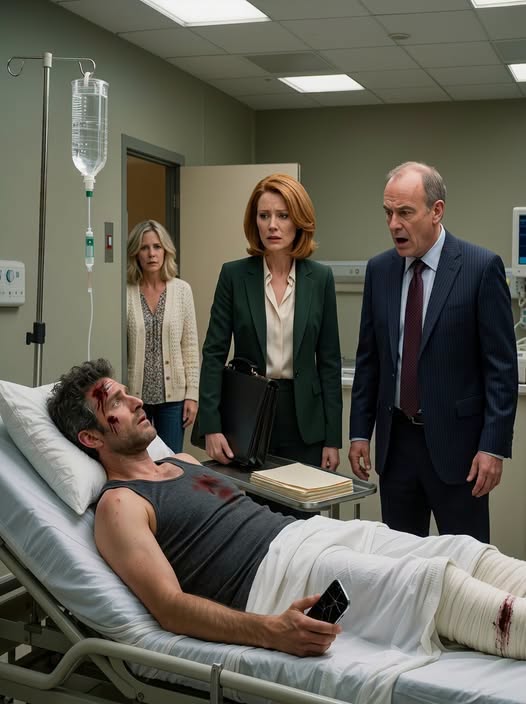
The rain over the industrial park did not fall so much as hang, suspended in the chill October dark like pulverized lead.
Maya Vance knew the rhythm of the city’s southern transit corridor by heart. For eleven months, she had lived inside the brutal cadence of the Reed Medical Technologies prototype rollout: sixteen-hour days spent recalibrating sensory telemetry on high-acuity patient monitors, breathing the ozone tang of cleanrooms, subsisting on cold espresso and salted almonds. When she finally steered her modest hatchback out through the security gate at 9:14 p.m., her neck burned with the deep, structural ache of chronic fatigue. Her left shoulder held the memory of five hundred lines of refactored firmware code that had finally cleared kernel validation less than twenty minutes prior.
She never saw the delivery truck run the red at the intersection of 4th and Mercer.
There was only a blinding, instantaneous rupture—a horn blaring like a dying animal, a wall of rusted steel shearing through her passenger side, and the violent, sickening torque of metal crumpling inward. Glass blew through the cabin in a diamond spray. The air smelled immediately of scalded engine coolant and pulverized safety powder. The seatbelt pinned her hard against the seat, snapping her left collarbone with a dry, internal crack that stole the air straight from her lungs.
Her world narrowed to the oscillating pulse of an emergency siren and the steady drip of rain through a shattered windshield.
When the trauma team wheeled her gurney through the sliding automatic doors of St. Jude Memorial, the bright halogen arrays hit her retinas like cold needles. The chaos was mechanical, practiced, indifferent. Triage nurses stripped her damp coat; a technician with ink-stained knuckles took three attempts to find a vein in her right wrist for an IV line; an orthopedist with cold fingers palpated the swelling around her ribs and declared that the bone had sheared clean, though the lung had miraculously escaped puncture.
“You’re lucky,” the resident murmured, scribbling on a tablet clipped to the foot of her bed in Trauma Bay 4. “Six inches closer to the driver’s pillar, and the chassis would have crushed your pelvis. As it is, you’ve got a broken clavicle, a hairline fracture in your left talus, two cracked ribs, and a moderate concussion. We’re holding you for observation until morning.”
Maya’s throat was bone-dry. The taste of copper lingered under her tongue. Her phone, rescued from the floorboard of her ruined car by an EMT and sealed inside a clear biohazard bag, lay on the metal tray beside her.
With trembling, blood-crusted fingers, she unlocked it.
The screen was spider-webbed, but the digits glowed through the fractures. 10:02 p.m.
She dialed her mother’s mobile. It rang four times before dropping to voicemail. She dialed her father’s cell; it rang until it clicked off. She dialed the home landline—the heavy beige unit that sat on the granite counter in her parents’ suburban kitchen, an appliance kept strictly for emergencies.
It rang six times.
A click. The receiver lifted with an irritated scrape.
“Where are you?” her mother, Eleanor, demanded. Her voice was not breathless with terror; it was tightened into the familiar, brittle pitch of an administrator whose evening schedule had been derailed. “Do you have any idea what time it is?”
Maya closed her eyes against the hospital ceiling’s harsh white glare. “Mom. I’m in the hospital. St. Jude’s.”
A heavy, dead beat hung over the line. For a single, foolish second, Maya braced herself for the sudden intake of breath, the frantic maternal scramble for keys, the immediate demand for directions.
Instead, Eleanor exhaled an aggrieved sigh. “Maya, please. Your sister just walked through the front door in absolute pieces. She got pulled over on the turnpike coming back from the vineyard. A three-hundred-and-eighty-five-dollar speeding citation. She was going twenty-two miles over the limit, and the officer refused to give her a warning. Her license is already sitting on three points from that scrape in June. If this goes onto her record, the premium on the Lexus will double. Your father is on the phone with the county clerk’s after-hours line trying to see if we can get her into diversion school before Monday.”
Maya stared at the plastic bag of IV saline swinging above her head. A drop formed, hung, and fell through the chamber. “Mom. Did you hear what I said? I was in an accident. A commercial van ran a light. My car is totaled.”
“I heard you,” Eleanor snapped, her voice dipping lower as though shielding someone delicate from an unwelcome disruption. “You don’t have to exaggerate every time Claire has a crisis. You’re at St. Jude’s, which means you’re sitting in an exam room and the nurses are taking care of you. Meanwhile, Claire is hyperventilating in the bathroom. Your father is losing his temper because the fine has to be certified within seventy-two hours or they suspend her registration. We’re dealing with enough tonight.”
The word settled in Maya’s chest like a fistful of dry salt. Exaggerate.
“Can Dad come down?” Maya’s voice sounded small to her own ears—thin, cracked, stripped of the authority she carried in the lab. “They’re going to discharge me in a couple of hours if the CT scan is clear. I don’t have shoes, Mom. My coat was cut off. I can’t drive. My car is gone.”
“Don’t make this into a competition, Maya. It is unbecoming.” Eleanor’s tone chilled into that practiced, patronizing cadence she used whenever Maya dared to take up space in the family ledger. “You have always been self-sufficient. You make good money. Call a cab. We will see you tomorrow afternoon once Claire has slept this off.”
The line went dead.
Maya let her right hand slide off the mattress. The cracked phone slipped from her fingers and landed on the thin cotton blanket with a dull thud.
In the plastic chair beside the wall, Lena Cruz sat up.
Popular Posts
→- 1
- 2
- 3
- 4




Recently Viewed
Stories you read recently will appear here.





