My fingers tightened in my lap.
My house was small, old, and paid off.
It sat on a corner lot in a neighborhood developers had suddenly started calling historic.
For thirty-two years, it had been shelter.
Now it was valuable.
“It is too much for a woman alone,” Celeste said gently.
Marlene added, “And it would be selfish to hold onto it when Michael and I could use the equity properly.”
I looked at my son.
His mouth tightened.
“Mom, listen before you get emotional.”
Before you get emotional.
The oldest trick in the world.
Make a wound, then accuse the bleeding person of making a mess.
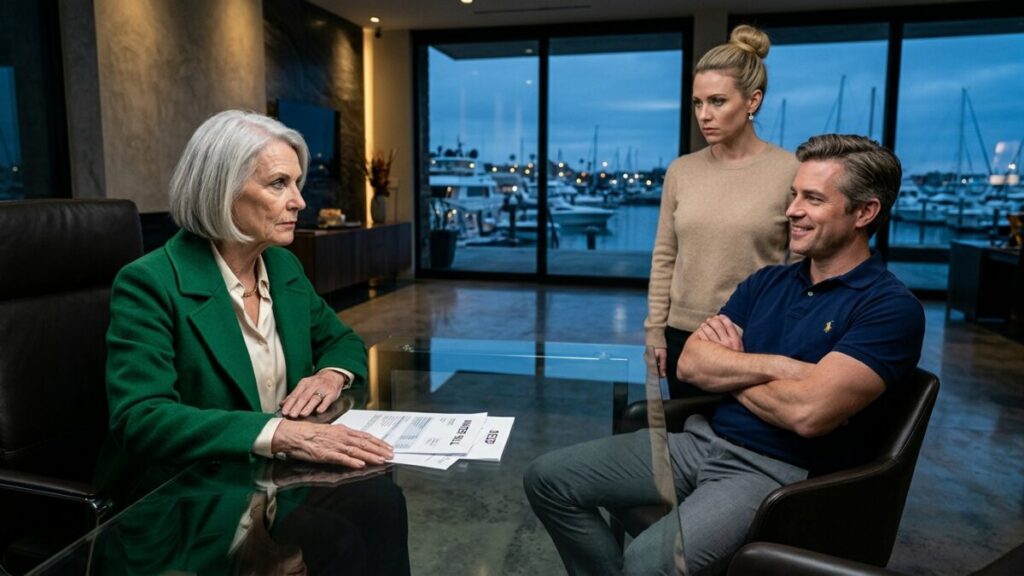
Gregory tapped the folder.
“We have arranged a very generous private transfer agreement.”
My voice came out calm.
“Transfer to whom?”
Marlene smiled.
“To Michael, naturally.”
Michael finally met my eyes.
“It would still be in the family.”
I stared at him.
“And where would I live?”
Marlene gave a little shrug.
“There are communities.”
Celeste leaned in.
“Very nice ones.”
Gregory nodded.
“Assisted living can be dignified when approached early.”
The water beside my hand trembled, though I had not touched it.
Michael spoke softer now, which made it worse.
“Mom, don’t make this hard.”
I remembered him at five years old, crying into my skirt after Henry left.
I remembered him at twelve, asleep at the kitchen table beside a science project I had stayed up building with him.
I remembered him at twenty-one, calling me because he was scared he had chosen the wrong life.
And now here he was, sitting over lobster I was not allowed to eat, asking me to sign away the only home I had left.
Marlene pushed a pen toward me.
“We thought doing this in public would help everyone stay calm.”
There it was.
The real reason for the chandeliers.
The witnesses.
The humiliation.
They wanted me small.
Hungry.
Embarrassed.
Publicly cornered.
They wanted me to sign so the pain would end.
I reached for the pen.
Michael exhaled, relieved.
Marlene’s smile widened.
Gregory looked satisfied.
I turned the pen slowly in my fingers.
Then I set it down.
“No.”
The word was small.
The silence after it was enormous.
Marlene’s face went pale with anger.
“Excuse me?”
I looked at her.
“No.”
Michael’s jaw tightened.
“Mom.”
I took a sip of water.
It tasted like nothing.
“You invited me to dinner to starve me, shame me, and pressure me into signing away my house.”
Marlene gave a sharp laugh.
“Don’t be dramatic.”
“I am not dramatic,” I said.
“I am accurate.”
Gregory leaned forward, his polite mask slipping.
“Helen, you need to understand your position.”
The kitchen doors opened before I could answer.
A tall chef in a white uniform stepped out.
The dining room did not stop entirely, but something shifted.
Servers moved aside.
The manager straightened.
The chef walked through the restaurant with the quiet authority of a man who did not need to raise his voice.
His hair was dark with silver at the temples.
His face was older, fuller, stronger.
But I knew his eyes.
For one breath, I was back in a rainy alley behind The Blue Lantern, holding a bowl of chowder out to a starving boy who refused to cry.
Daniel stopped beside my chair.
He bowed his head.
“Mrs. Helen,” he said, “we need you in the office.”
Marlene’s smile vanished.
Michael looked up so quickly his wine glass rocked.
Gregory frowned.
Celeste whispered, “Mrs. Helen?”
The chef ignored them.
He looked only at me.
“Please,” he said softly.
I stood.
Marlene reached out.
“She’s in the middle of a family dinner.”
Daniel turned his head toward her.
His expression was calm, but his eyes were cold.
“No, madam.”
He looked at the untouched water glass.
“She is in the middle of an insult.”
A hush spread around the nearby tables.
Marlene’s cheeks flushed.
Michael pushed back his chair.
“Who are you to speak to my wife that way?”
Daniel looked at him.
For a moment, there was something almost like pity in his face.
“I am the owner of this restaurant.”
The words struck the table like thunder wrapped in silk.
Marlene opened her mouth, then closed it.
Gregory’s expression changed from irritation to calculation.
Celeste lowered her wine glass.
Michael stared at Daniel, then at me, then back at Daniel.
“You know my mother?”
Daniel’s jaw tightened.
“Your mother fed me when no one else would look at me.”
I felt heat rise behind my eyes.
He continued, his voice steady.
“Your mother gave me work when I had no address.”
The dining room seemed to fade.
“Your mother convinced Antoine Bellerose to keep me in that kitchen when I burned the soup, dropped plates, and stole bread because I was still afraid hunger might come back.”
He looked down at me.
“Everything I became began with her kindness.”
Marlene gave a nervous laugh.
“That’s touching, but we’re paying guests.”
Daniel’s eyes did not move.
“Not anymore.”
A manager appeared beside him.
Daniel said, “Clear the table.”
Marlene gasped.
“You cannot be serious.”
Gregory stood halfway.
“I know people on the licensing board.”
Daniel smiled slightly.
“Then you should know better than to harass an elderly woman in a dining room full of cameras.”
The word cameras landed like a stone.
Marlene froze.
Michael’s face drained.
I looked up at Daniel.
He gave me the smallest nod.
Then he led me toward the back hallway.
The restaurant watched us pass.
I felt every eye on my pearl-gray dress, my old shoes, my silver hair, and my empty stomach.
But for the first time that night, I did not feel small.
I felt carried by every invisible version of myself that had survived.
The back hallway smelled of garlic, butter, lemon, and heat.
The kitchen was alive with motion.
Cooks moved like dancers.
Flames rose.
Pans hissed.
But when Daniel guided me through, every person stopped.
One by one, they nodded.
“Mrs. Helen.”
Popular Posts
→- 1
- 2
- 3
- 4




Recently Viewed
Stories you read recently will appear here.