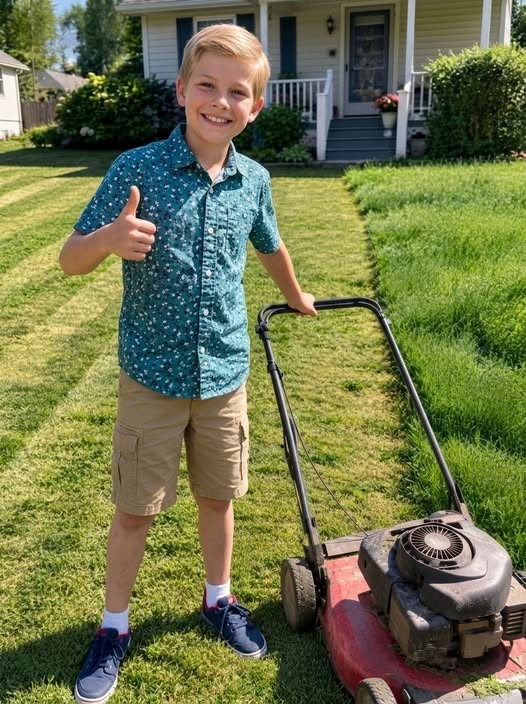
PART 2 — THE QUESTION AT THE DOOR
“Justin,” the officer said, his expression finally softening, “do you remember mowing Mrs.
Evelyn Carter’s lawn this morning?”
Justin swallowed.
“Yes, sir.”
The officer glanced at his partner, then back at my son.
“And while you were there, did Mrs.
Carter give you anything?”
My hands began trembling.
For several seconds, Justin said nothing.
That frightened me more than the police cars had.
“Justin?”
I asked.
His eyes dropped toward the floor.
“She gave me an envelope.”
The room seemed to become very quiet.
“An envelope?”
I repeated.
“Why didn’t you tell me?”
“I was going to.”
The officer lifted one hand reassuringly.
“Ma’am, Justin isn’t in trouble.”
Those six words allowed me to breathe again.
The officer introduced himself as Daniel Ruiz.
His partner was Officer Hannah Cole.
They had come because Mrs.
Carter had called the department—not to report Justin, but because she wanted witnesses present for something important.
Justin looked as confused as I felt.
Officer Ruiz smiled slightly.
“Mrs.
Carter told us your son has been mowing her lawn every other week since June.
She tried paying him every single time.”
Justin shrugged.
“She doesn’t need to pay me.”
“That,” Officer Cole said, “appears to be the problem.”
Justin blinked.
For the first time since they arrived, both officers laughed.
Then Officer Ruiz became serious again.
“Could you get the envelope?”
Justin hurried upstairs.
The moment he disappeared, I turned to the officers.
“What exactly is happening?”
Officer Cole glanced toward the staircase.
“Mrs.
Carter asked us not to explain everything.
She wants to do that herself.”
That answer did not calm me much.
Justin returned carrying a plain cream-colored envelope.
“I didn’t open it,” he said quickly.
“She told me to bring it home and open it with Mom.”
On the front, written in careful blue handwriting, were four words:
FOR JUSTIN AND HIS MOTHER.
Officer Ruiz nodded.
“You should open it.”
I sat beside Justin on the couch.
Inside was not money.
There was a photograph.
It showed a much younger Mrs.
Carter standing beside a man I didn’t recognize.
Between them stood a boy of perhaps thirteen, grinning beneath a baseball cap while holding the handle of an old red lawn mower.
Behind them was a house.
Our house.
I stared at the photograph.
“That’s here.”
Justin leaned closer.
“It is.”
The photograph had clearly been taken decades earlier.
The porch railing was different, and the maple tree in our front yard was barely taller than the roof.
I turned the picture over.
Three names were written on the back:
Evelyn Carter.
Thomas Carter.
Samuel Bennett.
Summer, 1986.
Bennett.
My maiden name.
I stopped breathing for a second.
“My father’s name was Samuel Bennett.”
Justin looked at me.
“Grandpa Sam?”
I nodded.
My father had died when Justin was four.
Justin remembered only fragments of him: peppermint candies, suspenders, terrible jokes and a voice that somehow filled every room.
I looked at Officer Ruiz.
“How does Mrs.
Carter know my father?”
“That,” he said gently, “is what she wants to tell you.”
The officers explained that Mrs.
Carter was waiting at home with another neighbor and had asked whether Justin and I would visit.
Ten minutes later, we walked three blocks to the little white house whose lawn Justin had mowed that morning.
Mrs.
Carter opened the door before we knocked.
She was seventy-eight, silver-haired and petite, with the kind of posture that suggested she had spent her life refusing to let age decide what she could do.
When she saw Justin, she smiled.
“I suppose I caused a little excitement.”
“A little?”
I said.
She looked apologetic.
“I’m sorry.
Daniel is my nephew.”
I turned toward Officer Ruiz.
He raised his hands.
“I tried telling her arriving in patrol cars might be dramatic.”
Mrs.
Carter sighed.
“And I told him young people exaggerate everything.”
Justin whispered, “Mom, she’s funny.”
“I heard that,” Mrs.
Carter said.
Then she invited us inside.
A man named George Whitaker was sitting at her dining table.
I recognized him as another neighbor whose lawn Justin had mowed several times.
On the table sat a wooden box.
Mrs.
Carter pointed to the photograph in my hand.
“Your father was thirteen when that was taken.”
“How did you know him?”
She sat slowly.
“Because Samuel Bennett did exactly what Justin has been doing.”
I looked at my son.
Justin looked at me.
Mrs.
Carter continued.
“The summer of 1986 was terribly hot.
My husband Thomas had injured his knee and couldn’t manage our yard.
One Saturday morning, a skinny boy appeared pushing a mower.”
Justin smiled.
“Grandpa was skinny?”
“Very.”
I laughed despite myself.
“He certainly didn’t stay that way.”
Mrs.
Carter smiled.
“Samuel offered to mow our lawn.
Thomas tried paying him.
Samuel refused.”
Something tightened warmly inside my chest.
“What did Dad say?”
Mrs.
Carter’s eyes brightened with memory.
“He said, ‘Maybe someday somebody will help my family when I can’t.’”
I had to look down.
That sounded exactly like my father.
Mrs.
Carter explained that Dad spent several summers helping older neighbors.
Eventually Thomas Carter taught him basic carpentry.
Another neighbor taught him bookkeeping.
Someone else helped him find his first job.
“It wasn’t charity,” George said.
“It was neighbors investing in one another.”
Mrs.
Carter opened the wooden box.
Inside were dozens of photographs, handwritten notes and old newspaper clippings.
Justin moved closer.
One clipping showed my father receiving a scholarship from a neighborhood association I had never heard of.
“The Maple Street Community Fund,” Mrs.
Carter said.
Apparently, decades earlier, several families had contributed small amounts each year to help local young people with school supplies, vocational training and college expenses.
My father had been one of its first recipients.
“But the fund disappeared,” I said.
“Not exactly.”
Mrs.
Carter exchanged a glance with George.
“It became inactive.
People moved.
Others passed away.
Eventually there weren’t enough volunteers.”
Justin touched one of the photographs.
Popular Posts
→- 1
- 2
- 3
- 4




Recently Viewed
Stories you read recently will appear here.





