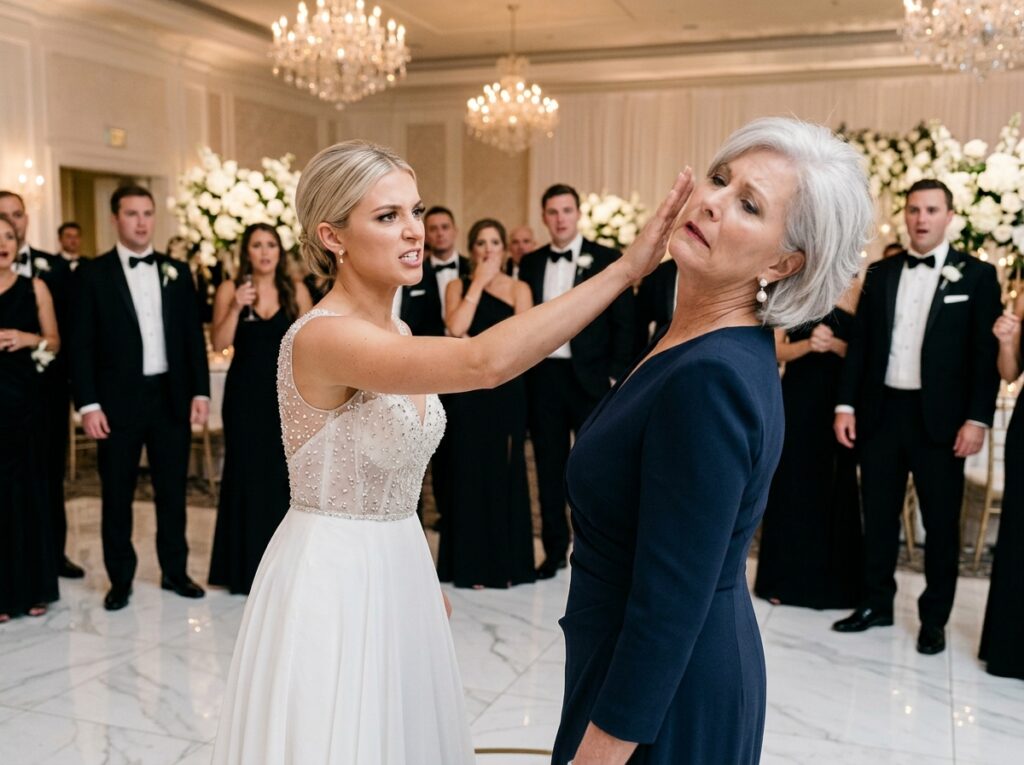
The slap cracked across the grand ballroom so sharply that the live band stopped in the middle of a song.
the slap rang through the grand ballroom like a gunshot.
One second, two hundred and fifty wedding guests were laughing beneath crystal chandeliers. The next, every conversation stopped as my daughter-in-law stood over me with her hand still raised, her designer reception gown sparkling beneath lights I had paid for.
No one moved.
No one spoke.
They simply stared as the woman I had sacrificed everything for struck me across the face in front of everyone.
Tiffany believed she had finally put an annoying old woman in her place.
What she had forgotten was that nearly everything surrounding her existed because of me.
The ballroom.
The imported roses and orchids.
The gourmet dinner.
The premium open bar.
The luxury transportation.
The live band.
Even the honeymoon suite waiting upstairs for the newlyweds that night.
Every contract carried one name.
Mine.
And after one phone call, her perfect wedding would have less than ten minutes left.
My name is Margaret Bennett. I am sixty-seven years old, and by the time my son’s reception began, I had spent more than forty-five thousand dollars trying to give him the happiest day of his life.
That had never been the original plan.
When Daniel and Tiffany first announced their engagement, the four of us sat around my kitchen table with coffee and a yellow legal pad. We agreed on a simple celebration—around eighty guests, a modest ceremony, and a family dinner afterward.
Daniel had smiled at me from across the table.
“We don’t need anything extravagant, Mom.”
Tiffany had nodded beside him.
“Something intimate would be perfect.”
I believed them.
I should have known better when Tiffany took the yellow pad home.
Within two weeks, eighty guests had become one hundred and thirty.
Then one hundred and seventy-five.
Then two hundred and fifty.
A cozy restaurant was suddenly “too ordinary.” Tiffany wanted an exclusive private estate with marble floors, landscaped gardens, and a ballroom large enough to look impressive in photographs.
Fresh seasonal flowers were replaced by imported roses and orchids.
A local bakery was rejected for a designer cake with six tiers, edible gold leaf, and hand-painted sugar flowers.
A simple shuttle became a fleet of luxury vehicles.
She added professional lighting, premium wines, custom gifts for every guest, embroidered napkins, a live band, a photographer, a videographer, a farewell brunch, and a honeymoon suite with champagne and breakfast service.
Every week brought another expense.
Every week, Daniel called me with the same tired voice.
“Please, Mom. It’s only one day.”
“She’s under a lot of pressure.”
“Can you let this one go?”
I always did.
Daniel was my only child.
His father, Thomas, had died six years earlier after a short battle with pancreatic cancer. Thomas had been the steady one in our marriage—the man who could look at a page of numbers, take off his reading glasses, and calmly say, “We can afford this,” or, “We need to stop.”
After he died, no one stopped me.
Certainly not Daniel.
I told myself I was helping my son begin his marriage without debt. I told myself Thomas would have wanted Daniel to have a beautiful wedding. I told myself money was only money, while family memories lasted forever.
Little by little, I emptied my savings.
I canceled a vacation to Italy that Thomas and I had dreamed about taking for nearly twenty years. After his death, I had planned to make the trip alone, carrying his old camera and visiting the villages he had circled in a travel book.
I called the travel company and canceled the reservation.
The refund paid for the band and half the flowers.
When Tiffany requested another twelve thousand dollars for the private estate, upgraded dinner service, and farewell brunch, I finally ran out of liquid savings.
That should have been the end.
Instead, I sold six acres of land Thomas had inherited from his grandfather.
The land sat outside town, covered in old oak trees and tall grass. Thomas had taken Daniel there when he was little. They had fished in the narrow creek, camped beneath the stars, and talked about building a cabin one day.
I can still remember the way the attorney slid the sale documents across the desk.
“Are you certain?” he asked.
I stared at Thomas’s name on the original deed.
“No,” I said honestly. “But I’m doing it anyway.”
Signing those papers felt like losing my husband all over again.
That night, I sat alone in my car outside the attorney’s office and cried until the windows fogged.
Then I wiped my face, called Daniel, and told him the final venue payment had been handled.
He sounded relieved.
“Thank you, Mom. You have no idea what this means to us.”
At the time, I believed I did.
The morning of the wedding began before sunrise.
I arrived at the estate while mist still clung to the gardens. Florists carried armfuls of white roses through the side entrance. Staff members rolled carts loaded with glasses and silverware across the marble floors. The band tested microphones in the ballroom.
I should have felt proud.
Instead, I felt strangely invisible.
Everywhere I looked, people were working from instructions printed on Tiffany’s monogrammed schedules. Her name appeared on welcome signs, cocktail napkins, gift bags, menus, and seating charts.
Mine appeared only on invoices.
Tiffany barely acknowledged me that morning.
When I entered the bridal suite to give her the pearl earrings Thomas had once bought for me, she glanced at the small velvet box and said, “Put them on the table. The stylist will decide whether they match.”
I stood there for a moment, holding the earrings.
“I thought they could be your something borrowed.”
She kept looking at herself in the mirror.
“My dress has crystal details. Pearls might clash.”
One of the bridesmaids gave me an uncomfortable smile.
I placed the box on the table.
Popular Posts
→- 1
- 2
- 3
- 4




Recently Viewed
Stories you read recently will appear here.





