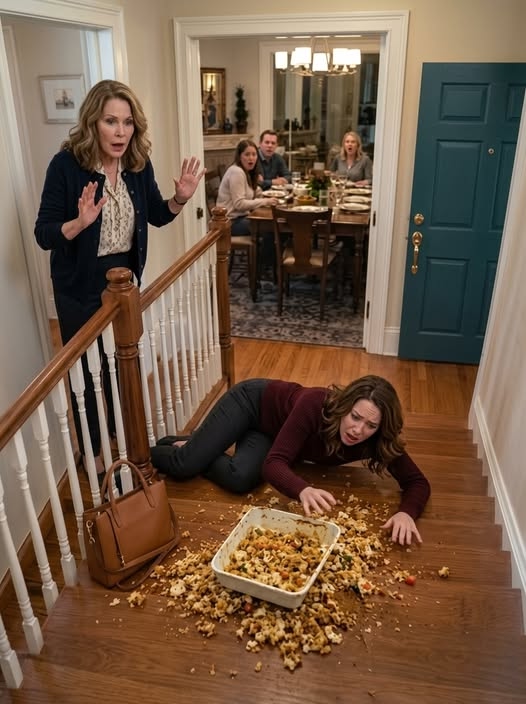
The door clicked shut behind Graham, and the room became so quiet that I could hear the rain ticking against the narrow window.
Dr. Evan Mercer did not sit down immediately. He looked at the chart in his hands once more, then at me, and something inside me tightened. I had seen concern on doctors’ faces before. This was different. This was the expression of someone fitting pieces together and not liking the picture they made.
“Nora,” he said gently, pulling the stool closer to my bed, “I need to ask you a few questions without your husband in the room.”
I nodded, though even that small movement sent a hot blade of pain through my side.
He set the chart on the rolling tray. “You have three cracked ribs on the left side. There’s bruising around your kidney, which we’ll need to watch closely overnight. And the mark across your upper back”—he paused, choosing his words carefully—“does not look like an impact from the stairs. It looks more consistent with force applied before the fall.”
For a second I just stared at him.
He was saying it in clinical language, but I understood him perfectly.
A push.
Not a slip. Not a stumble. Not clumsiness. A push.
My throat tightened. “So I’m not imagining it.”
“No,” he said, with quiet certainty. “You are not.”
The tears I had been fighting finally burned behind my eyes. Not because of the pain, though that was bad enough. Not even because Judith had shoved me. It was because someone in authority had just said the truth out loud without trying to soften it into family politics.
Dr. Mercer turned one page in the chart. “There’s something else.”
The room seemed to narrow around me.
“Your imaging also shows a healing fracture on another rib. Older than tonight. Not fully healed, but not fresh either.”
I stopped breathing for a beat.
He watched my face carefully. “Have you had a previous fall? A car accident? Anything that would explain that injury?”
Immediately, another memory rose up so fast it made me feel sick. Six weeks earlier, I had left Judith’s kitchen with a bruise spreading along my side after she had yanked a heavy pantry door open while I stood beside it. She had laughed, then said I startled too easily. Graham had told me it was awkward timing, nothing more. I had believed him because believing him had been easier than asking what it meant if I didn’t.
I swallowed. “There was… something before.”
“What kind of something?”
I stared at the blanket over my legs. “I told myself it was an accident.”
He let the silence stay long enough for me to hear the truth in my own words.
Then he said, very carefully, “Nora, I’m asking because your injuries tonight are severe, and because the scan suggests this may not be an isolated event. Has your mother-in-law ever hurt you before?”
The question landed harder than the fall had.
Not because I didn’t know the answer.
Because I did.
I thought of the cutting whispers, the cornering, the hand gripping my elbow too tightly whenever no one was looking, the smile she always wore in a full room. I thought of how every incident had come wrapped in deniability. How each one had trained me to doubt myself just enough to stay quiet.
“Yes,” I whispered. “I think so.”
He nodded once, not shocked, as though he had already suspected it. “Because this involves an assault allegation and injuries that do not fit a simple accidental fall, I’m required to make a report.”
Fear shot through me so sharply it nearly rivaled the pain. “A police report?”
“A mandatory report to hospital security and law enforcement,” he said. “You still control what you say. But this cannot be buried as a private family misunderstanding.”
The exact phrase Graham had used seemed to turn poisonous in the air.
I let my head sink back against the pillow. Part of me wanted to panic. Another part—smaller, shakier, but real—felt relief.
Graham could not smooth this over with the right tone of voice.
Judith could not cry her way around an X-ray.
A few minutes later, a nurse adjusted my IV and told me I would be admitted for observation because of the kidney bruising. Through the small glass panel in the door, I could see Graham in the hallway. He was pacing again, phone in hand, jaw tight, glancing up every few seconds as if waiting to be let back in and resume control of the story.
He looked less like a worried husband than a man watching a version of events collapse.
Then another figure appeared beside him: a woman in a dark blazer with a hospital badge clipped at her waist. She spoke to him briefly. His shoulders stiffened. He looked toward my room, but he did not come in.
A little later, after the nurse left, there was a soft knock. Not Graham this time.
A detective stepped inside, rain still shining on the shoulders of his coat. He introduced himself, then lowered his voice.
“Mrs. Hale,” he said, “before I take your statement, there’s something you should know.”
My fingers tightened around the blanket.
He glanced once toward the closed door, making sure we were alone.
“Someone from that dinner called,” he said. “They asked to speak to us—but only if Judith isn’t present.”
The detective returned just after midnight, when the hall outside my room had gone quieter and every sound seemed sharper because of it—the squeak of rubber soles, the distant beeping of monitors, the low roll of a cart somewhere around the corner.
He stood near the foot of my bed and kept his voice level. “The person who asked to speak is your husband’s uncle. Richard Bell. He said he didn’t want to talk at the house and he didn’t want Judith there.”
Pain medication had dulled the edges of my ribs, but not enough to stop the hard twist in my stomach.
Popular Posts
→- 1
- 2
- 3
- 4




Recently Viewed
Stories you read recently will appear here.





