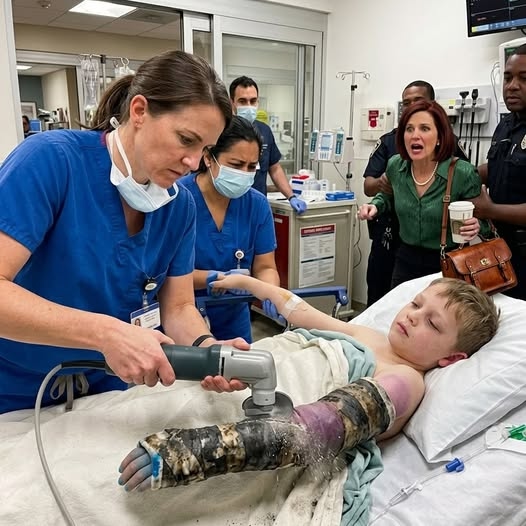
The smell had arrived in the ambulance bay before the gurney wheels crossed the pneumatic threshold.
It was not the sharp, copper stink of arterial hemorrhage, nor the sour, fermented reek of an upper gastrointestinal bleed—odors every trauma team absorbed until their nostrils ceased registering them. This was ancient. It carried the heavy, sickening sweetness of garden loam turned over in high summer, mixed with scorched meat and cheap lavender aerosol.
Dr. Sarah Lin pulled her latex gloves taut with a snap that echoed down the wide, linoleum throat of Trauma Bay 2. Outside, the November rain beat against the ambulance doors of St. Jude’s Children’s Memorial, drumming a wild, erratic cadence against the glass.
“Vitals on the run?” Sarah asked, her voice deliberately stripped of cadence, keeping her center of gravity low.
Beside her, Clara, a senior nurse whose calm had outlasted twenty years of pediatric horrors, was already spiking a liter bag of normal saline. On the opposite side of the steel gurney, Marcus, the clinical fellow, had his stethoscope looped around his knuckles, his gaze fixed on the bay doors as they banged open.
“Tachypneic at forty-four, heart rate one-sixty, pressure in the rig was eighty-two over forty,” the lead paramedic barked, steering the stretcher through the opening with one shoulder. He was sweating through his high-visibility vest. “Eight-year-old male. Mother walked him into an urgent care clinic forty minutes ago demanding an oral antibiotic for ‘a skin rash under his splint.’ Urgent care physician took one whiff, checked capillary refill, and called the box directly. We couldn’t establish an IV—veins are flat, completely collapsed. Kid’s burning up. Temp is one-hundred-three-point-eight.”
“I told them he didn’t need an ambulance,” a sharp, high voice cut through the mechanical squeal of the gurney wheels.
The mother had followed the stretcher through the doors, entirely ignoring the triage desk. She wore a tailored camel-hair coat that hung unbuttoned over an immaculate cream cashmere sweater. Her hair was gathered in a severe, glossy knot at the nape of her neck, and her manicure—pale blush, almond-cut—clutched an oversized designer tote bag like a shield. She looked forty, trim, her posture so rigid she appeared to be suspended from a hook.
“I have excellent private insurance,” she said, projecting her voice over the hiss of the wall suction. Her tone was brisk, managerial, the voice of someone returning an unsatisfactory purchase at a department store counter. “I drove him to the clinic because he was lethargic this morning. That incompetent doctor panicked. I told him Evan’s specialist is at Philadelphia Children’s, but he insisted on this transport. I want his chart transferred, and I want an attending physician who listens.”
“I am the attending,” Sarah said, not looking at her.
Sarah’s eyes were already on the boy.
He lay on the gurney like an unstrung marionette. His skin possessed that waxy, grayish-yellow undertone that pediatricians learn to dread in their marrow—the shadow that falls over a child whose organs are beginning to barter with one another for perfusion. His lips were dry and cracked, bleeding at the right commissure, and his dark eyes drifted toward the ceiling fixtures, unfocused, unblinking against the fluorescents.
His left arm lay across his small chest.
From the knuckles to just below the elbow, the limb was entombed in a crude, lumpy sleeve of white fiberglass. It was not the clean, smooth work of an orthopedic tech; the edges were jagged, fraying into sharp, synthetic threads that had dug into the crease of his elbow until the flesh there was ulcerated and scabbed over with yellow crust. The weave was thick in some spots and paper-thin in others, blackened with ground-in house grime, kitchen grease, and dark, oily stains that seemed to seep from the inside out.
From beneath the cuff of the wrist, five small fingers protruded. They were swollen to double their normal circumference, taut and shiny like overfilled sausages. The nail beds were not pink. They were the color of bruised plums.
“Clara, IO needle. Left tibia. We can’t fish for a vein right now; he’s in warm shock,” Sarah ordered, her fingers moving instantly to the boy’s radial artery.
There was nothing. Not even a thread of a pulse.
“Wait—what are you doing to his leg?” Martha Harris snapped, lunging toward the bed. “Do not drill into my son’s bone! What kind of medieval clinic is this? I demand you call Dr. Sterling—”
“Ma’am, step behind the yellow line,” Marcus said, interposing his body between the mother and the gurney.
“Get your hands off me! I am Evan’s mother! He has a low pain tolerance; you are terrifying him!”
The boy did not look terrified. He looked absent. His small chest hitched with shallow, dog-like pants. But as Sarah gently touched the tips of those cold, purple fingers, the boy’s head rolled on the pillow. His eyes, heavy-lidded and clouded with fever, fixed on the doctor’s badge hanging from her scrub pocket.
He parted his dry lips. A faint, whistling breath escaped him.
“Don’t…” he whispered.
Sarah leaned down until her ear was an inch from his mouth. “What is it, sweetheart?”
The boy’s eyes flickered past her shoulder, toward the sharp, immaculate silhouette of the woman in the camel-hair coat. A tremor passed through his chin, so violent his teeth clicked.
“I wasn’t… supposed to say,” he breathed.
Behind them, Martha’s managerial fury suddenly cut off. The sudden absence of her voice in the crowded room was louder than any shout. The silence hung there, suspended between the rhythmic beep of the cardiac monitor and the hiss of oxygen.
Sarah stayed low. Her voice remained steady, pitched at a conspiratorial, protective murmur that excluded everyone else in the world. “What weren’t you supposed to say, Evan?”
His gaze stayed pinned to his mother. He swallowed, his throat making a dry, clicking sound.
Sarah did not need a second glance. She rose smoothly, her face turning toward the open doorway where two hospital security guards had paused, alerted by the shouting.
Popular Posts
→- 1
- 2
- 3
- 4




Recently Viewed
Stories you read recently will appear here.





