Banners representing airborne and special operations divisions hung motionless from the high rafters. On stage, under the sharp glare of the spotlights, Lieutenant General Robert Hayes leaned in to secure the ribbon of the Purple Heart to my dress uniform.
His fingers were steady, his gaze piercing. “Sergeant Natalie Porter,” he murmured so only I could hear. “A long time coming, soldier.”
“Thank you, sir,” I whispered back. My heart pounded against my ribs like a trapped bird.
Two years earlier, on a scorched expanse of crushed rock outside an operating outpost in eastern Syria, an insurgent mortar had pulverized our perimeter wall. Shrapnel had shredded my shoulder and calf. Through the blinding dust and screaming chaos, I had found General Hayes—then a major general visiting the forward line—pinned beneath a collapsed steel support beam, his femoral artery dangerously close to being severed by jagged rebar. I had dragged him thirty yards across open ground under sporadic sniper fire, packing his wound with gauze until medevac arrived.
Today was supposed to be the closure of that nightmare. I had survived the surgeries, the endless physical therapy, and the night terrors. I had invited my father, Richard, because some foolish, unkillable part of me still wanted him to look at me and see someone worthy of respect.
He sat in the third row, dressed in a faded charcoal suit that looked two sizes too small. Beside him sat my stepmother, Linda, wearing an oversized floral blouse and a permanent sneer, her arms crossed over her chest. Next to her was her twenty-four-year-old son, Kyle, slouching in his seat, idly spinning his smartphone on his knee as if being present at a military honors ceremony was an unbearable chore.
General Hayes stepped back and offered a crisp salute. I returned it, the muscles in my arm burning with a clean, sharp pride. But as Hayes turned to acknowledge his aide-de-camp, his heel caught the raised edge of the temporary wooden riser. His bad leg—the one saved by steel pins and arterial grafts—buckled violently beneath him.
My body moved before my brain could register the command. I lunged forward, sliding my left arm beneath his broad shoulder, absorbing his two-hundred-pound frame just inches before he would have struck the edge of the stage.
He steadied himself on his good leg, drawing in a sharp breath. His hand rested on my forearm, his silver-threaded eyebrows lifting with quiet warmth. “Still looking after everyone, Sergeant Porter.”
“Always, sir,” I replied quietly.
Then, Linda’s voice pierced the reverie like broken glass.
“Look at her! Always putting on a show for the brass. Disgusting.”
The words cut through the hushed silence of five hundred soldiers, officers, and civilian families. Several junior officers in the front row stiffened. A row of paratroopers behind Linda turned their heads in unison, their jaws clenching.
I looked down from the edge of the stage. My voice was calm, pitched low to prevent any further scene. “Linda, sit down. Please.”
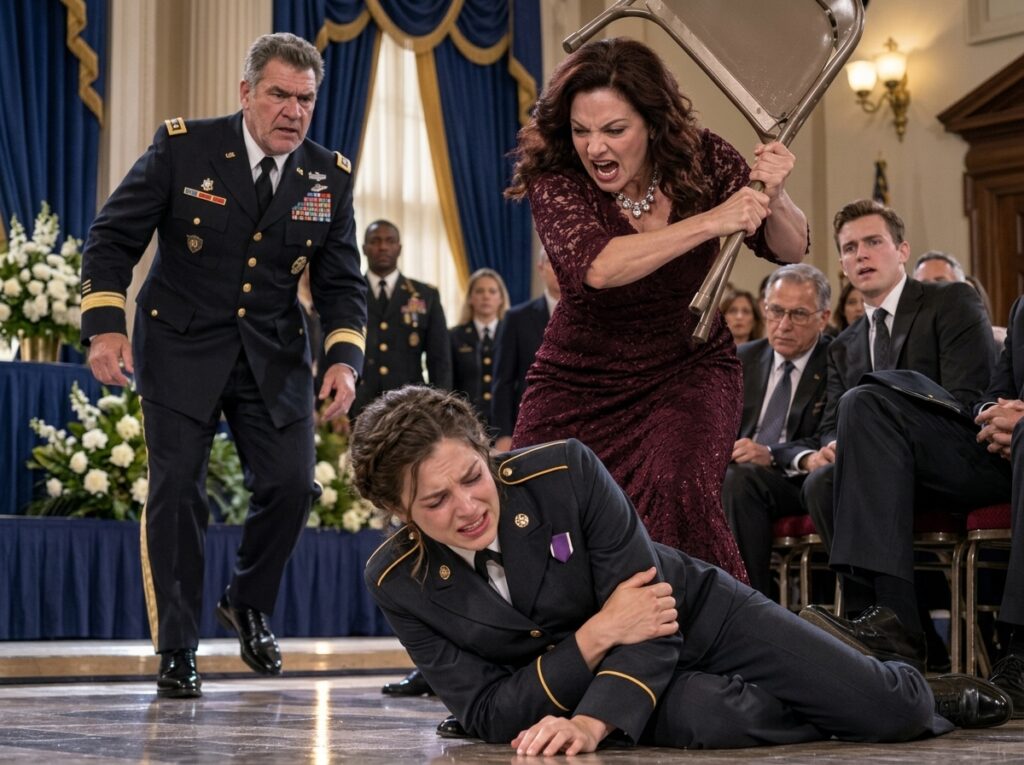
I didn’t curse. I didn’t shout. But in Linda’s warped world, a boundary from me was an unforgivable declaration of war. Her face twisted into a mask of pure, venomous rage. Before the military police stationed at the back could react, she reached down, grabbed a heavy, institutional steel folding chair from the empty seat beside her, hoisted it over her head, and charged the stage steps.
“Who the hell do you think you are?” she shrieked.
She swung the steel edge directly at my temple.
Survival instinct overrode protocol. I threw up my left arm to shield my head. The tubular steel struck the center of my forearm with a sickening, hollow crack that echoed off the auditorium walls.
The pain didn’t hit immediately—it blossomed like white fire, stealing the air from my lungs. My knees gave out, and I collapsed onto the wooden floor of the stage, clutching my shattered arm against my chest.
Through the red haze of agony, I heard chairs violently scraping backward. Boots thudded against the hardwood. Linda lunged forward again, spitting spit as she yelled, “A piece of tin doesn’t make you better than us! You’re nothing! You’re trash in uniform, just like your mother was!”
I lifted my head from the stage, searching the third row. *Dad. Please. Stop her.*
My father stood up. He looked at me, lying in a heap on the floor, my face pale and twisted in shock. He looked at Linda, who was now being tackled to the carpet by two armed MPs.
Then, Richard Porter lowered his eyes. He stared intently at the beige commercial carpeting between his worn dress shoes. He shoved his hands deep into his pockets.
Beside him, Kyle let out a wet, mocking snicker.
Two MPs wrestled Linda to the floor, twisting her arms behind her back as she shrieked, “Get off me! She’s my stepdaughter! This is a family matter! Richard, tell them!”
“No, ma’am,” a voice boomed across the stage—a voice forged in thirty years of combat command.
General Hayes stepped to the apron of the platform. The room fell into a deathly, suffocating silence. The general looked past the thrashing woman and fixed his gaze directly upon my father.
“It is not a family matter,” Hayes said, his tone colder than sub-zero steel. “It is an aggravated assault on an active-duty non-commissioned officer on a federal installation. And you, sir—” Hayes pointed a rigid finger at my father, who shrank beneath the weight of the stars on the general’s shoulders “—how does a father watch his daughter receive a medal for valor, watch someone try to cave her skull in, and find the floorboards more worthy of his attention than his own flesh and blood?”
Richard’s face drained of every drop of color. Linda began screaming that Hayes didn’t know the truth, that I was a liar who had manipulated everyone.
Popular Posts
→- 1
- 2
- 3
- 4




Recently Viewed
Stories you read recently will appear here.





