The rain was tapping a dull, monotonous rhythm against the roof of my car as I turned off Route 9 onto Elm Street. The town of Milbrook hadn’t changed in the decade since I left. The same peeling paint on the municipal building, the same flickering neon sign above the dry cleaners, the same suffocating blanket of small-town judgment hanging heavy in the damp New England air.
I checked my watch: 6:42 PM.
My fingers, resting on the steering wheel, were still faintly trembling. Not from the drive, and not entirely from the fatigue that had been hollowing out my chest since I received my mother’s phone call three days ago. It was the residue of a lifetime spent bracing for impact.
“Your father is dying,” she had said. No greeting. No warmth. Just a sentence designed like a hand grenade, lobbed straight into the quiet, carefully curated life I had built for myself in Boston.
I am Cassandra Miller. Thirty-six years old. I own a boutique interior design firm in Beacon Hill that took twelve years of seventy-hour workweeks, blood-shot eyes, and rejected bids to establish. I live in a fourth-floor brownstone with exposed brick, an espresso machine that cost more than my first used car, and absolute, undisputed autonomy. I don’t answer to anyone. I don’t explain my choices. And above all, I don’t carry emergency medication because I’m “making a fuss.”
Except, of course, when I do.
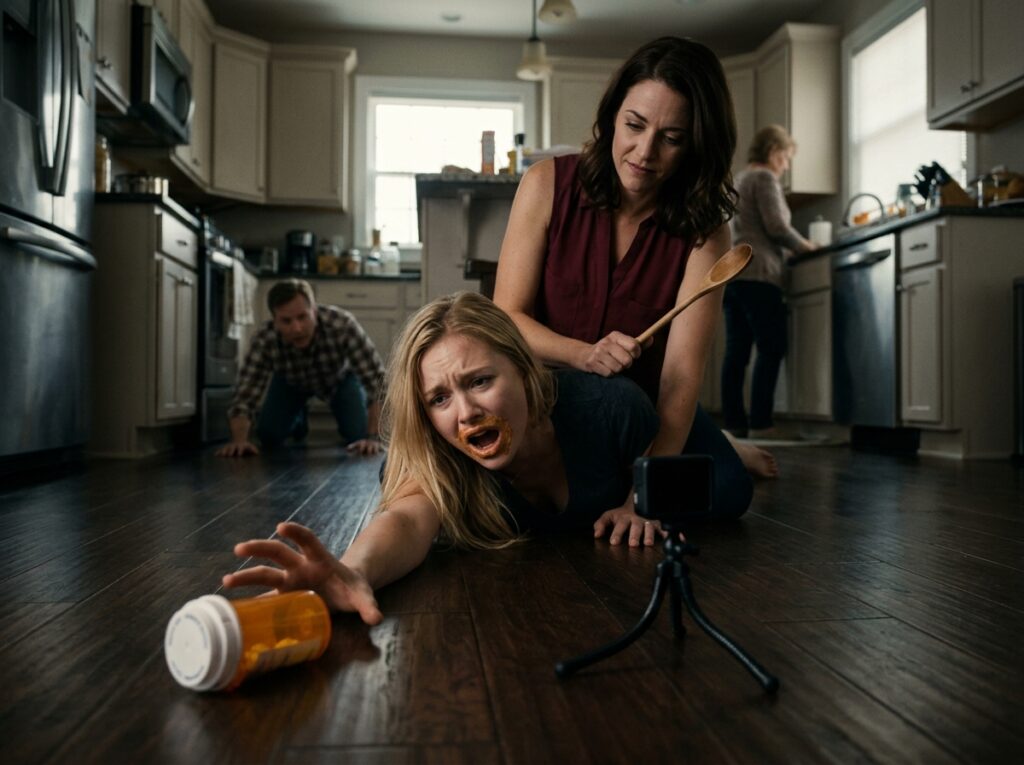
I reached instinctively for my right coat pocket, brushing my fingers against the hard plastic casing of my EpiPen. It was there, clipped securely inside its sleeve. Good. A second-nature reflex, forged when I was nine years old and my throat swelled shut over a handful of trail mix at a birthday party while my mother shrieked at the ER intake nurse for interrupting her paperwork.
“She’s just sensitive,” my mother had told the doctor, as if my immune system launching a full-scale civil war against cashew protein was a personality quirk she found mildly embarrassing. “Always has to be the center of attention.”
I pulled into the gravel driveway of the house where I grew up.
It was a sprawling colonial, once white, now a dull, weathered gray. The porch light was on, casting a jaundiced yellow glow over the overgrown hydrangeas. As I cut the engine, the silence of Milbrook rushed in to fill the car—heavy, oppressive, and smelling faintly of decaying leaves and wood smoke.
Before I could kill the headlights, the front door swung open.
Lydia.
My younger sister stood framed in the doorway, bathed in the harsh interior light. At thirty-two, she had perfected the art of looking like she belonged on the board of a junior league charity that didn’t actually do anything. Her ash-blond hair was blown out into cascading waves that defied the evening humidity. Her pearl earrings caught the porch light. She wore a cream cashmere cardigan that screamed “quiet luxury” over a pair of tailored black trousers.
On her wrist flashed the gold watch our father had given her for her thirtieth birthday. A watch he had never given me. Not because I didn’t turn thirty, but because by the time I hit thirty, I hadn’t spoken to them in five years, and my milestones were commemorated by silence.
I stepped out of the car, grabbing my leather tote bag. The mist was turning into a steady drizzle, plastering a strand of dark hair against my cheek.
“You’re late,” Lydia said, her voice carrying across the wet gravel. She didn’t move off the welcome mat. She stood there with her arms crossed, guarding the threshold like a bouncer at an exclusive club that nobody actually wanted to enter.
“Traffic on the turnpike,” I replied evenly, walking up the driveway. I kept my posture straight, shoulders back—the stance I used when walking into a hostile corporate client meeting where everyone expected me to fold. “And hello to you too, Lydia. It’s been—what? Three years?”
“Three years and four months,” she said, her lips tightening into a thin, bloodless line. “And you could have spared yourself the gas. You can see Dad for fifteen minutes. Then he has to rest.”
I stopped two steps below her on the porch, looking up into her pale, perfectly powdered face. “I drove three hours, Lydia. I’m not a visiting dignitary dropping in for a tea break. He’s my father.”
“He’s exhausted,” she shot back, her voice rising just enough to echo off the siding. “The doctor said—”
“I don’t care what the doctor said. I’m going inside.”
I brushed past her, catching a sharp whiff of her expensive jasmine perfume—a scent that managed to feel synthetic even up close.
Popular Posts
→- 1
- 2
- 3
- 4




Recently Viewed
Stories you read recently will appear here.





