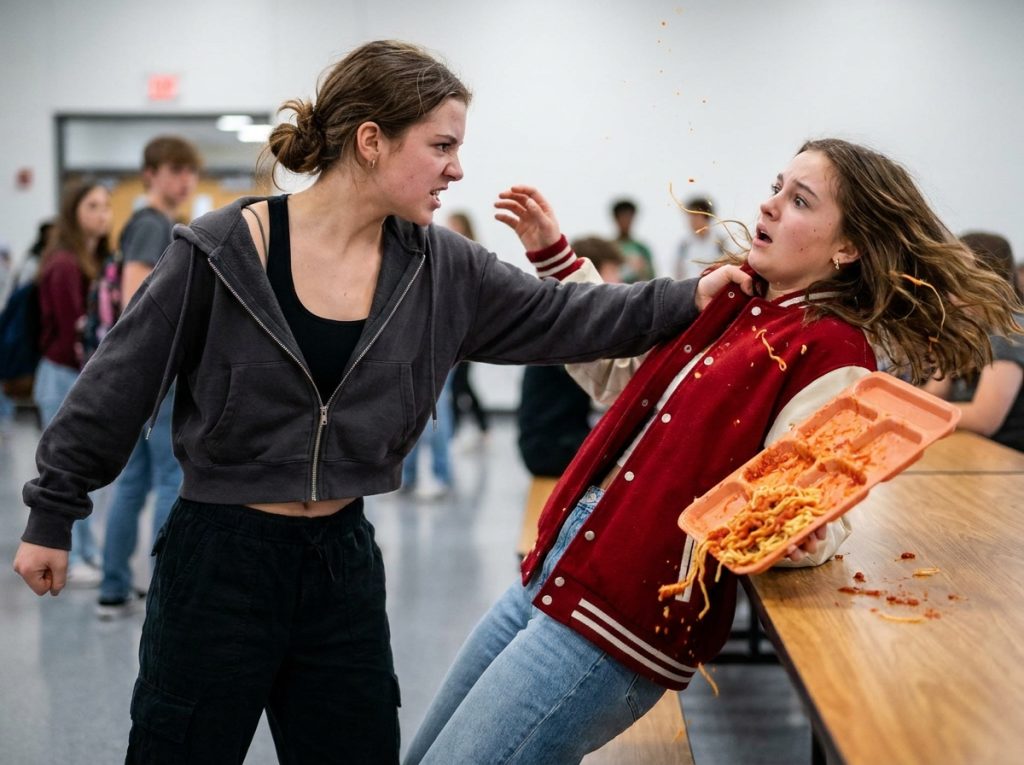
The fluorescent lights of Crestview High School did not merely illuminate; they interrogated. They buzzed with a low, persistent drone, casting an institutional pallor over locker-lined corridors that smelled perpetually of damp wool, floor wax, and teenage anxiety. For most people, high school was a chaotic mosaic of bells, pop quizzes, and awkward social rituals. But for Maya Lin, Crestview had spent the last seven months transforming into a calculated psychological gauntlet.
Bullying in the modern era rarely announces itself with movie-cliché shoves into metal lockers on the first day of the semester. It begins invisibly, like hairline fractures spreading across a windshield before the glass completely shatters. It starts in the architecture of exclusion: the hushed laughter that abruptly dies when you sit down at an open desk, the sideways glances exchanged across a chemistry lab bench, the calculated absence of your name from group chats that organize weekend study sessions.
Maya had watched the architecture build itself around her with the dread of someone watching the tide rise while pinned beneath a boulder.
She was seventeen, quiet by nature, with an observant mind and hands perpetually stained with charcoal from the advanced placement studio art course she treated as her sole sanctuary. Until sophomore year, she had existed comfortably on the periphery of the school’s social food chain. She had friends, she ran track, and she kept her grades sharp. But school dynamics are fragile ecosystems governed by predator-prey dynamics, and at the absolute apex of Crestview’s social hierarchy sat Vanessa Vance.
Vanessa was the daughter of an influential city commissioner and a founding patron of the school district’s athletics foundation. She carried herself with the untouchable arrogance of someone who had never once faced a consequence she could not smile, charm, or purchase her way out of. With her sleek ponytail, pristine leather-sleeved varsity jacket, and an entourage that operated like nervous courtiers guarding a vindictive queen, Vanessa ruled Crestview through an economy of humiliation.
The rift between them had started over something humiliatingly trivial: an honors English presentation. Vanessa, used to relying on the labor of others, had assumed Maya would quietly carry their paired semester project on dystopian literature. When Maya refused to attach Vanessa’s name to work she had not written, submitting her solo draft directly to the instructor, Vanessa had received her first academic reprimand.
To someone like Vanessa, accountability was not a lesson; it was an act of treason.
From that day forward, the campaign began. It was subtle at first—rumors circulated on anonymous student forums questioning Maya’s integrity, her family’s financial standing, her mother’s battle with chronic illness. Then came the physical micro-aggressions: elbows planted aggressively on her desk, art portfolios knocked from her hands in crowded stairwells with feigned apologies, shoes scuffing the back of her sneakers as she walked between classes.
Every adult Maya had ever consulted recited the same exhausted platitudes: “Just ignore her, Maya. People like that only want a reaction. When she sees it doesn’t bother you, she’ll move on.”
It was the most dangerous lie ever fed to victims of systematic cruelty. Ignorance does not starve a bully; it emboldens them. Silence does not project dignity; to a predator, silence registers as permission. By refusing to strike back, Maya had inadvertently signaled to Vanessa that the perimeter was undefended.
And so, the cruelty escalated until the air inside Crestview became unbreathable.
The Tuesday of the cafeteria incident began under a sky the color of wet slate. A freezing November rain battered against the tall, arched windows of the third-floor art studio. Maya had spent her free period meticulously working on a large oil canvas—a study of hands pulling apart thorns—attempting to submerge the knot of dread that lived permanently in her sternum.
When the midday bell rang, shrill and demanding, the knot tightened. Lunch was always the crucible. The cafeteria was an open arena where tribal allegiances were declared and territorial lines were strictly enforced. There were no teacher desks to hide behind, no structured assignments to diffuse tension, only rows of bolted-down laminate tables and four hundred watchful eyes.
Maya descended the stairs, her stomach churning. She had considered skipping lunch entirely, hiding out in the library annex with a dry granola bar, but she immediately rebuked herself for the thought. The moment you alter your daily survival around someone else’s malice, you have already surrendered your autonomy. She would eat. She would sit by the tall windows near the courtyard doors. She would finish her day.
Pushing through the double fire doors into the cafeteria, the sheer wall of noise hit her: the clatter of plastic trays, the screech of metal stools across linoleum, bursts of laughter, the thumping bass of someone’s Bluetooth speaker hidden inside a backpack. The smell of cheap tomato sauce, french fry oil, and bleached floor cleaner hung thick in the warm, humid air.
Popular Posts
→- 1
- 2
- 3
- 4




Recently Viewed
Stories you read recently will appear here.





