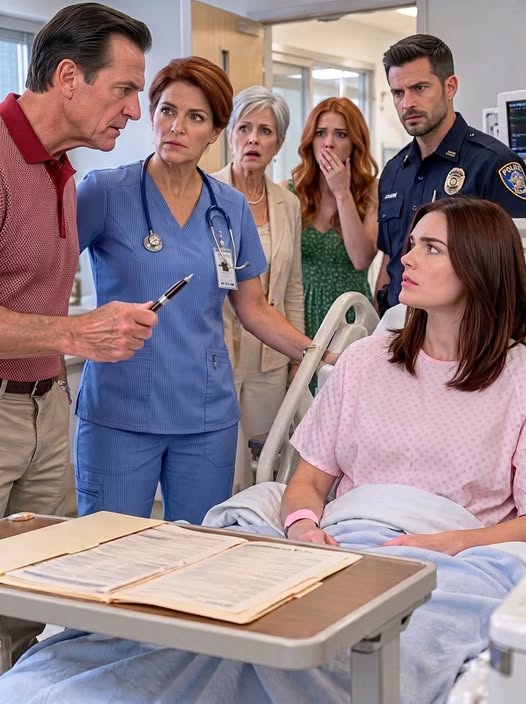
“She fainted? She’ll be fine
“Where do I sign?” Dad asked with an easy smile, as if he had come to pick me up from an appointment instead of a cardiac unit.
Ruth Vance, the charge nurse, stepped into the doorway before he could reach my bed.
“There’s nothing for you to sign.”
His smile barely changed.
“We’re her parents.”
Ruth held his gaze.
“That doesn’t give you authority here.”
I stayed silent while Dad looked past her at me, waiting for the version of Florence who always made things easier for everyone else. For thirty-four years, my family had mistaken my silence for surrender, but they had no idea that an old manila folder resting on the tray beside me had already changed everything.
Nine days earlier, I had gone to my parents’ house before dawn to see them off for a trip to Charleston for my younger sister Camille’s engagement gala. Suitcases crowded the entryway, Mom was fixing her lipstick, and Dad kept checking the flight status when my heart suddenly lost its rhythm.
I hit the kitchen floor hard enough that when I came around, all I could see were shoes, cabinet doors, and the underside of a chair. Camille sounded annoyed before she sounded concerned.
“Is she doing this now?”
A paramedic knelt beside me, studied the monitor, and immediately became serious.
“This isn’t a fainting spell. We need to transport now.”
Dad already had his keys in his hand.
“She’ll live. Gate’s at six.”
Then all three of them left for the airport while an ambulance took me in the opposite direction.
I spent the first days in the cardiac unit with an empty visitor chair beside my bed. The family group chat filled with photographs of champagne, formal dresses, chandeliers, and captions about how proud everyone was of Camille, while my own phone never rang.
It hurt, but it was not unfamiliar. I had been fainting since childhood, and every episode had been explained away as sensitivity, drama, jealousy, stress, or another attempt to get attention.
Eventually, I stopped asking anyone to believe me. I became an engineer instead and built a career around understanding exactly how much pressure a structure could withstand before it failed, although I somehow never applied the same logic to my own family.
Then Dr. Lindren, the electrophysiologist assigned to my case, noticed something strange in my medical history. There was a pediatric cardiology referral from when I was nine, a note documenting a prolonged QT interval, and then twenty-five years of silence.
“The file just stops.”
The next morning, she returned carrying the original paper record. It was an old manila folder with softened corners and my childhood name written across the tab in faded ink.
Inside was an ECG from when I was nine, followed by a specialist’s recommendation for treatment and follow-up. Behind those pages was one final document that Dr. Lindren hesitated to read aloud.
“You should see this yourself.”
She turned the folder toward me. After reading that page, I stopped wondering whether my parents had simply misunderstood what was happening to me as a child.
Now they stood in my hospital room, sun-tanned from Charleston, with Dad still behaving as though he controlled what happened next.
“We are taking our daughter home today. If you need a supervisor, get one.”
Ruth did not move.
“I am the supervisor. And Florence is not being released to you.”
Mom’s expression tightened while Camille’s smile disappeared. Dad looked at me again, clearly expecting me to calm everyone down and agree to leave with them.
I said nothing.
Ruth continued.
“You are not authorized to make medical decisions for this patient.”
Dad gave a short, disbelieving laugh.
“That’s absurd.”
Then a chair shifted behind my bed.
Someone who had been sitting quietly in the corner stood up, and Dad’s expression changed before the man even spoke. It was not anger that crossed his face first, but recognition followed almost immediately by fear.
“Hello, Dad.”
My brother Reed had supposedly been outside our family for six years. What my parents did not know was that a legal document had kept his name connected to mine the entire time.
They knew even less about the folder on my tray.
Dr. Lindren picked it up, crossed the room, and placed the yellowed medical record beneath the fluorescent light in front of my parents. Mom looked toward the wall while Dad stopped clicking his pen.
Dr. Lindren opened to the final page, where two signatures were visible beneath a handwritten note. She rested one finger beside the writing and looked directly at my mother.
“Mrs. Young, would you like to read what you wrote here twenty-five years ago… or shall I?”
Mom finally looked down at the page.
And all the color drained from her face.
Popular Posts
→- 1
- 2
- 3
- 4




Recently Viewed
Stories you read recently will appear here.





