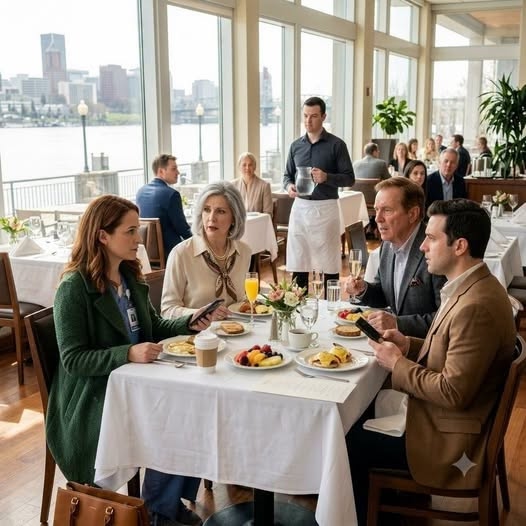
The first thing Elaine Miller said when her daughter walked into the restaurant was, “You look tired.”
Not hello.
Not how are you.
Not even the small mercy of asking whether Barbara had made it through another night shift at the pediatric unit.
Just tired.
Elaine said it softly, with a little smile tucked into the corner of her mouth, the way she always did when criticism needed to pass as concern.
Barbara stood beside the table with the strap of her work bag digging into her shoulder and scrub marks still pressed faintly into her skin.
The restaurant smelled like butter, maple syrup, coffee, and clean linen.
Outside the tall riverfront windows, late morning sun struck the water hard enough to make everything look brighter than it felt.
Barbara had not eaten since the vending-machine crackers she bought at 3:42 a.m.
Her paper coffee cup had gone cold in the cup holder of her car before she made it downtown.
At 5:48 a.m., a six-year-old boy had finally started breathing on his own.
His mother had cried into Barbara’s hands like those hands were the only steady thing left in the world.
Barbara had stayed calm through the monitors, the oxygen tubing, the frantic father who kept asking the same question, and the resident whose voice shook when the numbers dipped.
Then she had washed her hands until the hospital soap stripped her knuckles raw.
And still, she came to brunch.
She came because her mother had texted twice.
She came because her father had written, Your mom really wants the family together.
She came because some exhausted part of her had not yet given up on the idea that family could become family if she kept showing up in the right clothes, with the right tone, carrying the right amount of forgiveness.
Elaine sat with her pearls on and her posture perfect.
Robert Miller sat beside her with his Sunday jacket open and a champagne glass already half full.
Jeffrey was across the table, leaning back in a navy blazer that looked expensive in the effortless way money looks when nobody asks where it came from.
Barbara had seen that expression on her brother’s face since childhood.
It was the expression of a man who had never had to wonder whether someone would catch him.
Someone always had.
Their parents had paid for Jeffrey’s first car because he needed reliable transportation.
They had paid for his grad school because he had potential.
They had helped with the down payment on his condo because the market was impossible for young people.
When Barbara needed help during nursing school, her mother had suggested a cheaper apartment.
When Barbara picked up extra shifts until her feet cramped, her father told her hard work built character.
When she slept in her car between clinical rotations because driving home cost too much gas and too much time, nobody called that potential.
They called it discipline.
The waiter came by with water, and Barbara lowered herself into the open seat.
Her whole body ached from the night before.
Elaine looked at her daughter’s hair, then at the faint coffee stain on the sleeve of her scrub top beneath the coat.
“You should really try to take better care of yourself,” Elaine said.
Barbara smiled because smiling had been her first language in that family.
She smiled when she was hurt.
She smiled when she was embarrassed.
She smiled when she needed money and when they made her feel small for needing it.
She smiled when Jeffrey took credit for things other people made possible.
She smiled so often around them that sometimes, driving home, her jaw hurt.
Robert lifted his glass before Barbara had even unfolded her napkin.
“To Jeffrey,” he said.
Jeffrey looked down with a false little shrug, already pleased.
Elaine’s face lit up.
“Three-point-two million in revenue,” she said, turning toward Barbara like she was announcing a national holiday. “Can you believe it?”
Barbara looked at her brother.
He nodded once, humble enough to be unbearable.
“It was a strong quarter,” he said.
Robert clapped him on the shoulder.
“Our boy built something real,” he said.
Barbara felt something tighten under her ribs.
Their boy.
She looked at Jeffrey’s hand resting near his phone.
He had a watch Barbara recognized from a photo he had posted the month before.
Her mother had commented, So proud of the man you’ve become.
Barbara had been at work when she saw it.
A child had vomited on her shoes that morning.
A father had screamed at the intake desk.
A grandmother had handed Barbara a sandwich because she said nurses never ate enough.
Barbara had liked the photo anyway.
She had always liked the photos.
That was the kind of daughter she had trained herself to be.
Elaine turned toward her.
The smile changed.
Barbara saw it before the words came.
Her mother had different smiles for different uses.
There was the church smile, the neighbor smile, the waitress smile, the Jeffrey smile, and the Barbara smile.
The Barbara smile was soft enough to look kind from across a room.
Up close, it had teeth.
“Barbara,” Elaine said, “how does it feel being the one who never quite keeps up?”
The waiter stopped pouring water.
It was not dramatic.
It was worse than dramatic.
It was ordinary.
The kind of cruelty that had been allowed to become familiar because nobody at the table ever called it what it was.
Jeffrey laughed under his breath.
Robert did not look embarrassed.
He took his butter knife and spread butter across his toast with careful little strokes.
Barbara looked at her mother.
Her hands were still raw from hospital soap.
The room had that strange restaurant brightness where nothing could hide.
Forks hovered.
A spoon chimed against a cup, then stopped.
Champagne bubbles climbed in narrow glasses like the table had not just split open.
The waiter stared at the white tablecloth, trying to become invisible.
Popular Posts
→- 1
- 2
- 3
- 4




Recently Viewed
Stories you read recently will appear here.





