PART 2
Gene’s scream shattered the careful Christmas silence.
The small brass key slipped from her fingers, struck the edge of her plate, and landed beside a smear of cranberry sauce with a sharp metallic click.
For several seconds, nobody moved.
The chandelier hummed faintly above us. Somewhere in the kitchen, the refrigerator motor kicked on. Outside, the winter wind pushed the American flag against the porch railing again and again.
Tap.
Tap.
Tap.
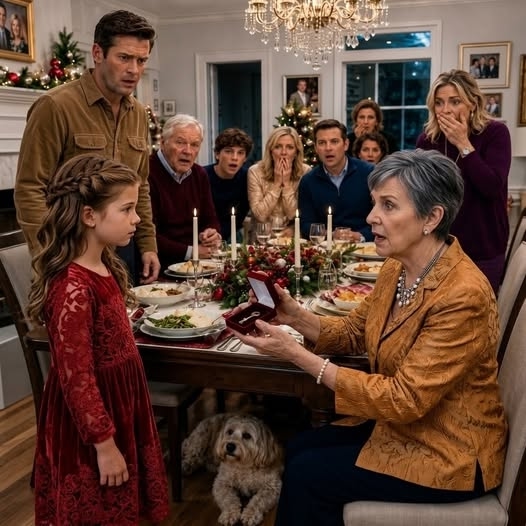
Gene stared into the red velvet box as though Brandon had placed something alive inside it.
“What is this?” she demanded.
Her voice was no longer polished.
No longer amused.
It was frightened.
Holly remained standing beside the table in her wrinkled gold dress, her little purse hanging from one wrist. She looked at Brandon, then at me, uncertain whether she had done something wrong.
Brandon stepped closer to her.
“You’re okay,” he said quietly.
Gene snatched the folded card from the box.
“Brandon, what did you do?”
“Read it.”
“I asked you a question.”
“And I told you to read it.”
The entire family seemed to shrink into their chairs.
Gene had spent decades controlling rooms through discomfort. She knew how to sigh at precisely the right moment, how to turn an insult into a joke, how to punish resistance with silence.
But for the first time since I had known her, the room wasn’t afraid of disappointing her.
It was waiting for her to understand something.
Gene unfolded the card.
Her eyes moved across the first line.
Then the second.
Her face changed.
The color drained from her cheeks so quickly that her sister, Margaret, whispered, “Gene?”
Gene ignored her.
She read the note again.
Then she looked at Brandon.
“You wouldn’t.”
Brandon’s expression remained calm.
“I already did.”
My stomach tightened.
I still didn’t know what was happening.
“What does it say?” I asked.
Brandon glanced at me.
Before he could answer, Gene slammed the card onto the table.
“This is my house!”
No one spoke.
She pointed at Brandon with a trembling finger.
“My house. Your father bought this house for me. I raised you here. I buried my husband from this house. You cannot come in here and threaten me because some child got her feelings hurt over a Christmas present.”
Brandon’s jaw hardened.
Beside him, Holly lowered her eyes.
I saw it immediately.
So did he.
Some child.
Not Holly.
Not his daughter.
Just some child.
Brandon bent, picked up the card, and handed it to me.
I read it.
And suddenly, the brass key made sense.
Three years earlier, shortly after Brandon’s father died, Gene had called us one night crying.
She said the mortgage was behind.
She said medical bills had wiped out almost everything.
She said the bank was preparing foreclosure paperwork.
Brandon had never told me the full details afterward.
He only said, “It’s handled.”
I assumed he had given her money.
He hadn’t.
His development company had purchased the mortgage and later acquired the house outright through a private agreement Gene signed with an attorney present.
She was allowed to remain in the property for life.
No rent.
No payments.
No risk of losing it.
There had been one personal provision Brandon had insisted on adding to the arrangement.
Not a legal condition.
A promise.
As long as this remained the family home, every child Brandon considered his own would be welcomed there as family.
The note in my hand was simple.
Gene had broken the promise.
Repeatedly.
So Brandon had transferred ownership of the property out of his company and placed it into a newly created trust.
Holly’s trust.
Gene could remain for ninety days.
After that, Holly’s trustee would decide whether the property would be leased, sold, or used differently.
I stared at Brandon.
“You gave Holly the house?”
“No.”
He looked at our daughter.
“I gave her control over what happens to a place where she was repeatedly told she didn’t belong.”
Gene laughed once.
The sound was harsh and broken.
“You’re insane.”
“No.”
“You’re throwing your mother onto the street!”
“I paid your mortgage for three years. I covered the property taxes. I paid for the roof, the plumbing repairs, and Dad’s remaining medical debt. You were never going onto the street.”
Brandon’s voice lowered.
“But I will not finance a place where my daughter is humiliated.”
Gene pushed back from the table.
“This is because of a candle?”
Brandon stared at her.
“No. The candle is just the first thing everyone else finally saw.”
Silence.
He began counting.
“The Easter dinner when you seated Holly at the kitchen counter while the other grandchildren sat at the dining table.”
Gene opened her mouth.
“The family photograph where you told the photographer to take one picture without her.”
“That was—”
“The birthday party where every grandchild’s name was written on the cake except hers.”
“I forgot.”
“The beach trip you invited us to, then told Holly there wasn’t enough room in the rental house.”
“That was a misunderstanding.”
“The Christmas card addressed to me, my wife, and ‘guest.’”
Gene’s lips tightened.
Brandon’s eyes never left hers.
“And yesterday, a candle labeled ‘To Brandon’s Girl.’”
He pointed toward the handwritten place card beside Holly’s plate.
“And today, you wrote Guest instead of her name.”
No one defended Gene.
That seemed to frighten her more than Brandon’s anger.
She looked around the table.
“Surely one of you understands how ridiculous this is.”
Her eldest daughter, Camille, stared down at her hands.
Gene turned toward her.
“Camille?”
Camille swallowed.
“Mom, you did leave Holly out.”
Gene’s expression sharpened.
“Excuse me?”
“You did.”
Gene laughed again.
“Wonderful. Apparently I’m being tried in my own dining room.”
Then Holly spoke.
“I don’t want your house.”
The adults turned toward her.
She stood so still that she looked much older than seven.
Gene blinked.
“What?”
Holly picked up the brass key.
She crossed the room.
For one terrible second, I thought she was going to apologize.
Popular Posts
→- 1
- 2
- 3
- 4




Recently Viewed
Stories you read recently will appear here.





