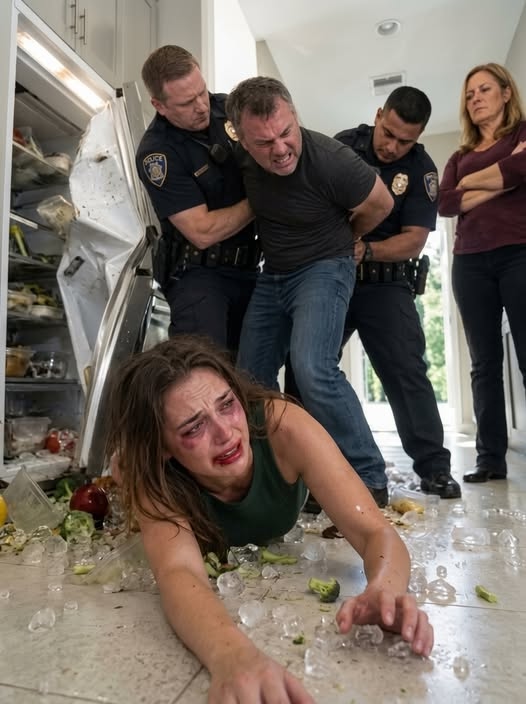
My sister’s first words were, “Please don’t call Mom.”
Then I heard her dragging herself across the kitchen floor.
“Lily, where’s your wheelchair?”
“He put it outside. Claire, I can’t stand up.”
Her breathing broke into shallow, frightened gasps. Behind her, my stepfather shouted that she had better hang up before he gave her something worth crying about.
I grabbed my keys, but I didn’t start driving yet. I called emergency services with our mother’s address, explained that an injured woman with a spinal disability was trapped inside, and stayed connected until dispatch confirmed officers and an ambulance were going.
Then Lily whispered what had happened.
Grant had rammed her into the open refrigerator because she refused to sign some papers. When she tried to reach her chair, he drove his knee into her face. She had crawled through spilled groceries to retrieve the phone he had knocked beneath a cabinet.
“Mom watched,” she said.
That was the sentence I carried through five hours of rain.
I lived across the state. Until that night, I had believed distance was our biggest problem. Our mother, Denise, always said Lily was tired when I called, sleeping when I visited, improving whenever I asked about her treatment.
At twenty-four, Lily had lived with limited movement in her legs since the crash that killed our father seven years earlier. She could transfer herself with assistance and walk short distances in braces. She could also run circles around me with a spreadsheet.
By the time I reached the hospital, Grant was in custody.
Our mother was outside Lily’s room, wearing dry clothes and carrying a department-store bag.
“It’s just a minor scratch,” she said. “Grant lost his temper. Your sister can be difficult.”
Through the doorway, I saw the splint across Lily’s broken nose.
“Move.”
Mom caught my sleeve. “Before you make this worse, remember who has been taking care of her.”
I pulled away.
Lily lay beneath a thin blanket, holding her phone with both hands. Her wheelchair stood beside the bed, wet from the officers retrieving it from the porch.
She cried when she saw me, but she didn’t ask whether Grant would come back.
She asked, “Did I sign anything?”
A nurse explained that Lily had repeatedly asked the same question. She was frightened that medication would make her agree to something she didn’t understand.
“You don’t have to sign anything,” I told her.
Her eyes shifted toward the doorway.
“There’s a hearing Monday. Mom says you already agreed.”
Mom stepped inside before I could answer.
“She’s confused. The attorney will explain.”
Lily pressed her phone into my palm. Beneath its cracked screen was a photograph of a court petition requesting emergency guardianship over her finances and medical decisions.
Attached was a statement claiming Lily could no longer understand basic choices and that her closest relative supported institutional placement.
I scrolled to the signature page.
My name was there.
My signature was there.
And below it, my mother had written that I had personally witnessed my sister threatening to hurt herself.
“I never signed this.”
Mom glanced at the phone, then at the nurse. “We discussed it. You were upset.”
“Leave the room.”
The nurse called security when Mom refused. As they escorted her out, she told Lily that nobody else would tolerate the burden of caring for her.
Lily’s fingers tightened around mine.
Once the door closed, she showed me the message Mom had sent that morning: Sign the consent tonight, or Grant will explain why you should.
The photograph wasn’t evidence of confusion. It was evidence of a deadline.
I called the attorney listed on the petition. His voicemail said his office would reopen Friday. I left a message disputing my signature and asking him to preserve every document and communication connected to the filing.
Then I contacted the officer handling Grant’s arrest. Detective Elena Ruiz returned my call before sunrise.
She photographed the message, requested the hospital’s injury documentation through the proper process, and asked Lily questions directly. She never looked at me for answers Lily could give herself.
That simple courtesy nearly made my sister cry again.
Grant had told responding officers that Lily fell while reaching into the refrigerator. Mom supported him. But the damaged refrigerator liner, scattered groceries, and Lily’s account gave Ruiz reason to keep investigating.
There was something else.
Our father’s estate included a trust for Lily’s care. Mom managed it as trustee. At twenty-five, Lily would gain the right to request a full accounting and appoint an independent trustee under its terms.
Her birthday was eleven days away.
“I asked for the statements,” Lily said. “That’s when they started saying my medication made me paranoid.”
She had received notices for therapy sessions she never attended and medical equipment she never received. When she questioned them, Grant took her laptop. Mom started screening her calls.
I wanted to smash something. Instead, I wrote down dates.
The doctor also asked Lily whom she wanted visiting. She named me, excluded our mother, and requested that staff document the choice in her chart.
By Friday afternoon, a legal aid attorney named Marcus Bell had agreed to represent Lily in opposing the petition. He explained that physical disability alone did not establish inability to make decisions, and he requested the underlying records.
One attachment contained an assessment from a private evaluator.
Lily stared at his photograph.
“That man never met me.”
Mom had told the court he examined Lily at home. His report described memory failures, aggression, and a dependence on sedatives. Lily’s hospital physician found her alert, oriented, and capable of explaining the choices before her.
Then Marcus found the electronic signing record for my declaration.
The authorization code had gone to Mom’s phone. The document had been opened from her home internet connection.
But the biggest shock came from Lily.
“Grant wasn’t the one who wanted the money,” she said.
Popular Posts
→- 1
- 2
- 3
- 4




Recently Viewed
Stories you read recently will appear here.





