On My Seventieth Birthday, My Daughter-in-Law Threw My Dinner in the Trash—Then My Son Chose Her
PART 1: THE ROAST IN THE GARBAGE
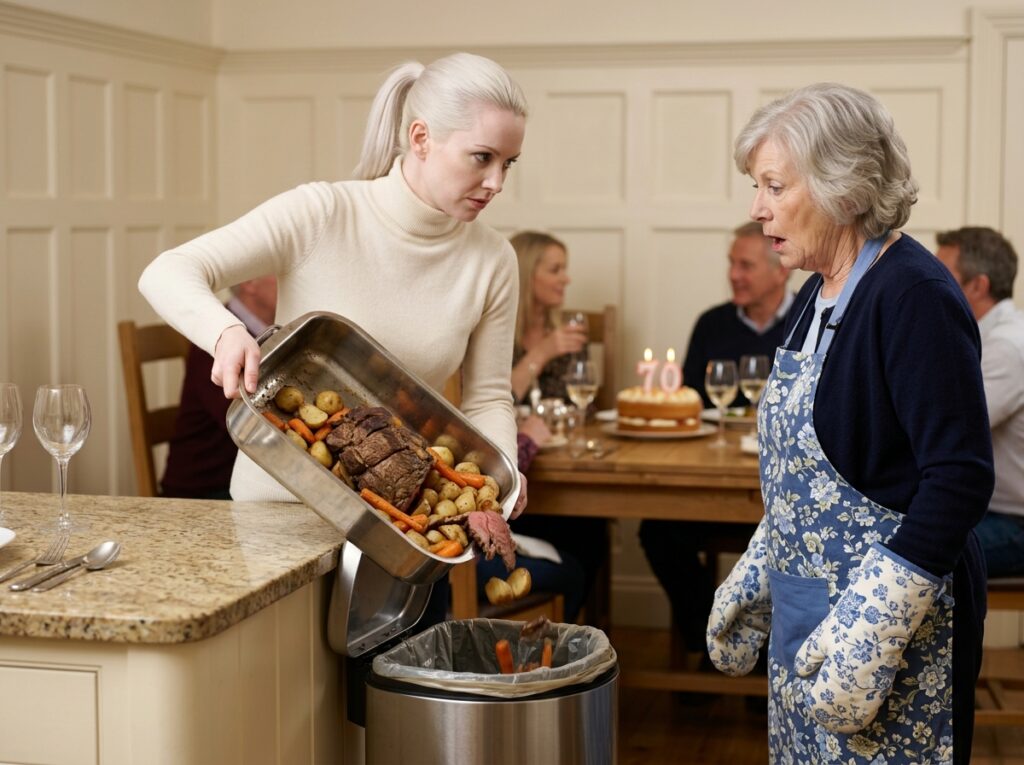
My daughter-in-law grabbed the roast I had cooked for my seventieth birthday and dumped it straight into the trash in front of twenty guests.
The silver tray struck the rim with a sharp metallic clang.
Potatoes rolled across coffee grounds. Carrots disappeared beneath crumpled paper towels. The roast I had seasoned before sunrise slid sideways into a black plastic bag while the smell of rosemary and garlic still hung in my dining room.
Nobody moved.
Not Helen, my oldest friend.
Not my sister-in-law Joan.
Not the neighbors who had known me for twenty years.
Not even the three women Sarah had invited without asking me.
Sarah stood beside the trash can with both hands resting on her hips.
Then she looked me directly in the eye.
“I told you not to serve that. My friends are here.”
For a moment, the only sound in the room was the soft music playing from the speaker on the kitchen counter.
I looked at the garbage.
Then at Sarah.
Then at the candles burning on the cake somebody had placed at the far end of the table.
Seventy candles would have been ridiculous, so Helen had bought two number candles instead—a seven and a zero.
They were still burning.
“This is my birthday,” I said.
My voice sounded strangely small.
Sarah did not apologize.
She gave me the same tight, irritated expression she used whenever I put something in the dishwasher differently than she preferred.
“Exactly,” she said. “So stop embarrassing us and sit down.”
Across the room, Helen slowly lowered the wineglass in her hand.
Someone whispered my name.
I barely heard it.
Because Michael was moving.
My son.
My only child.
Forty years old, broad-shouldered, still with the little scar near his eyebrow from the time he fell off his bicycle at eight.
He stepped between Sarah and me.
And for one foolish, desperate second, I thought he was going to defend me.
I thought I would hear him say, Sarah, what are you doing?
I thought he might pick up the tray.
I thought he might tell his wife that she had crossed a line.
Instead, he turned toward me.
“Mom, stop.”
I stared at him.
He rubbed the back of his neck.
“Sarah worked really hard on tonight.”
Something in my chest went hollow.
“She just threw my dinner in the garbage.”
“It’s not about the dinner.”
Sarah folded her arms.
“Thank you,” she murmured.
She said it as if Michael had finally corrected an unreasonable employee.
I looked at my son for so long that he shifted his weight.
My hands were still holding the oven mitts.
Blue cotton.
Little white flowers.
Michael had given them to me for Mother’s Day years ago.
I looked down at them and almost laughed.
For fourteen months, I had been swallowing little things.
A moved chair.
A replaced curtain.
A shelf cleared without asking.
A photograph taken down.
A dinner changed.
A weekend plan altered.
A guest invited.
A room repurposed.
Each time I objected, Michael said some variation of the same sentence.
“Is it really worth fighting about?”
And because I loved him, because I wanted peace, because I had spent most of my life believing that maturity meant knowing which battles not to fight, I had always answered no.
No, it wasn’t worth it.
No, the curtains weren’t worth it.
No, the bookshelves weren’t worth it.
No, the dining room wasn’t worth it.
No, my preferences weren’t worth making my son uncomfortable.
Standing there on my seventieth birthday, staring at the dinner I had cooked sitting in the garbage, I finally understood what all those small noes had become.
Permission.
Sarah looked around my dining room.
“We live here, Margaret,” she said. “It’s our home too.”
Helen drew in a breath behind me.
I turned slowly toward Michael.
I waited.
He looked at the floor.
“Your home?” I asked.
Sarah lifted her chin.
“You know what I mean. We contribute. We live here. We’ve made this place livable again.”
Livable.
My house.
The house where I had raised Michael.
The house where my husband, Robert, had spent six months replacing the upstairs floors himself because we could not afford contractors.
The house where I had sat beside him during his last Christmas.
The house whose mortgage had been paid off with thirty-one years of our work.
Livable.
Michael and Sarah had moved in fourteen months earlier because they were in trouble.
“Three months,” Michael had told me.
“Maybe four.”
Their rent had gone up. Sarah had changed jobs. They wanted to save enough for deposits and moving expenses.
I had three bedrooms.
I lived alone.
He was my son.
I had not charged them a dollar.
At first, they bought groceries.
Michael fixed the leaking bathroom tap.
Sarah cooked dinner twice a week and thanked me constantly.
Then three months became five.
Five became eight.
By the ninth month, Sarah stopped asking before inviting people.
By the tenth, she changed my curtains.
By the eleventh, my books disappeared into cardboard boxes in the garage because she “needed a cleaner look.”
By the twelfth, the framed photographs from our family vacations had been replaced by an enormous portrait from their wedding.
Whenever I objected, Michael sighed.
“Mom. Is it really worth fighting about?”
Apparently Sarah had decided the answer would always be no.
Now she stood in the center of my birthday party and looked at me as though I were the guest who had overstayed.
“You can’t keep acting like everybody has to ask your permission forever,” she said.
I stepped toward her.
“No, sweetheart.”
My voice had changed.
I heard it.
So did everyone else.
“Explain exactly what you mean.”
Sarah gave a small, superior smile.
“Things are changing, Margaret.”
Michael said quietly, “Sarah.”
But she was looking at me now.
“You can’t keep controlling this house forever.”
Popular Posts
→- 1
- 2
- 3
- 4




Recently Viewed
Stories you read recently will appear here.





