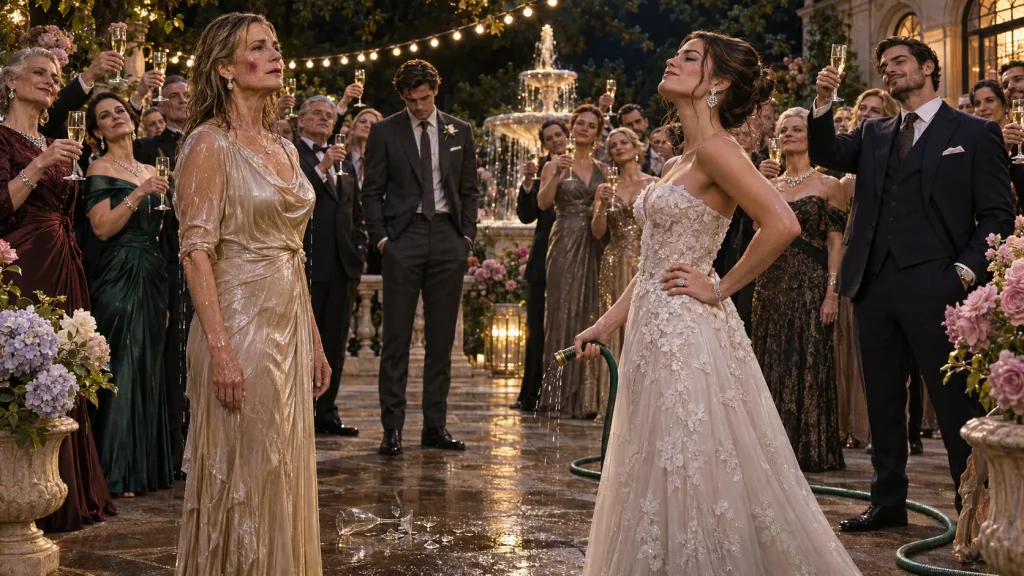
The moment my son’s fiancée turned a garden hose on me in front of thirty guests, I knew she expected me to lose control.
But I didn’t understand how carefully she had prepared for it until twenty-seven champagne glasses rose into the air.
And by then, my only son had already made his choice.
My name is Eleanor Bellini.
I was sixty years old that evening, standing on the terrace of a home I had owned for almost three decades.
My cream silk dress clung to my skin.
Water dripped from my hair onto the polished stone beneath my feet.
A broken champagne flute lay beside my shoes, its delicate stem shattered into pieces.
Around me stood people I had known for years.
People I had welcomed into my home.
People whose businesses had survived because of decisions I had made.
And they were laughing.
Not nervous laughter.
Not the uncomfortable kind that comes when something terrible happens and nobody knows how to respond.
They were enjoying themselves.
Serena stood a few feet away, wearing a white engagement dress that probably cost more than some people earned in a month.
The garden hose lay behind her.
She had dropped it only after soaking me from my shoulders to my knees.
“Maybe now you’ll understand,” she said, smiling.
“This isn’t your night.”
I stared at her.
“Serena, what exactly do you think you’re doing?”
She stepped closer.
“Teaching you something you should have learned years ago.”
Then she slapped me.
Hard.
My head turned with the impact.
A sharp pain spread across my cheek, followed by a ringing sensation inside my ear.
Someone gasped.
Someone else laughed.
And somewhere behind Serena, I heard a man say, “Well, that’s one way to handle her.”
I could have struck her back.
I had every reason to.
Instead, I looked past her.
Adrian stood ten feet away.
My son.
My only child.
Twenty-nine years old, handsome in a charcoal suit, with the same dark eyes his father had possessed.
He looked directly at me.
For one brief second, I thought he would move.
Instead, he lowered his eyes.
That hurt more than the slap.
“Adrian.”
He didn’t answer.
“Look at me.”
His jaw tightened.
“Mom, please don’t make this worse.”
For a moment, I couldn’t breathe.
I was the one standing there drenched.
I was the one whose face had just been struck.
And somehow, in my son’s mind, I was the person capable of making things worse.
Serena gave a small, satisfied laugh.
“You see, Eleanor?
Even Adrian understands.”
I turned back toward her.
Something about her confidence bothered me.
It wasn’t simply arrogance.
Serena wasn’t behaving like a young woman who had lost her temper during an argument.
She looked pleased.
Almost relieved.
As though everything was proceeding according to schedule.
And that was when I smiled.
The expression surprised her.
Her own smile faltered.
I reached toward a nearby table, picked up a fresh champagne flute, and turned toward the guests.
“I have one question.”
The laughter diminished.
“If you believe Serena was justified in what she just did, raise your glass.”
For approximately two seconds, nobody moved.
Then the glasses went up.
Almost together.
Twenty-seven.
Perhaps twenty-eight.
I counted them twice.
Some guests smiled.
Others looked uncomfortable, but they raised their glasses anyway.
A man near the fountain shouted, “Cheers!”
The laughter returned.
Serena looked delighted.
But I barely noticed her.
I was watching their hands.
For thirty-four years, I had helped run the Bellini organization.
I had negotiated contracts, settled disputes, faced hostile competitors, and survived people who shook my hand while quietly trying to destroy everything I had built.
I understood human behavior.
I understood hesitation.
And I understood the difference between a spontaneous reaction and a rehearsed one.
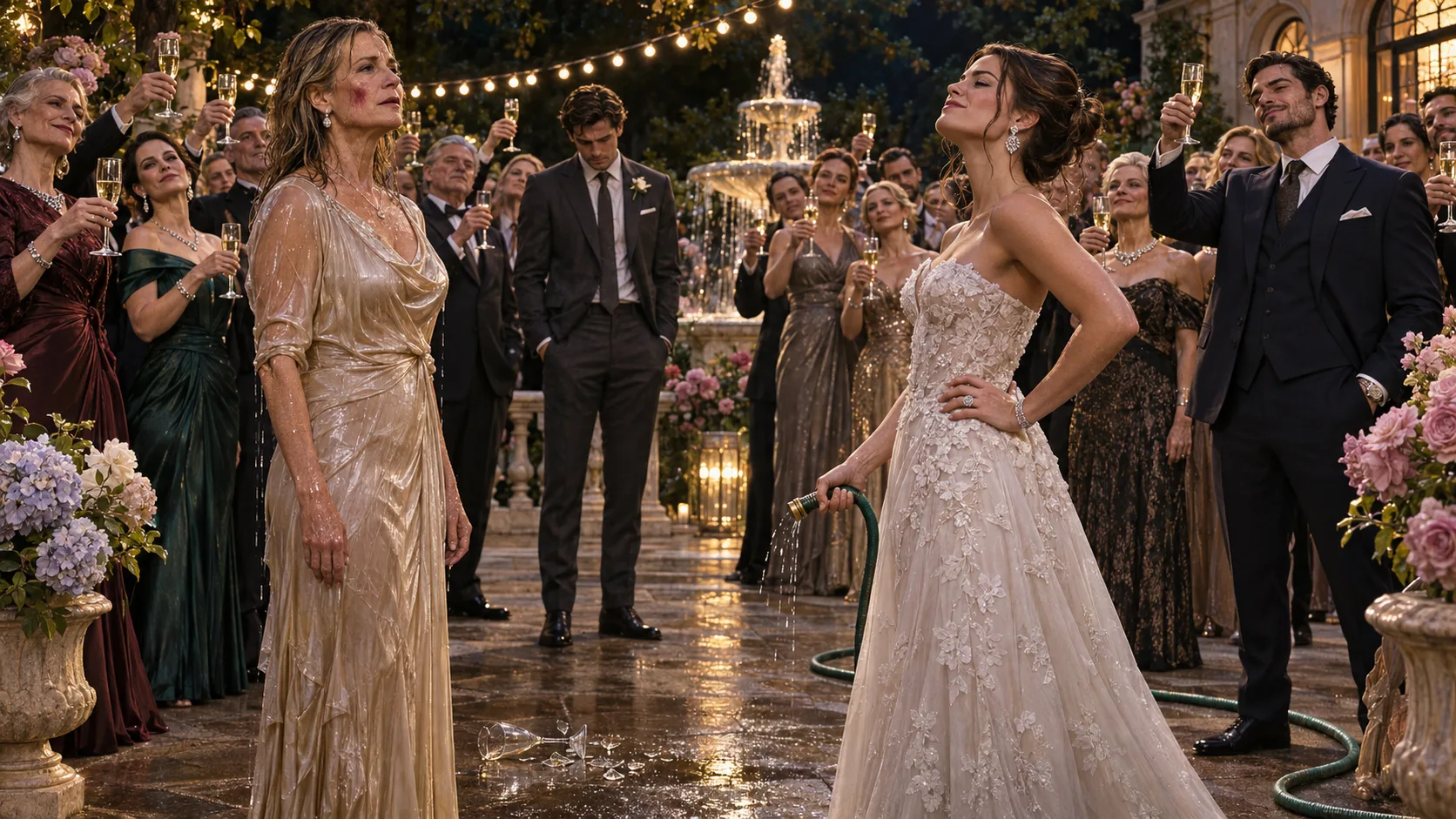
Twenty-seven people did not make the same unusual gesture at nearly the same instant unless someone had prepared them.
I looked at Serena.
“You knew they would do that.”
Her eyes flickered.
“What?”
“The glasses.”
She laughed.
“Everybody knew.”
Everybody knew.
Except me.
Before I could ask another question, her older brother stepped forward.
Grant Whitmore.
Forty-two years old.
Expensive suit.
Expensive watch.
The permanent expression of a man who believed other people existed to recognize his importance.
Grant had spent months advising Adrian about the need for younger leadership.
He had never particularly liked me.
Until that evening, he had at least pretended to respect me.
“Look around you, Eleanor,” he said.
“These people are tired of kneeling.”
“No one here has ever knelt to me.”
“That’s what tyrants always say.”
I studied him.
“Do you actually believe that, Grant?
Or have you simply practiced saying it?”
His smile vanished.
“You need to leave.”
I looked around my own garden.
The stone fountain my husband had chosen.
Popular Posts
→- 1
- 2
- 3
- 4




Recently Viewed
Stories you read recently will appear here.





