My Son Let His Bride Humiliate My Wife, So I Stopped Paying for Their Perfect Wedding
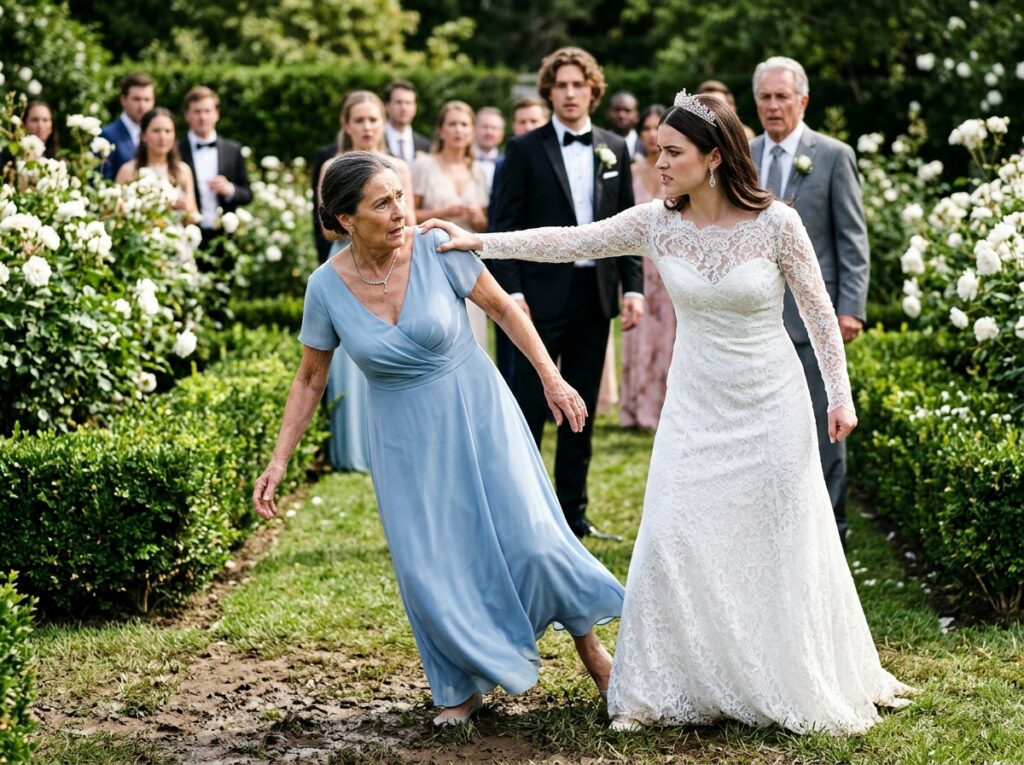
When my son’s cruel bride pushed my wife into the mud, the wedding stopped being a celebration in my eyes.
I had paid for everything. The venue. The flowers. The music. The dresses. Every invoice that crossed my desk in the months leading up to this day, I signed without hesitation. I told myself it was love. I told myself that family meant making things possible, even when they were not asked for, even when they were never thanked for.
My wife stood beside me the entire time. She had spent years being kind to that woman. Years of swallowing words that wanted to come out. Years of smiling at dinners where the bride made small comments designed to humiliate her quietly. And I said nothing. I told myself patience was a form of strength.
I was wrong.
The mud was dark and cold. I watched it catch the hem of her dress. I watched her knees press into the wet ground in front of two hundred people. The bride stood above her with nothing on her face except satisfaction. No shock. No regret. Just the look of someone who had finally gotten away with something she had been planning for a long time.
The guests were quiet. That silence was worse than any sound. It meant everyone saw it. Everyone decided to watch.
I walked to the microphone. I did not shout. I did not cry. My hands were steady because something inside me had gone still in a way I had never felt before. I canceled the entire wedding payment. Every account. Every commitment. I said it into that microphone with the same calm voice I had used when I signed the first check.
Then I walked away.
I left them to face the public shame of what they had done. I did not look back at my son’s face. I did not look at hers.
The wedding was held at…
The wedding was held at Briarwood Estate, a white-columned venue outside Charleston with manicured lawns, a lake behind the ceremony arch, and two hundred guests dressed as though they had stepped from the pages of a magazine.
My son Daniel stood beside his bride, Vanessa, smiling like a man who had just been handed the life he believed he deserved.
My wife Margaret sat in the front row with tears in her eyes and a folded handkerchief held carefully between both hands. She had always done that at important moments. She treated joy as something fragile, something that could be bruised if you held it too tightly.
For months, she had tried to love Vanessa.
She helped choose flowers, though Vanessa changed her mind three times and blamed Margaret each time the florist sent another invoice. She addressed invitations at our kitchen table in her careful, sloping handwriting. She made calls to relatives Daniel had not spoken to in years because, as she said, “It is still his wedding day. We should at least try.”
And she gave Vanessa the pearl bracelet her own mother had worn on her wedding day.
Margaret placed it in Vanessa’s hands one Sunday afternoon, standing in our living room beside the old china cabinet. Her fingers shook a little as she fastened the clasp around Vanessa’s wrist.
“These belonged to my mother,” she said. “I want you to have them.”
Vanessa looked down at the pearls and smiled with her lips, not her eyes.
“They’re very vintage,” she said.
Margaret nodded as though that were a compliment.
Later, Vanessa told one of her bridesmaids that she might wear them to the rehearsal dinner, but not for the wedding itself. She said it loudly enough for Margaret to hear from the hallway.
My wife did not say a word.
That was her way for too long.
I wish I could tell you I saw every warning clearly. I did not. I saw them as isolated moments. A rude comment. A forgotten thank-you. A sharp little smile after Margaret offered help. I called it stress. I called it wedding nerves. I told myself Vanessa was young, spoiled perhaps, but not cruel.
There are lies we tell ourselves because the truth would require action.
The ceremony itself was beautiful. The sun was lowering behind the lake, turning the water copper at the edges. The vows were spoken. Daniel kissed his bride. Guests applauded. Champagne appeared on silver trays. The band began playing soft jazz beneath the white reception tent.
For a few minutes, I allowed myself to think we had made it through.
Then everyone began walking across the lawn toward the reception tables.
Rain from the night before had softened one stretch of ground near the garden wall. Margaret knew it was uneven, so she walked slowly, one hand on her cane and the other lifting the hem of her pale blue dress. She had bought that dress months earlier and kept it covered in plastic in the guest-room closet.
She had wanted to look nice for her son.
I was speaking to an old business acquaintance near the bar when I saw Vanessa approach her from behind. Two bridesmaids were beside her. They were smiling at something, the secretive kind of smile people wear when they have already decided another person is not fully human.
Vanessa leaned toward Margaret and said something I could not hear.
Margaret turned around, confused.
Then Vanessa put both hands on my wife’s shoulders and shoved her.
Margaret fell sideways into the mud.
Her cane rolled across the grass. Her handkerchief landed in a puddle. The pale blue fabric darkened at once, soaked through at the hip and knee.
For one terrible second, the whole wedding went silent.
It was not a small silence. It was the silence of two hundred people watching something they knew was wrong and waiting to see whether anyone with power would say so.
Then Vanessa laughed.
Popular Posts
→- 1
- 2
- 3
- 4




Recently Viewed
Stories you read recently will appear here.





