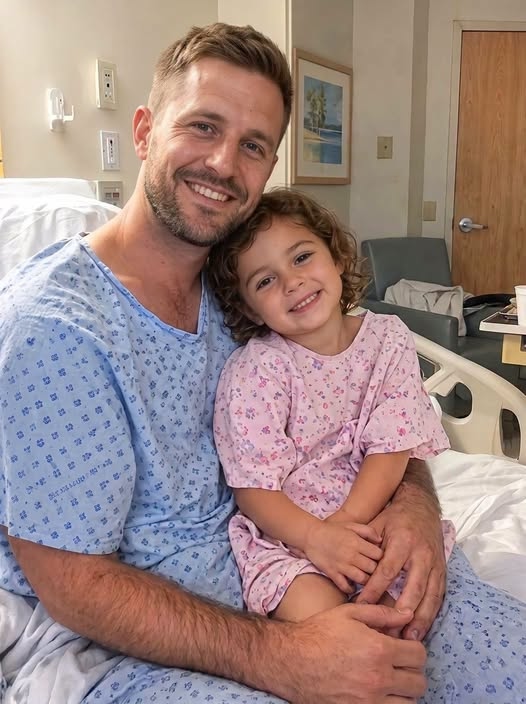
My son hated hospitals, yet he volunteered to give a kidney to a 5-year-old girl—and died from complications. The morning after I buried him, the girl’s mother appeared at my door with a folded paper. “Ethan never told you why he really did it, did he?”
Needles could turn my six-foot-tall, thirty-year-old son pale. Doctors made him nervous. Hospitals were worse.
Ethan hated hospitals.
His older brother, Daniel, had died in one when Ethan was seventeen.
I had spent thirteen years watching Ethan find different ways to carry that loss.
Needles could turn my six-foot-tall, thirty-year-old son pale.
Then one Sunday afternoon, he walked into my kitchen, opened my refrigerator like he still lived there, and said, “Mom, I’m donating a kidney.”
I actually laughed.
“You’re doing what?”
He shut the refrigerator. “Donating a kidney. To a little girl.”
“Mom, I’m donating a kidney.”
I stared at him.
“I know how it sounds…”
“You nearly passed out getting a flu shot.”
“That was one time.”
“You were twenty-eight.”
He rubbed the back of his neck. “Can we not make this about the flu shot?”
“I know how it sounds…”
“You’re right, because you’re talking about surgery. That’s way bigger than a flu shot.”
“I know.”
“Major surgery.”
“I know, Mom.”
I knew that tone. Ethan used it when he’d already made up his mind and was only deciding how much of the reason he was willing to give me.
“Major surgery.”
That was when I stopped arguing long enough to look at him.
“Whose little girl needs a kidney?” I asked.
Ethan sat across from me and pulled out his phone.
A picture filled the screen. A little girl with brown curls sat in a hospital bed wearing purple pajamas. There were tubes taped to her arm, but she was smiling at whoever had taken the picture.
“Whose little girl needs a kidney?”
“Her name is Rosie,” he said. “Lauren’s daughter.”
I knew the name.
Lauren and Ethan had gone to high school together. I remembered her vaguely as a quiet girl with dark hair. I had seen her at graduation and maybe twice after that.
At least, that was how little Lauren mattered in the version of Ethan’s life I knew.
Lauren and Ethan had gone to high school together.
“Lauren posted that Rosie’s kidneys are failing,” Ethan continued. “They’ve been trying to find a living donor. Nobody in the family matched.”
I looked from the little girl to my son.
“And you do?”
He nodded.
“You saw a post and got tested?”
“Nobody in the family matched.”
“Yes.”
“Without telling me?”
His jaw tightened.
“I didn’t need permission.”
“No, you didn’t, but… You hate hospitals and doctors, Ethan. And now you’re volunteering to have an organ removed. For a child you have no connection with. It’s strange.”
“I didn’t need permission.”
He leaned forward.
“She’s five.”
I said nothing.
“She’s supposed to be learning how to ride a bike. She’s supposed to be fighting about bedtime and getting grass stains on her clothes. She’s not supposed to know which nurse works which shift.”
“For a child you have no connection with. It’s strange.”
My eyes burned.
He looked down at Rosie’s picture.
“Sometimes being there when somebody needs you is reason enough.”
He said it like it was something he’d learned, not something he’d just decided.
I almost asked him who had taught him that. In hindsight, I wish I had.
He said it like it was something he’d learned
I wanted to tell him not to do it.
That is the ugly truth.
But Rosie’s face was still on his phone between us.
So instead I asked, “When?”
“Three weeks.”
I wanted to tell him not to do it.
I closed my eyes.
He reached across the table.
His fingers wrapped around mine.
“I’m going to be okay.”
I looked at him.
“Don’t promise me things you can’t control.”
“I’m going to be okay.”
His smile disappeared.
“Okay.”
***
A week before the surgery, I asked him whether Lauren had thanked him.
“More times than I can count.”
“And?”
“And I keep telling her to stop.”
“Don’t promise me things you can’t control.”
I studied him.
“You two were never close in school.”
Ethan looked away.
“We knew each other better than you think.”
Before I could ask what that meant, he stood and carried his coffee cup to the sink.
That was all he gave me.
“You two were never close in school.”
***
The transplant was successful.
That was what everyone kept telling me.
Rosie was doing beautifully.
For a few hours, I thought that meant the frightening part was over.
I didn’t understand yet that while Rosie was getting stronger, something was already going wrong with my son.
The transplant was successful.
Her new kidney started working almost immediately. Her color improved. She asked for macaroni and cheese the second day.
Ethan laughed when he told me.
“Apparently hospital macaroni is disgusting,” he said from his bed.
“You look awful.”
“Thanks.”
“I’m serious.”
“You look awful.”
“So am I. I look terrible.”
He smiled, but there was sweat on his forehead.
I called the nurse.
His vitals were not right.
Then everything happened very fast.
I called the nurse.
There was a complication. Rare. Severe. Words I understood separately but could not make sense of together.
Doctors filled the room.
Machines started beeping.
A nurse pushed me into the hallway.
I kept saying, “That’s my son.”
Machines started beeping.
As if they didn’t know.
As if saying it loudly enough could keep him alive.
I paced the corridor outside his room, and tried not to feel like I was retracing the steps I’d paced in a different hospital when my oldest son died years ago.
“It will be okay,” I muttered. “It has to be okay.”
I was retracing the steps I’d paced in a different hospital when my oldest son died years ago.
Hours later, they let me back in.
Ethan looked smaller somehow.
Popular Posts
→- 1
- 2
- 3
- 4




Recently Viewed
Stories you read recently will appear here.





