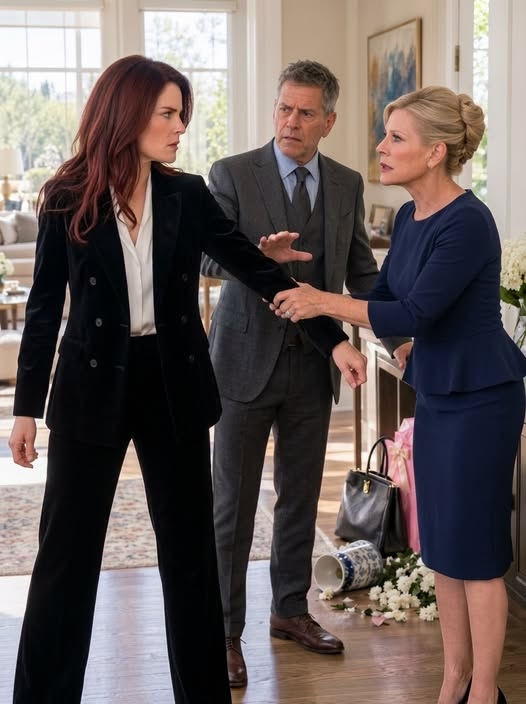
My mother had barely crossed my threshold when she asked me for fifty thousand dollars. She said it gently, as though the amount were an awkward detail we could get past if nobody raised their voice. Behind her, my father stood in the apartment hallway with rain on the shoulders of his coat. For three years, neither of them had called me on my birthday. Now Mom was looking over my shoulder at the living room, waiting to be invited in.
“It’s for Mia,” she said. “Her thirtieth is coming up.”
I kept one hand on the door. Mom’s hair was smooth despite the weather, and she wore the dark coat I remembered from holidays when she wanted the family photographs to look expensive. Dad seemed smaller. He shifted his weight, glanced toward the elevator, then back at me. I had imagined this meeting too many times: an apology in a hospital corridor, perhaps, or an accidental encounter at a grocery store. In none of those versions had my parents arrived with a price.
“Fifty thousand for a birthday?” I asked.
“A venue, catering, a trip afterward. We want to give her something wonderful.” Mom adjusted the strap of her purse. “She’s had a difficult few years.”
Through the gap beside her, I could see the elevator doors closing. They had come together, and neither was about to leave before I gave them an answer. I stepped back. Mom entered first, carrying the faint scent of her usual perfume. Dad wiped his shoes on the mat, a small courtesy that almost hurt more than the request. They knew where I lived. They remembered which things mattered when they wanted to seem considerate.
Mom took the couch and folded her coat across her knees. Dad remained standing until I pulled out a chair for him. I did not offer coffee. On the low table lay a closed notebook and the ordinary clutter of my Tuesday: a library book, a grocery receipt, a pen without its cap. At 4:16 that afternoon, my attorney had emailed me a file I had waited six months to see. I had read it twice before dinner and a third time after washing my plate. My hands had stopped shaking by the time my parents knocked.
Three years earlier, Dad had asked me to put my house behind a loan for Mia’s boutique. The shop was in trouble again, though at the time he called it a short stretch of poor sales. He wanted my signature as a co-signer and spoke as if signing were the natural thing for an older sister to do. I asked for the accounts. He said there was no need to make the conversation unpleasant. Mom said Mia would feel humiliated if she knew I had demanded proof. I declined the loan.
Within two weeks, Mom had told the family that I had turned cold and selfish. An aunt called to ask why I was punishing Mia. A cousin stopped inviting me to dinner. Dad sent one message saying I had disappointed him. After that came silence: no calls at Christmas, no reply when I sent news of a promotion, no acknowledgment when I mailed Mom a card after she had surgery. At first I counted the weeks. Eventually, I stopped. The absence still had a shape; I had simply learned how to walk around it.
Now Dad leaned forward and said, “We wouldn’t have come if we had another way.”
“What happened to the boutique?” I asked.
Mom’s eyes moved to him. “This isn’t about the boutique.”
I had been asking about Mia. Mom had heard the question beneath it. She drew a slim leather folder from her bag and set it on the table, centering it between us. She had always liked a neat presentation. Birthday menus had once appeared in folders like that, with printed options and figures everyone was expected to admire. This time she opened it to a single typed page.
It was a repayment agreement. The amount was fifty thousand dollars. There was no interest, and repayment would begin when it became “financially practical.” Mom had marked the place for my signature with a narrow yellow tab. I read the page without touching it. Dad watched my face. His hands rested on his knees, thumbs pressed together so tightly that the nails had gone pale.
“You prepared this before you came,” I said.
“We wanted you to see that it’s a loan,” Dad replied. “We’re doing this properly.”
“There’s no date when you have to pay it back.”
Mom gave a short, patient breath. “We can discuss the wording. Mia knows nothing about any of it. The celebration will be a surprise.”
I looked again at the amount. Mia’s life had held plenty of costly surprises. Our parents had paid for private school, then helped launch one business and rescue another. They had paid for her wedding; eleven months later, the marriage was over. I did not hold those things against Mia. When we were younger, she had been taught that a mistake could be brought home and placed in our mother’s hands. I had been taught to manage without asking. We had both learned our parts so early that for years we mistook them for our personalities.
The first sign that something had changed between us had been a call from Mia six months earlier. We had spoken only briefly in the years since my parents cut me off. When her name appeared on my phone, I let it ring twice because I could not guess what she wanted. She was holding a tax notice concerning a trust distribution she said she had never received. I thought at first she had called the wrong person. Then she mentioned Grandma’s lake house.
Popular Posts
→- 1
- 2
- 3
- 4




Recently Viewed
Stories you read recently will appear here.





