The Morning My Family Left Without Me
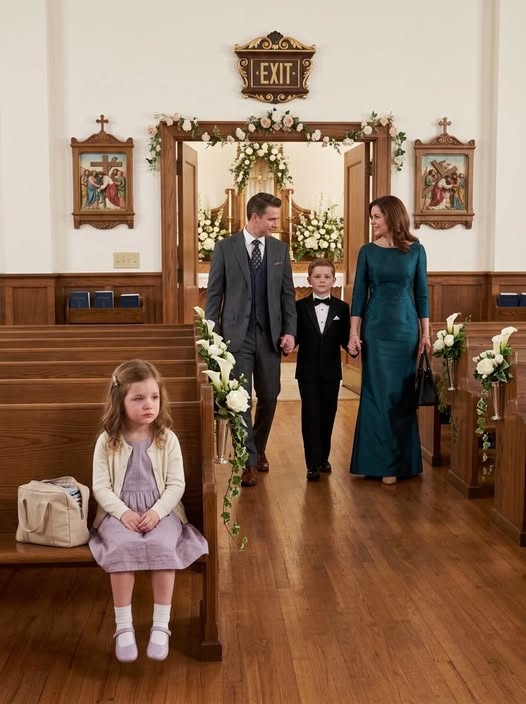
I was four years old when my mother walked away and left me inside a church in Pennsylvania.
For years, I recalled that morning only in fragments: the smooth wooden pew beneath my fingers, the soft blue light filtering through stained-glass windows, and the distant sound of an organ somewhere beyond the sanctuary.
My mother, Valerie Whitmore, knelt before me and fastened my navy coat all the way up to my chin.
She seemed unusually calm.
My father, Randall, stood several feet away. Next to him was my older brother, Preston, who was eight years old then.
I believed we were simply waiting for Sunday service to start.
Then my mother gently tucked a loose strand of hair behind my ear.
“Stay right here, Camille. Someone will come soon.”
I frowned.
“Are you coming back?”
Her expression shifted for barely a second.
Then she kissed my forehead.
“Just stay where you are, sweetheart.”
She stood up, took my father’s hand, and headed toward the doors.
Preston went with them.
I remember calling after her once.
“Mom?”
She turned around.
For one brief second, our eyes met.
Then she stepped outside.
The heavy wooden doors shut behind them.
At four years old, I couldn’t understand why my family had left. I only knew that I had been told to wait, so I waited.
Ten minutes turned into thirty.
Thirty became an hour.
Eventually, an elderly church volunteer named Mrs. Bellamy noticed me sitting there by myself.
She asked where my parents had gone.
I pointed toward the doors.
“They’re coming back.”
But they never did.
Not that afternoon. Not the following morning. Not for the next twenty years.
The Woman Who Stayed
Authorities searched for my parents, but the details they had provided didn’t lead anywhere helpful.
For a while, my world became a collection of unfamiliar rooms and unfamiliar adults asking questions I couldn’t possibly answer.
Then I met Ruth Caldwell.
Ruth was fifty-eight, widowed, and lived in a modest two-story home outside Lancaster. She taught piano lessons and played music for a nearby congregation on weekends.
She wasn’t excessively affectionate when we first met.
She didn’t kneel theatrically or promise me that everything would become perfect.
She simply set a mug of warm cocoa in front of me and said:
“You don’t have to call me anything until you’re ready.”
That was Ruth.
She never demanded affection.
She earned it.
When nightmares woke me, she stayed beside my bed until I drifted back to sleep.
When school became difficult, she spent evenings sitting with me and helping with homework.
When other children created family trees and I came home unsure where my biological parents belonged, Ruth never told me to remove them.
Instead, she brought out another sheet of paper.
“Families aren’t always shaped like trees,” she said. “Sometimes they’re more like gardens. Some people plant the seeds, Camille. Other people stay long enough to help them grow.”
I always remembered that.
Ruth stayed.
Through illnesses, birthdays, school performances, first heartbreaks, college applications, and all the ordinary days that came between them.
By the time I was eighteen, I had stopped imagining my biological mother suddenly appearing through our front door.
I had already understood the difference between being connected to someone and truly belonging with them.
The Life I Created Without Them
I received a scholarship to a small Pennsylvania college and studied community services.
After graduating, I took a position at Grace Covenant Church, helping organize food programs, family support, and after-school activities.
Working inside a church felt unexpectedly healing.
For years, churches had brought back memories of that wooden bench.
Eventually, they started reminding me of something different.
People staying. People appearing when needed. People helping strangers without expecting anything in return.
Ruth was proud of me.
By then, arthritis had made it difficult for her to play piano, so I frequently filled in for her during community events.
Our life wasn’t glamorous.
Sunday dinners were modest. Our house was old. Ruth complained about heating costs every winter.
But I felt happy.
Then, three weeks after my twenty-fourth birthday, the past walked straight through the church doors.
“We Need You”
Rain was falling that afternoon.
I was arranging donation boxes beside the fellowship hall when I heard someone speak my childhood nickname.
“Cami?”
Nobody had used that name in twenty years.
I froze.
Three people were standing near the entrance.
An older woman. An older man.
And a man around thirty years old.
I recognized them before my mind was prepared to believe it.
My mother. My father. My brother.
Valerie covered her mouth and began to cry.
Then she rushed toward me, took both of my hands, and whispered:
“Camille… we need you.”
Not I missed you.
Not I’m sorry.
Not even Can we talk?
We need you.
Those three words explained almost everything.
I pulled my hands free.
“Why are you here?”
My father lowered his eyes toward the floor.
My brother Preston moved forward.
“It’s my daughter.”
His voice trembled.
“Her name is Maisie. She’s six.”
I stared at him.
He explained that Maisie had developed a serious blood condition. Her medical team was looking for a compatible marrow donor, but the closest relatives tested so far hadn’t been suitable.
Then someone mentioned the sister Preston hadn’t seen since he was a child.
Me.
Suddenly, twenty years of silence became understandable.
They hadn’t searched for me simply because they couldn’t bear another day without knowing me.
They had found me because they needed something that I might be uniquely able to provide.
The Truth I Had Waited Twenty Years to Know
Before agreeing to anything, I wanted answers.
We sat together in a small meeting room behind the church office.
Ruth remained beside me.
My mother appeared uneasy when she noticed her.
I noticed that immediately.
“Why did you leave me?” I asked.
For a moment, nobody answered.
Finally, my father began speaking.
Popular Posts
→- 1
- 2
- 3
- 4




Recently Viewed
Stories you read recently will appear here.





