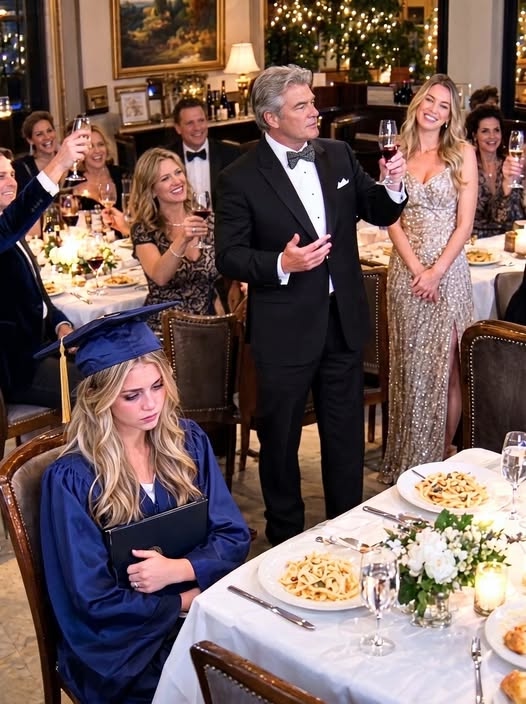
PART 1: THE GRADUATION THAT MADE ME DISAPPEAR
My name is Julia Smith, and I was thirty years old when my parents finally realized the daughter they had spent years dismissing had built a life they knew nothing about. But the story did not begin when they came looking for me seven years later; it began long before that, in a house where love always seemed to come with conditions.
I grew up in Lancaster, Pennsylvania, three years younger than my sister Monica. From the time we were children, my parents treated her achievements as proof that she was destined for something important, while mine were acknowledged only when they were impossible to ignore.
When I was eight, I won third place in a school art contest for a colored-pencil drawing of our backyard garden. I carried it into the dining room proudly, convinced that the blue ribbon pinned to the corner might finally make my parents look at me the way they looked at Monica.
“That’s nice, sweetie.”
Two seconds later, Dad turned toward my sister and asked her to tell Mom about the gifted program she had just entered. My drawing was forgotten before dinner even started, and the following morning I found it lying flat in the kitchen trash with the ribbon still attached.
That moment taught me something I would spend years trying to unlearn: effort did not matter if you were the wrong child.
Four years later, Monica won first place at the state science fair, and the local newspaper photographed her between our smiling parents. That same month, I received honorable mention at the county fair for a working water-purification project, but neither of them attended my ceremony.
Mom later summarized my work to my aunt in one sentence.
“Julia did something with water. She got a certificate.”
Monica understood more than our parents ever realized. That night, she came into my room, handed me my favorite candy bar, and apologized even though none of it had been her fault.
The pattern continued as we grew older.
When Monica turned nineteen, my parents bought her a brand-new Honda Civic and told the neighbors she had earned it through discipline and hard work. When I later asked about getting a car, Mom told me I could use the old Corolla whenever it happened to be available, so I began walking more than two miles to my part-time library job and saving every paycheck myself.
By the time college applications arrived, my parents treated Monica’s future like a family project. They hired a consultant, proofread her essays, studied university rankings, and organized every deadline, while I applied to Penn State, Temple, and Drexel without help and was accepted to all three.
When I chose Penn State, Mom barely reacted.
“That’s fine, Julia. Very practical. Not everyone is cut out for research like Monica.”
During college, I worked twenty hours a week, took out loans, and learned how to survive on very little. My parents contributed twelve thousand dollars toward my education, while Monica graduated with her much larger tuition fully paid, and by the time I completed my communications degree in 2017, I owed eighty-two thousand dollars.
Still, I hoped graduation might finally belong to me.
At the ceremony, I spotted my parents in the audience while walking across the stage. Dad was looking at his phone, Mom was searching through her purse, and only Monica noticed me enough to wave.
The reception afterward was held in a private room at an Italian restaurant with more than sixty relatives and family friends. I thought the size of the gathering meant my parents had finally decided to celebrate something I had accomplished.
At 7:14, Dad stood and tapped his glass.
“Today, we celebrate achievement.”
He turned toward Monica and proudly announced that she had been accepted into a PhD program at Johns Hopkins. The entire room applauded, and then Dad finally looked at me.
“And Julia graduated today, too. Communications degree.”
He paused before smiling.
“Julia, maybe one day you’ll find something you’re actually good at.”
People laughed.
I counted seventeen.
Mom smiled as though Dad had made a harmless joke, while Monica went pale and tried to say something. I stayed seated, smiled when expected, and memorized every face in the room.
I left the reception without anyone noticing.
That night, alone in my nearly empty dorm room, I opened my laptop and created a new email account under a name my family did not know. Then I started researching remote work, anonymous businesses, audiobook narration, podcast editing, and every possible way to build a life without needing anyone’s permission.
Three weeks later, I bought a one-way bus ticket to Seattle.
My parents believed I disappeared because they had finally broken me. They were wrong.
I disappeared because I had finally understood the rules of their game, and I had decided never to play it again.
PART 2: THE FIFTEEN THOUSAND DOLLARS THAT ERASED ME
On June 3, 2017, I bought a one-way Greyhound ticket to Seattle for one hundred eighty-six dollars and packed everything I owned into two suitcases. The day I left, my mother sent one message asking where I planned to stay after the dorm closed, and I answered with only two words.
“West Coast.”
Three weeks passed before she replied.
“Okay. Let us know if you need anything.”
They did not ask what city I was in, where I lived, or whether I had arrived safely. They did not call, and after years of being compared to Monica, I discovered that being ignored from two thousand miles away felt strangely peaceful.
Seattle gave me something I had never had before: anonymity. I rented a tiny studio on Capitol Hill, slept on an air mattress during my first week, and built a recording setup inside the closet with a laptop, a USB microphone, cheap headphones, and soundproofing foam.
Popular Posts
→- 1
- 2
- 3
- 4




Recently Viewed
Stories you read recently will appear here.





