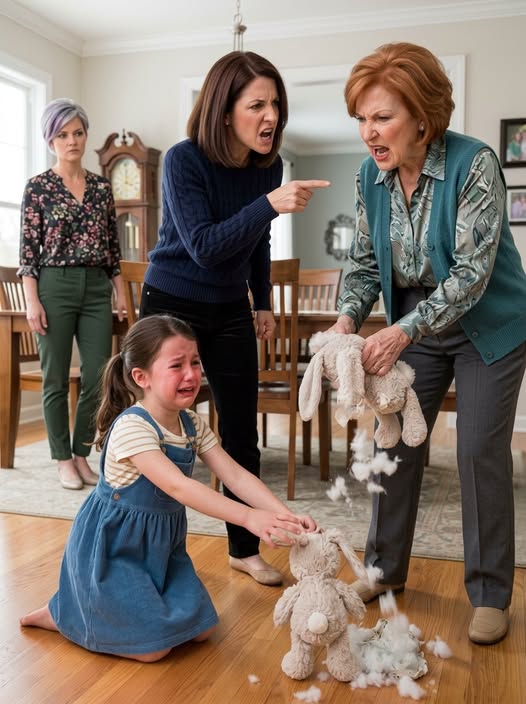
The ripping sound made everyone at the dinner table go silent.
Eight-year-old Lily watched in shock as my mother opened her stuffed rabbit and pulled out handfuls of soft white filling.
It was the final gift Lily’s biological mother, Rachel, had given her before passing away from cancer.
“Grandma, please stop!” Lily cried, reaching toward it.
Mom pushed her hand aside. “Enough with this old thing! Your mom is gone. You need to move forward.”
My sister Megan agreed. “She’s too old to carry that worn-out thing everywhere anyway.”
Lily sank beside the damaged rabbit, crying so intensely she struggled to catch her breath. My husband, Ben, hurried toward her, but I reached my mother first.
“Leave,” I said.
Mom laughed. “You’re asking us to leave over a toy?”
“No. I’m asking you to leave because you intentionally d@maged the one thing that helped a grieving child feel secure.”
Megan rolled her eyes. “Stop being dramatic, Claire.”
I collected every piece of the rabbit, including its torn fabric heart, and carefully placed everything inside a grocery bag.
Then I took Lily upstairs while Ben showed them outside.
That night, Lily asked whether forgetting Rachel would make Grandma care about her more.
The question changed something inside me.
After she went to sleep, I opened my laptop.
For three years, I had paid Mom’s mortgage and covered the rent for Megan’s struggling beauty salon.
They described it as temporary assistance, but neither had returned a single dollar.
I stopped the automatic payments.
Then I removed Mom as Lily’s emergency contact and contacted our family attorney.
Before ending the call, I asked him to cancel the old financial power of attorney I had given Mom following my surgery two years earlier.
At 11:42 p.m., my phone rang.
It was my bank’s fraud department.
Someone had just tried using that power of attorney to request a $62,000 withdrawal from Lily’s college account.
As the banker explained the request, I noticed something tucked inside the rabbit’s torn fabric heart—a folded piece of paper Megan had apparently been trying to find.
Written across it, in Rachel’s handwriting, were six words:
“Claire, don’t let Megan find this.”
I had believed my mother d@maged Lily’s rabbit simply out of anger.
But now I understood that the scene had apparently been a distraction—and whatever Megan wanted might still be hidden somewhere inside it.
My hands trembled as I carefully searched through the stuffing again.
Beneath another layer of fabric was a tiny brass key wrapped securely in clear plastic.
A number was engraved into it: 317.
Ben went pale when he saw it. “Rachel had a safe-deposit box.”
He explained that Rachel had closed all her accounts before she passed away—or at least that was what he had believed.
The following morning, we brought the key and her documents to the bank.
The manager confirmed Box 317 still existed, but opening it required a court order because Rachel had named only one beneficiary: Lily.
While our attorney submitted the paperwork, the bank investigated the attempted withdrawal from Lily’s college account.
The request originated from Mom’s home computer, while the uploaded authorization included Megan’s email address.
When I confronted them, Mom immediately pointed to my sister.
“She told me you wanted the money transferred somewhere safer!” Mom said.
Megan took the phone. “You owe us after embarrassing us over that ridiculous toy.”
Then she said something that immediately caught my attention.
“The key belongs to our family, not that child.”
I had never mentioned the key to either of them.
Ben checked the camera footage from our home office.
During dinner, while Mom distracted everyone with the argument involving Lily, Megan had quietly gone down the hallway and searched through my desk.
She photographed Lily’s Social Security card and an older copy of my power of attorney.
Then she returned to the dining room and whispered something to Mom shortly before the rabbit was pulled apart.
The incident had apparently been planned.
Two weeks later, Mom and Megan sat crying inside our attorney’s office.
The bank had stopped the attempted transfer, the salon’s rent payment had failed, and Mom had received a foreclosure warning after I stopped paying her mortgage.
But that wasn’t what frightened them most.
Our attorney placed the recovered key on the table and explained that he had obtained the necessary court order. We had opened Box 317 earlier that morning.
Inside was a letter, a flash drive, and financial documents indicating that $62,000 had previously disappeared from an account established for Lily after Rachel’s death.
The signatures authorizing the withdrawals appeared to be Ben’s.
They looked almost identical—but Ben had never signed them.
Megan stopped crying.
Mom turned toward her and whispered, “You told me Rachel destroyed those records.”
That was when we understood the attempted withdrawal might not have been the first incident.
The records suggested Megan had been taking money connected to Lily for years, while my mother apparently knew enough to help keep the situation hidden.
Then our attorney connected the flash drive.
Rachel appeared on the screen, visibly weak but remarkably composed.
“If you’re watching this,” she said, “Megan finally came looking for the evidence.”
Rachel’s face filled the screen. A blue scarf covered her head, and although her illness had changed her appearance, her voice remained steady.
“Ben doesn’t know I’m recording this,” she began. “He thinks the missing money was a banking error. It wasn’t.”
Ben tightened his grip around my hand.
Years earlier, while Rachel was receiving treatment, Megan had briefly worked as a receptionist for the accounting firm that handled Rachel’s small design business. I had introduced them.
At the time, Megan said she needed experience and promised she was trying to rebuild her life.
Rachel explained that Megan had obtained access to scanned signatures, account information, and insurance documents.
The first unexplained withdrawal was only $4,800. When Rachel questioned it, Megan described it as a bookkeeping error and returned some of the money.
Popular Posts
→- 1
- 2
- 3
- 4




Recently Viewed
Stories you read recently will appear here.





