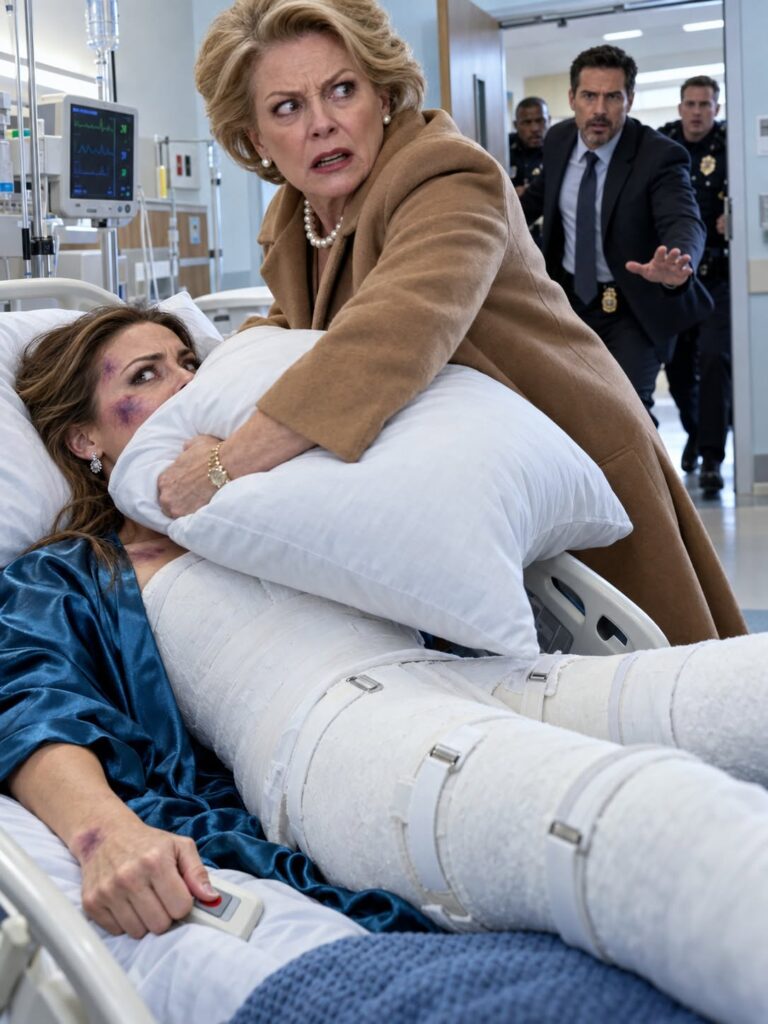
My mother-in-law pressed a pillow over my face while I lay trapped inside a rigid full-body cast. She whispered that I should have died in my accident and that her son deserved another chance. Margaret believed I could not move enough to resist her. She did not know I had spent forty-eight hours waiting for her to try again.
As the pillow crushed the air from my lungs, I counted silently. One, two, three—Margaret pushed harder while continuing to speak. Beneath the brace around my thumb was a tiny emergency switch. I needed her to say enough before I pressed it.
Ten days earlier, someone had pushed me from the second-floor balcony of the home I shared with my husband, Ethan Morgan. I survived with fractures throughout my body, spinal injuries, bruising, and a hazy memory of the fall. The police report called it an accident. Ethan insisted I became dizzy and slipped.
I remembered something different. Ethan and I had been arguing about messages between him and another woman. When he came home, his phone sat between us on the kitchen island while I demanded the truth. Ethan minimized the messages, called me emotional, and accused me of destroying our marriage over nothing.
I walked onto the balcony because I needed air. Ethan followed and said I would not leave him because of text messages. My hip touched the railing as he moved toward me. I raised one hand and told him to stay back.
Then I felt a powerful shove from the side and behind me. The railing vanished, the night turned upside down, and I saw Ethan’s face as I fell. That expression returned in my dreams: shock, fear, and something that looked like guilt. I hit fabric on the way down before striking the sidewalk.
When I regained consciousness two days later, Ethan sat beside me holding my hand. He cried and told me how lucky I was to be alive. When I tried to say I remembered being pushed, his grip tightened. Then Margaret entered the room and watched both of us with an expression I could not understand.
Ethan had already told police we were not arguing. Margaret claimed I complained about dizziness earlier that week, which was true but irrelevant to what I remembered. There were no witnesses, the balcony railing remained intact, and I could not describe the hands clearly. My fractured memory made their simple explanation more convincing than mine.
Margaret began visiting daily. When nurses were present, she prayed, adjusted my blankets, and called me darling. Once they stepped away, her manner changed. She said Ethan would have been free if I had died and described me as a burden he should never have married.
She always denied the comments when Ethan returned. He called them misunderstandings caused by medication, pain, and my emotional state. Margaret smiled sympathetically while he explained me to myself. I began to understand that the accident was not the only danger surrounding me.
Detective Mason arrived without dramatic promises. Instead of telling me whether he believed my memory, he took out a notebook and asked exactly what I remembered. I described Ethan following me, the movement near the railing, the shove, and the fear in his face. Mason wrote every word down.
He asked whether anyone else might have been in the house. I initially said no, but Margaret’s hospital behavior made me hesitate. She had called me temporary during my engagement and repeatedly insisted Ethan married too quickly. Every cruel comment happened when he was absent or medical staff had stepped away.
Then Margaret waited until Ethan left and whispered, “He would have been free by now.” I reported the sentence to Mason. He did not dismiss it as grief or an unpleasant mother-in-law. He asked whether I would be willing to help him determine what she said when she believed nobody could hear.
Mason and the hospital quietly arranged a legally approved recording device. They placed a concealed emergency switch beneath my thumb brace because that was the only part of my body I controlled reliably. Officers would remain close enough to respond. Still, Mason warned that no plan could eliminate the danger.
For two days, I listened while Margaret shifted between public tenderness and private threats. She never said enough while staff remained nearby. I understood that she needed complete privacy and certainty that I was helpless. So when she entered one evening, locked the door, and lifted a pillow, I did not reveal the switch.
She placed it over my face and told me I should have died on the sidewalk. She said Ethan deserved another chance and that I was making everything difficult, just as another woman apparently had before me. I counted while the recording captured her words. At ten, I pressed the switch with my thumb.
The door burst open. Detective Mason and uniformed officers pulled Margaret away while she screamed that she had only been adjusting the pillow. The recording contradicted her immediately. For the first time, the polished, grieving mother lost control of the story.
After she was removed, Mason returned with a photograph. It showed a young woman standing on the same balcony from which I had fallen. Her name was Emily Morgan. She had been Ethan’s first wife—and four years earlier, she had died after falling from that balcony.
Emily Morgan. She had dark hair, an easy, unguarded smile, and eyes that looked entirely too trusting for a family like the Morgans.
“Four years ago,” Mason said softly, his thumb tracing the edge of the laminated crime-scene photo. “Case was closed in under forty-eight hours. Ruled an accidental fall during a late-night domestic dispute. Ethan told the responding officers she had been drinking heavily, lost her footing, and went over.”
“And Margaret?” My voice was raspy, the pillow incident having scraped my throat raw, but the fear driving me forward kept my mind razor-sharp.
Popular Posts
→- 1
- 2
- 3
- 4




Recently Viewed
Stories you read recently will appear here.





