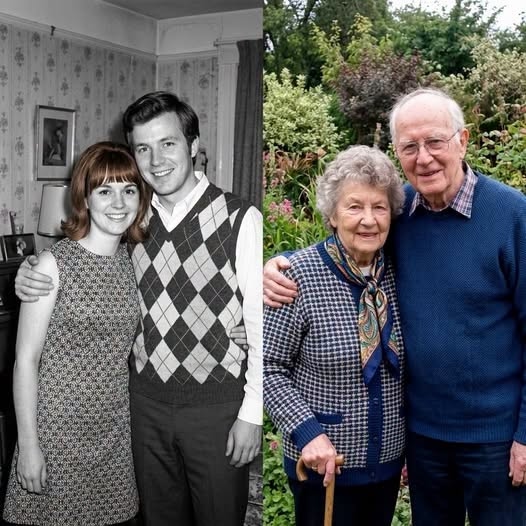
I was ninety years old, still wearing my wedding ring, when a lawyer read those words aloud in front of our three children and my husband’s younger sister.
For several seconds, I honestly thought I had misunderstood him.
My husband, Harlan, had died two weeks earlier after months of failing health. We had known each other since college, when he was a shy young man who owned one good jacket and somehow managed to wear it to every date.
We married at twenty-one.
Then came children, mortgages, job losses, grandchildren, illnesses, retirement, and the ordinary little arguments that fill almost seven decades together.
We had three children — Della, Gareth, and Neil — and later five grandchildren.
Our marriage wasn’t perfect, because no marriage lasting sixty-nine years could possibly be perfect.
But I had been happy.
More importantly, I had always believed Harlan and I were on the same side.
During his final four months, we moved a hospital bed into our bedroom so he could stay at home. Every evening, after the nurse left, I sat beside him and held his hand.
Sometimes we talked.
Sometimes he slept.
Sometimes I simply listened to him breathe.
Three nights before he died, he opened his eyes and looked at me for a long time.
“You’ll be all right, Noreen,” he whispered.
I squeezed his hand.
“Don’t start talking like that.”
“You will.”
“I’ll be lonely.”
“Yes.”
That was so much like Harlan that I almost laughed. He had never been a man who softened uncomfortable truths.
Then he lifted my hand to his lips.
“But you’ll still be you.”
At the time, I thought he was trying to comfort me.
I had no idea he was also saying goodbye to a plan he had already put in motion.
Two weeks after his funeral, his attorney, Mr. Keaton, asked the immediate family to meet at his office.
Harlan’s sister, Mavis, arrived before everyone else.
She had been unusually attentive since Harlan became ill.
She brought casseroles I never asked for, offered to organize my medications, and repeatedly suggested that I should consider selling the house because it was “too much for a woman my age.”
I tried not to be offended.
Mavis was seventy-eight. To me, she was still Harlan’s annoying little sister who used to borrow his car without asking.
Maybe fussing over me was simply her way of grieving.
At the lawyer’s office, she sat beside me and took my hand.
“You don’t have to deal with any of this alone,” she whispered.
“I know.”
“If it becomes too much, I can speak for you.”
I smiled politely.
“I’m ninety, Mavis. I’m not dead.”
She laughed a little too loudly.
“I didn’t mean it that way.”
Mr. Keaton began reading the will.
Harlan left fifty thousand dollars to the hospice organization that had cared for him.
His fishing cabin went to Mavis.
Several investment accounts were divided among our children and grandchildren.
I felt no surprise.
Harlan and I had talked about most of those things over the years.
Then Mr. Keaton paused.
He adjusted his glasses.
“To my wife, Noreen,” he read, “I leave no assets under this will.”
For a moment, nobody moved.
I thought perhaps there was another sentence coming.
There wasn’t.
Della spoke first.
“I’m sorry. What?”
Mr. Keaton repeated it.
“To my wife, Noreen, I leave no assets under this will.”
I looked at him.
“That can’t be right.”
“It is what the document says.”
My youngest son, Neil, leaned forward.
“Dad left Mom nothing?”
Mr. Keaton didn’t answer beyond what he had already read.
My daughter stared at me with a strange mixture of confusion and alarm.
“Mom… did something happen between you and Dad?”
The question hurt more than the will.
“What do you mean?”
“I mean, he wouldn’t just do this.”
Gareth immediately turned toward his sister.
“Della.”
“I’m only asking.”
“Then don’t.”
But she was looking at me.
“Did you two fight before he died?”
I could barely believe what I was hearing.
I had spent four months bathing her father, feeding him soup when his hands shook too badly to hold a spoon, and sleeping in a chair beside his bed because he became frightened when he woke alone.
Now my own daughter was wondering what I had done to make him punish me.
Behind me, Mavis placed a hand on my shoulder.
“Noreen, honey, no one is blaming you.”
I turned slightly.
Her face was full of sympathy.
But there was something else in her eyes.
Relief.
It disappeared so quickly I almost convinced myself I had imagined it.
“You can stay with me for a while,” she continued. “Until we understand what Harlan was thinking.”
“I’m going home.”
“You shouldn’t be alone right now.”
“I have lived in that house for fifty-two years.”
“That’s exactly why this is difficult. There are taxes, repairs, bank accounts—”
“Mavis.”
She stopped.
“I said I’m going home.”
When the meeting finally ended, everyone slowly filed into the hallway.
I reached for my purse.
“Noreen,” Mr. Keaton said.
I looked back.
“Would you stay for a moment?”
Mavis immediately turned.
“I can stay with her.”
“No,” he said politely. “I need to speak with Mrs. Bell alone.”
Something about his tone made Mavis’s expression tighten.
Then she smiled.
“Of course.”
The door closed behind her.
Mr. Keaton waited until we heard the others moving down the hallway.
Then he opened a drawer and removed a cream-colored envelope.
“Your husband did leave something for you.”
I stared at it.
“Then why wasn’t it in the will?”
“Because he didn’t want anyone else to know about it.”
He placed the envelope in my hands.
“Harlan gave this to me almost eight months ago. He instructed me to give it to you only after the will had been read in front of the family.”
My name was written across the front in Harlan’s handwriting.
Suddenly, I missed him so much I could barely breathe.
I opened it.
Popular Posts
→- 1
- 2
- 3
- 4




Recently Viewed
Stories you read recently will appear here.





