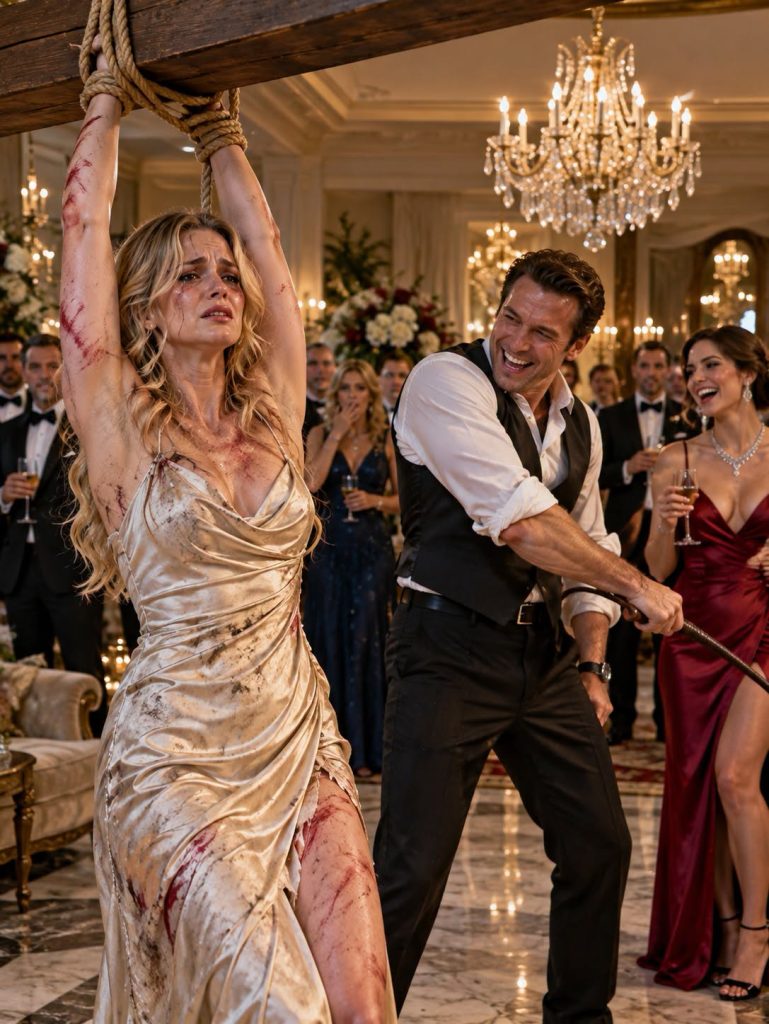
“My husband tied me up in front of nearly 40 guests on my birthday—then laughed when I called my five brothers, not knowing what each of them was about to do.
Chap 1
The chandelier above the Grand Salon of the Calloway country estate was wrought from blackened iron and four hundred hand-cut Austrian crystals, designed in the winter of 1912 to reflect the soft, flattering amber of candlelight. Tonight, beneath its eight thousand lumens of halogen brilliance, it reflected only sweat, the dregs of vintage Pinot Noir, and the tight, white skin over my cheekbones.
Grant had chosen hemp rope.
Not nylon cord, which cut cleanly and released with a single flick of a kitchen paring knife, and not silk ribbon, which might have carried some perverse, mock-ceremonial pretense of aristocratic foreplay.
He had sent Thomas, his estate manager, down to the stable block twenty minutes earlier to cut an eight-foot length of double-braided utility hemp from the tack room. It smelled of saddle soap, dry dust, and the sour grease used to preserve horse harnesses.
“Keep your arms high, Claire,” Grant murmured. His voice had that low, syrupy cadence he only used when he was performing for an audience he believed he owned. “You have such lovely lines when you don’t slouch. Doesn’t she, Mother?”
Across the parquet floor, Evelyn Calloway smoothed the silk lapel of her seafoam-green St. John knit. She did not set her flute down. The crystal remained suspended between her manicured index finger and thumb, three inches below her pearls, catching the brutal glare from above. Her gaze drifted toward the wall-mounted Dutch oil painting behind me—a seventeenth-century depiction of dead pheasants and bruised fruit—before settling somewhere around my collarbone.
“A woman who cannot govern her carriage rarely governs her temper,” Evelyn said. Her voice was like parchment being turned in an empty library. “Stand still, Claire. You are making the men’s task unnecessarily dramatic.”
The men were Donald and Craig, two off-duty private security contractors Grant hired whenever the family held their autumn galas. They did not look at my eyes. Professionals of a certain low tier learned early that looking a client’s target in the face made the subsequent invoice feel cheap; they looked at my wrists instead. Donald’s thumb pressed hard against the median nerve of my left arm, forcing my fingers to splay, while Craig looped the abrasive hemp over the hand-carved corbel of the timbered load-bearing arch.
“Tighter,” Grant ordered.
“Mr. Calloway,” Donald muttered, his voice dropping into that uneasy register common among men who knew they were crossing from civil tort into the state penal code.
“She’s not resisting. The friction alone will—”
“I didn’t ask for your commentary on tensile strength, Donald,” Grant snapped. He took half a step forward, the soles of his bespoke Berluti oxfords clicking sharply on the waxed white oak. “I asked you to secure my wife so she can reflect on basic domestic decorum without fleeing into the garden like an hysterical schoolgirl.”
He turned back to the room.
There were thirty-eight people present. I counted them twice while Craig finished the half-hitch knot. It was a habit drilled into me from the time I was seven years old, sitting on the cold linoleum of our kitchen in South Boston while my eldest brother, Michael, drilled us on exits, sightlines, and headcounts before he left for his first shift at the depot.
*Count the room, Claire-bear,* he used to say, tapping my forehead with a grease-stained knuckle. *When the shouting starts, people stop being people and start being obstacles or doors. Know which is which before you make a move.*
To my left, near the Steinway grand piano, Madison Vale stood with her weight shifted to her right hip. She was twenty-six, daughter of a state appellate judge who regularly played thirty-six holes with Grant’s father, and she had spent the last seven months occupying Grant’s executive suite at the Calloway Tower three afternoons a week. Her ivory silk column dress—a Carolina Herrera sample piece she had bragged about for twenty minutes during the cocktail hour—bore a jagged, violet-black smear running from the left hip down to the hem.
The wine.
She had backed into me at the threshold of the conservatory. It had been deliberate, clumsy, and obvious; her elbow had caught the rim of my glass while she threw her head back to laugh at an unremarkable joke Grant had made about tax shelters. The glass had shattered on the flagstones, the wine had splashed, and within three seconds, Grant had seized my wrist with enough force to burst the capillaries beneath his thumb.
Popular Posts
→- 1
- 2
- 3
- 4




Recently Viewed
Stories you read recently will appear here.





